
President Dr. Julius Maada Bio has reaffirmed his administration’s commitment to agricultural transformation under the flagship Feed Salone Initiative, following a strategic visit to Newton Poultry and the symbolic commencement of a 22-metric ton fish harvest at his private farm in Mafintha, along the Masiaka Highway.
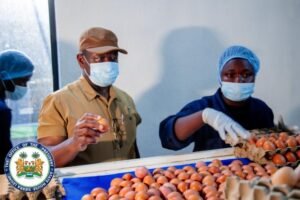
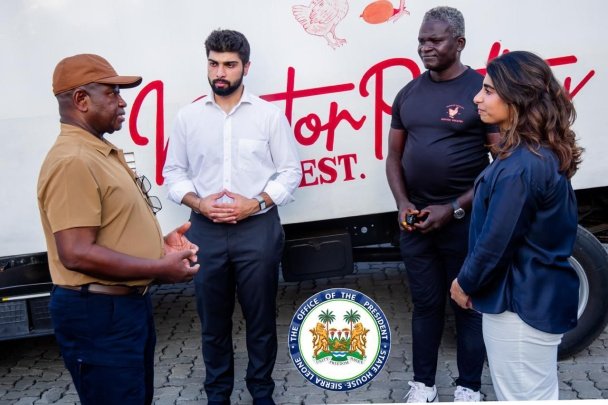
The President’s visit to Newton Poultry on Thursday, 16 April 2026, highlighted what is being described as a significant milestone in Sierra Leone’s drive toward food security. The facility, regarded as the country’s first fully automated poultry farm, is a private sector response to the Government’s call for increased investment in agriculture. He was received by the Founder, Manav Shahani, who briefed him on the operations and long-term vision of the enterprise.
Established in 2024, Newton Poultry has rapidly positioned itself as a key player in domestic food production, with a daily output capacity of approximately 22,000 eggs. The initiative is expected to reduce dependence on imported eggs, improve access to fresh and affordable poultry products, stabilize market prices and create employment opportunities for Sierra Leoneans. President Bio commended the facility as a model of innovation and a testament to the role of private sector partnerships in achieving national agricultural goals.
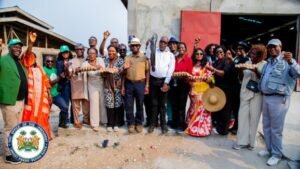
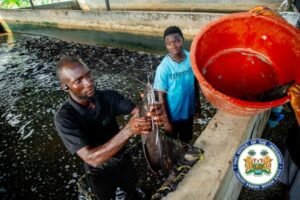
In a demonstration of hands-on leadership, President Bio also toured his private agricultural project in Mafintha, where he symbolically commenced the harvest of 22 metric tons of tilapia fish. The exercise forms part of his broader effort to inspire citizens to take an active role in farming and food production.
The guided tour of the farm showcased an integrated agricultural system, including fishponds, poultry units and livestock facilities. The farm hosts a variety of animals, including high-breed goats, sheep, cattle, ostriches, guinea fowl and other poultry species. The event attracted a cross-section of stakeholders, including Government officials, private sector representatives, farmers, and members of the media, all of whom witnessed firsthand the progress being made in local food production.
Addressing attendees, President Bio disclosed that his engagements began earlier in the day with a visit to an onion farm at Lokomasama. He emphasized that unity and collective commitment in agriculture remain critical to transforming the sector and ensuring sustainable national development.
“This is what we mean by transforming the agricultural sector, producing what we eat ourselves,” the President stated. “I am doing so by example. These projects are being driven not by external experts, but by young, energetic Sierra Leoneans who are committed to building our nation.”
He further urged citizens across the country to embrace agriculture as both a viable economic opportunity and a patriotic duty. According to him, increasing domestic food production is essential for reducing import dependency, strengthening economic resilience and achieving long-term food self-sufficiency.
The President’s engagements underscore a dual-track strategy aimed at accelerating agricultural transformation in Sierra Leone, mobilizing private sector investment while demonstrating practical, example-driven leadership. Observers note that such an approach is critical in galvanizing national participation and sustaining momentum toward the Feed Salone Initiative’s objectives.
Notably, Sierra Leone continues to confront global economic pressures and food supply challenges, with initiatives like Newton Poultry and the President’s own farming efforts increasingly positioned as practical pathways toward a more self-reliant and food-secure future.