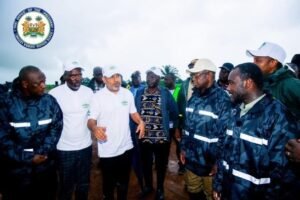


As I stood overlooking nearly 3,000 hectares of precision rice cultivation in Tormabum on July 31, 2026,watching drones apply fertilizers and crop protection products with remarkable accuracy while the foundation is laid for solar-powered irrigation canals to carry life across the fields, I realized I was witnessing far more than another agricultural project. I was seeing a glimpse of Africa’s future.
I had the privilege of accompanying His Excellency President Julius Maada Bio and the Minister of Agriculture and Forestry, Dr. Henry Musa Kpaka, on a visit to this remarkable initiative. It reminded me that transformative change often begins quietly, in a field, on a farm or along a newly constructed irrigation canal, before it reshapes economies and transforms lives.
For more than half a century, Africa has debated agricultural transformation through policy papers, development programmes, conferences and political declarations. I have been privileged to participate in that journey; as an agricultural economist at Michigan State University, later as Director-General of the United Nations Industrial Development Organization (UNIDO), and as co-author, with Dr. Patrick Kormawa, of Agribusiness for Africa’s Prosperity.
Despite those efforts, the continent continues to spend tens of billions of dollars every year importing food that we have the land, water, climate and human capital to produce ourselves. Rice alone accounts for one of Africa’s largest food import bills, leaving millions vulnerable to volatile global markets and external supply shocks.
The lesson from Tormabum could not be clearer.
Africa does not simply need more farming; it needs smarter farming. It needs climate-smart agribusiness built on technology, innovation and investment.
The partnership between Fambul Rice and the Republic of Sierra Leone Armed Forces (RSLAF) demonstrates that large-scale precision agriculture is no longer beyond our reach. Modern machinery, satellite-guided land preparation, drone technology, renewable energy, digital monitoring and advanced irrigation systems are dramatically increasing productivity while making farming more efficient, climate-resilient and commercially viable.
As climate variability intensifies across Africa, precision agriculture is no longer a luxury. It is becoming essential for producing more food while using water, fertilizer and energy more efficiently.
Perhaps most importantly, projects like Tormabum are changing the image of agriculture itself.
Africa’s greatest agricultural challenge is no longer convincing young people that farming matters. It is convincing them that agriculture is one of the most exciting technology sectors of the future. Drones, artificial intelligence, satellite imagery, robotics, biotechnology, data analytics and precision irrigation have the potential to transform farming into a modern, knowledge-intensive industry capable of creating millions of skilled jobs while feeding a rapidly growing population.
The digital revolution offers Africa a unique opportunity to leapfrog traditional development pathways. Just as mobile technology enabled Africa to bypass conventional banking infrastructure, digital agriculture can help us overcome decades of low productivity, fragmented farming systems and weak extension services. Precision agriculture, remote sensing, climate forecasting, digital advisory platforms and smart irrigation can fundamentally reshape how food is produced across the continent.
But technology alone is not enough.
Successful agricultural transformation requires integrated investments in roads, energy, irrigation, logistics, storage, agro-processing facilities and digital connectivity. Farmers cannot prosper if they cannot move their produce to markets, access reliable electricity for processing or secure dependable water supplies in an era of increasing climate uncertainty.
That is why the commitments secured at the Vienna Roundtable earlier this year are so significant. Development partners pledged approximately US$850 million for a portfolio of projects supporting the Feed Salone and Energy Transition agenda, including financing for the Koribondo–Tormabum road. It is also why we have developed decentralized energy services under the EU’s Salone Off Grid Renewable Energy Accelerator (SOGREA) and the Mission300 DARES, which will both provide electricity access to bout 1.5 million people are so critical. Infrastructure investments such as these unlock agricultural potential by connecting production zones to markets, reducing transport costs and post-harvest losses, and transforming isolated farming communities into engines of economic growth.
Ultimately, this is about restoring Africa’s food sovereignty.
Yet the greatest opportunity lies beyond national borders.
Food security can no longer be viewed solely through a national lens. West Africa imports billions of dollars’ worth of rice annually despite possessing some of the world’s most fertile agricultural land. Too often, our countries compete rather than collaborate, while fragmented markets discourage the large-scale investments required to transform agriculture.
Regional integration offers a different path.
Through coordinated investment, harmonized standards, integrated value chains and cross-border infrastructure, West Africa can become a globally competitive agricultural powerhouse. Individually, our countries possess important comparative advantages. Collectively, we have the scale to attract global investors, technology providers and agribusiness leaders capable of transforming the region’s agricultural landscape.
This regional vision will move from aspiration to action at the West Africa Integration and Investment Summit (WAIIS), which Sierra Leone will host later this year. Working alongside West African Ministers of Agriculture, the Gates Foundation, development finance institutions and private-sector leaders, we are advancing a US$1 billion regional rice initiative designed to transform rice production across West Africa.
The ambition extends far beyond increasing yields. It is about reducing import dependence, strengthening food security, creating millions of jobs for young Africans, expanding regional trade and building globally competitive agricultural value chains that generate shared prosperity across the region.
Agriculture must no longer be viewed simply as a social sector deserving subsidies. It is an investment opportunity, an industrial strategy, a climate adaptation strategy and perhaps Africa’s greatest untapped engine of economic transformation.
The world is changing rapidly. Artificial intelligence, biotechnology, digital platforms and renewable energy are reshaping every sector of the global economy. Africa has a historic opportunity to ensure that agriculture becomes part of this technological revolution rather than remaining trapped in outdated production systems.
Tormabum gives us confidence that this transformation is not only possible—it is already underway.
It demonstrates that with visionary leadership, strategic partnerships, private-sector investment and modern technology, Africa can produce more of its own food, create better jobs for its young people and build more resilient economies.
The question before us is no longer whether this transformation can happen.
It is whether we have the courage, the urgency and the collective ambition to scale it across Sierra Leone, across West Africa and across the African continent.
If we seize this moment, Africa’s farms will do far more than feed our people. They will power new industries, create millions of decent jobs, strengthen regional integration, restore our food sovereignty and demonstrate to the world that Africa can lead—not follow—the next agricultural revolution.
About the Author: Hon. Dr. Kandeh K. Yumkella
Chairman, Presidential Initiative on Climate change, Renewable Energy and Food Security and Special Envoy of H.E. President Julius Maada Bio for the West Africa Integration and Investment Summit (WAIIS).