

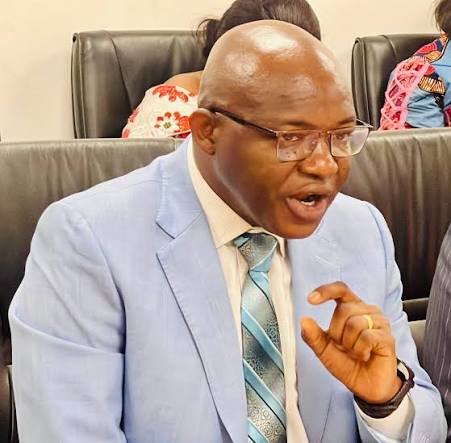
Parliament is preparing to intensify scrutiny of the National Revenue Authority (NRA) following concerns that weaknesses in tax enforcement and administration are preventing Sierra Leone from realising its full domestic revenue potential.
The Majority Leader and Leader of Government Business, Hon. Matthew Sahr Nyuma, raised the concerns while contributing to the parliamentary debate on the 2026 Supplementary Budget. He demanded greater accountability from the NRA, particularly in the collection and remittance of the Goods and Services Tax (GST).
Hon. Nyuma said significant investments had been made to improve the country’s tax administration system, but the results had not met expectations.
“We are tired. The NRA must improve its performance. It must be corrected,” he told lawmakers.
He disclosed that the Commissioner-General of the NRA is expected to sign a performance contract containing specific revenue targets and other institutional responsibilities. According to him, Parliament will closely examine the Authority’s progress and demand accountability if the agreed targets are not achieved.
“We are going to monitor that performance contract. If the targets are not achieved, we will ask questions because someone must be responsible,” he warned.
The Majority Leader identified GST as a major source of revenue that could significantly strengthen the Government’s financial position if properly enforced. He said consumers pay GST daily when purchasing goods and services, but weaknesses in collection and remittance continue to deprive the State of much-needed revenue.
“GST has saved us. Every day, every minute, people pay GST when they buy goods and services. The challenge is ensuring that this revenue is fully and efficiently remitted to the Government,” he stated.
Hon. Nyuma noted that the NRA had distributed approximately 10,000 electronic fiscal cash register machines to businesses as part of efforts to improve tax compliance. However, he expressed concern that the devices were not being effectively used across the business community.
He called on the NRA to conduct stronger monitoring, enforce the relevant tax laws and ensure that registered businesses issue fiscal receipts for taxable transactions.
“If we are serious about enforcing GST, we can raise billions,” he maintained.
The Majority Leader also renewed his call for the full automation of Sierra Leone’s tax administration system, describing digitalization as essential to reducing human interference, preventing revenue leakages and improving transparency.
“I have been saying this for over three years let us automate,” he said.
According to him, many developed countries use automated systems that immediately record VAT or GST at the point of sale. He argued that introducing a similar system across Sierra Leone would enable the Government to accurately track transactions and determine how much tax businesses collect from consumers.
Hon. Nyuma further connected stronger revenue generation to improvements in the salaries and working conditions of public-sector employees. He said Parliament had exercised restraint in considering its own financial requirements because of the country’s economic challenges but insisted that discussions about workers’ welfare must continue.
“Our welfare must be discussed. We understand the financial constraints, but that does not mean we should stop talking about improving the welfare of public servants,” he told the House.
He also urged the Government to review and harmonise the national wage structure, citing disparities in the salaries paid to employees performing comparable duties in different public institutions.
“There are considerable disparities in wages. People doing similar work are paid differently. This is an issue the Government must address,” he said.
Despite his demand for stricter tax enforcement, Hon. Nyuma supported the Government’s decision to provide carefully targeted tax incentives to investors. He explained that such concessions could encourage private-sector expansion, attract investment, generate employment and contribute to national economic development.
“This is an incentive for investment. It is intended to encourage private-sector participation and support economic development,” he explained.
The Majority Leader also defended targeted Government subsidies, arguing that they remained necessary to protect citizens from the effects of rising prices and other economic pressures linked to global developments.
Concluding his contribution, Hon. Nyuma commended Finance Minister Sheku Ahmed Fantamadi Bangura for presenting what he considered a practical economic policy framework through the 2026 Supplementary Budget.
He nevertheless stressed that Sierra Leone’s long-term fiscal stability would depend on the Government’s ability to modernise tax administration, enforce GST compliance, eliminate revenue leakages and hold revenue-generating institutions accountable for their performance.