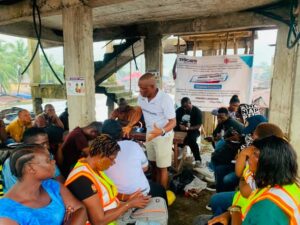

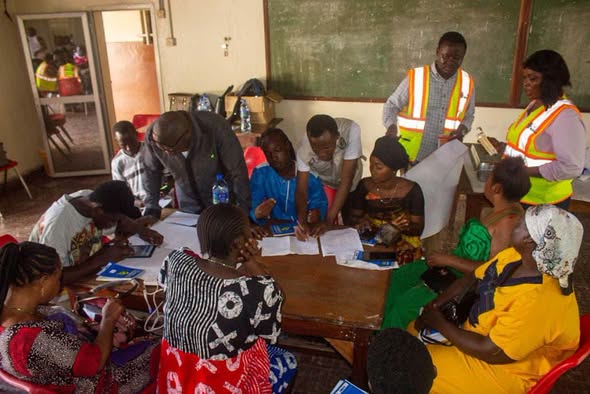
Caritas Freetown, with financial support from Trócaire, has conducted a two-day training and simulation exercise aimed at strengthening disaster preparedness, risk mapping and emergency-response capacity in vulnerable communities across Western Area Urban.
The exercise, held on August 17 and 18, 2026, formed part of a project titled: “Strengthening Community Disaster Preparedness, Flood Mitigation, Climate Resilience and Emergency Response Systems in Vulnerable Communities of Western Area Urban, Sierra Leone.”
A total of 45 people participated in the programme, including 30 members of Community Disaster Management Committees from Bottom Oku, Moa Wharf and Moyiba, as well as 15 Caritas Freetown project staff and volunteers.
The initiative was designed to improve participants’ understanding of disaster risks, hazards and vulnerabilities while strengthening community preparedness, early-warning mechanisms and basic emergency-response skills. It also promoted coordinated and inclusive action before, during and after disasters.
The first day of the training, held at St.Edwards Compound in Kingtom on August 17, focused on disaster preparedness, community risk mapping and first aid. Facilitators adopted a participatory approach that allowed participants to share their experiences and apply their knowledge of conditions within their respective communities.
Chairman of the Community Disaster Management Committee National Secretariat, Daniel Bob Jones, facilitated the opening session, which examined communities’ social memory of disasters, available emergency responders and preferred communication channels.
Participants reflected on major disasters and hazards that affected their communities between 2016 and 2026. Flooding, mudslides and fire outbreaks were identified among the most common emergencies experienced during the period.
The discussion demonstrated that residents possess valuable knowledge about the threats facing their communities. Facilitators stressed that such knowledge should serve as a foundation for effective disaster-preparedness planning, early-warning systems and community-led mitigation measures.
A second session, facilitated by Madam Philomena of the National Disaster Management Agency, introduced participants to important concepts associated with disaster-risk reduction. Those included hazards, risks, vulnerability, capacity, mitigation, preparedness and resilience.
Participants examined how hazards interact with existing community vulnerabilities and available capacities to determine the severity and potential consequences of a disaster.
They were also guided through the process of identifying hazard-prone areas, vulnerable people, available community resources, early-warning signs, safe locations and important public facilities. Particular attention was given to locations requiring urgent mitigation or preparedness interventions.
Paul Kargbo of the Sierra Leone Red Cross Society facilitated the final session of the first day, which focused on the principles and practice of first aid in disaster management.
Participants learned how to provide immediate assistance to injured or critically affected people while awaiting professional medical support. The session covered emergencies including fires, drowning, road accidents and other incidents that frequently occur within communities.
Practical demonstrations and interactive discussions provided participants with an opportunity to ask questions, share personal experiences and improve their understanding of first aid as an important component of community-level emergency response.
The second day of the training, held at Kolleh Town on August 18, built on the knowledge acquired during the opening sessions. It placed greater emphasis on practical disaster response, emergency safety, first aid, rescue preparedness and community risk identification.
Addressing participants, Daniel Bob Jones emphasized that disaster preparedness must begin before an emergency occurs. He encouraged Community Disaster Management Committee members to continuously identify threats, educate residents and support measures aimed at reducing vulnerabilities.
He urged communities to keep roads and pathways accessible, identify alternative routes for emergency responders and work collectively to address conditions that increase the risk of flooding and other disasters.
Participants also discussed rescue preparedness and the importance of providing trained community volunteers with basic equipment such as ropes, gloves, headlamps, cutters and hammers.
Facilitators, however, warned that volunteers must prioritize their own safety and understand how to use rescue equipment properly. Community responders were also encouraged to recognize situations that require the intervention of professionally trained emergency personnel.
First aid remained a major component of the second day’s activities. A representative of the Sierra Leone Red Cross Society conducted another practical session that enabled participants to explore how immediate assistance could be provided safely during emergencies before professional medical services arrive.
The risk-mapping exercise continued, with participants identifying flooding, fire outbreaks, blocked drainage systems, unsafe buildings and poor roads as some of the major hazards affecting their communities.
They also mapped essential community resources and facilities, including hospitals, health centres, schools, markets, roads, open spaces, water sources and communication facilities. Those resources are expected to support preparedness planning, evacuation and emergency coordination.
Simulation exercises allowed Community Disaster Management Committee members to apply the knowledge and skills acquired during the training. Participants are expected to continue using those skills during planned community risk-mapping exercises in Bottom Oku, Moa Wharf and Moyiba.
The upcoming activities will involve residents in identifying hazards, vulnerable areas, available resources and essential facilities within their respective communities.
The programme concluded with a call for participants to transform the knowledge acquired into practical and sustainable community action.
Caritas Freetown stressed that disaster preparedness is a shared responsibility requiring the participation of Government institutions, humanitarian organisations, local authorities, community leaders, disaster management committees, volunteers and residents.
Caritas Freetown and Trócaire believe that strengthening Community Disaster Management Committees and equipping local volunteers with practical skills will improve their ability to prevent and mitigate disaster risks. The intervention is also expected to enhance their capacity to serve as effective first responders when emergencies occur.