

Twelve days after Parliament declared the Constitution of Sierra Leone (Amendment) Bill 2025 passed, the country remains divided between support for its proposed reforms and concern over the parliamentary process used to approve it.
The Bill contains several widely welcomed provisions, including measures to strengthen the electoral commission, introduce a constitutional quota for women’s political nomination and broaden the political participation of dual citizens. Those reforms represent the outcome of a constitutional review process spanning more than two decades.
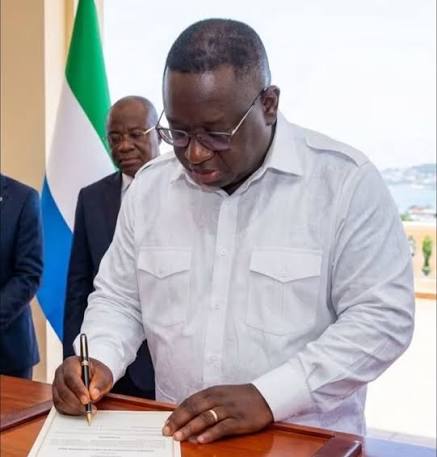
However, the manner in which Parliament declared the Bill passed on 10 August 2026 has generated serious legal and political controversy. Lawyers, Civil Society Organisations, religious leaders, trade unionists and opposition politicians are now urging President Julius Maada Bio to withhold his assent until the Supreme Court determines whether Parliament followed the constitutional voting requirement.
The dispute centres on Section 108(2)(b) of the 1991 Constitution, which requires any Bill seeking to amend the Constitution to receive the support of not less than two-thirds of Members of Parliament at its second and third readings.
With 149 seats in Parliament, critics maintain that the Bill required at least 100 votes to pass. The controversy arose after members of the main opposition All People’s Congress walked out of the chamber over disagreement about whether the required two-thirds majority should be calculated using the full membership of Parliament or only those present and voting.
Following the walkout, the Speaker declared the Bill passed based on the votes of the remaining members. He subsequently referred the question of the appropriate voting threshold to the Supreme Court for interpretation.
Critics have questioned the decision to declare the Bill passed before seeking the Supreme Court’s opinion. They argue that the sequence created uncertainty over whether one of the most significant pieces of legislation considered by Parliament in recent years was constitutionally enacted.
Nicol-Wilson and Law Firm has formally petitioned the Speaker, describing the decision as an unconstitutional exercise of Parliament’s amendment powers. The law firm argues that Parliament relied on the ordinary voting provision under Section 91(1), instead of the higher threshold required under Section 108(2)(b).
The firm also rejected suggestions that Section 94(2), which protects parliamentary proceedings from certain legal challenges, could prevent the courts from examining an alleged constitutional violation.
It cited the Court of Appeal decision in APC and Others v Speaker and Others (2000), which held that parliamentary procedural protection does not extend to actions that violate the Constitution.
The firm’s position is that the required majority must be secured at the time of voting and that a subsequent court interpretation cannot correct a vote that failed to meet the constitutional threshold.
Other legal commentators have made a similar distinction between Parliament’s internal procedures and its constitutional authority. They argue that Standing Order 42 and Section 94(2) protect Parliament’s management of its proceedings but do not place alleged constitutional breaches beyond judicial review.
The Institute for Legal Research and Advocacy for Justice has also criticized the process, warning that referring the threshold question to the Supreme Court after declaring the Bill passed created a constitutional outcome before the legality of the vote had been determined.
The organisation has additionally expressed concern over reports that civil society observers were removed from the parliamentary chamber during the sitting. It urged all parties to avoid irreversible action until the Supreme Court resolves the dispute.
The Sierra Leone Labour Congress has appealed directly to President Bio not to sign the Bill, citing the controversy surrounding the voting threshold and its objection to a separate provision concerning the system through which Members of Parliament are elected.
The Labour Congress wants the Bill returned to Parliament for further consideration and broader consultation.
The Inter-Religious Council of Sierra Leone has adopted a more conciliatory position, calling on Parliament, the judiciary and the President to exercise patience and act in the national interest. It urged lawmakers to pursue greater consensus and avoid treating the Constitution as the property of any political party.
The Sierra Leone Association of Journalists welcomed the referral to the Supreme Court and called on all sides to respect the Court’s eventual decision.
The All People’s Congress has also said it will not recognize the amendment as valid until the Supreme Court rules on the legality of the parliamentary process.
Concern has not been limited to opposition and civil society voices. Former Secretary-General of the ruling Sierra Leone People’s Party, Sulaiman Banja Tejan-Sie, publicly described the episode as a “comedy of errors,” reflecting unease from within the governing party’s wider political circle.
Despite the controversy, most critics have not rejected the Bill’s major reforms. The proposed strengthening and renaming of the electoral commission, increased political representation for women and broader inclusion of dual citizens are generally regarded as important developments.
The central objection is that constitutional reform must be conducted strictly according to the procedures established by the Constitution. Critics maintain that worthwhile reforms could still lose public confidence if enacted through a process affected by unresolved legal questions.
President Bio has repeatedly presented constitutional reform as the culmination of a national process extending across several administrations. Those calling for him to withhold assent argue that the same patience should be exercised at the final stage.
They warn that signing the Bill before the Supreme Court delivers its interpretation would not resolve the controversy but transfer it from Parliament to the judiciary after the President’s signature had already been attached.
Waiting for the Court’s decision, they argue, would cause only a temporary delay while allowing the proposed reforms to proceed on firmer constitutional foundations.
The dispute is therefore not simply between supporters and opponents of reform. It is about whether constitutional change should proceed only after full compliance with the law has been established.
For a country still affected by disagreements arising from the 2023 elections, the method used to change its supreme law is not a minor procedural matter. It is central to public confidence in the reforms and the democratic institutions responsible for delivering them.