

Demand for dependable construction materials is rising across Sierra Leone as investment in residential housing, commercial properties and public infrastructure continues to grow.
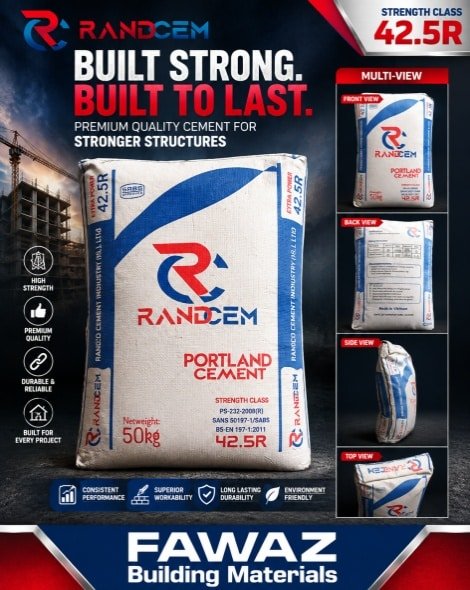
Responding to the expanding market, FAWAZ Building Materials has increased the availability of RANDCEM 42.5R Cement for engineers, contractors, developers, masons and individuals undertaking construction projects nationwide.
Manufactured in Vietnam and supplied in 50-kilogram bags, RANDCEM 42.5R is suitable for several building applications, including foundations, columns, beams, concrete floors, blocks and other structural works.
FAWAZ Building Materials says the product is designed to provide reliable performance and strong early development when properly mixed, applied and cured. Under suitable working conditions, its reported setting time of about 30 minutes could also help construction teams manage their schedules efficiently.
The company has stressed, however, that durable buildings cannot be achieved through cement quality alone. Safe construction requires approved structural designs, firm foundations, proper reinforcement, accurate measurements, clean sand, appropriate aggregates, skilled workers and qualified supervision.
The amount of water added during concrete preparation is particularly important. Excessive water may weaken the mixture, increase shrinkage and contribute to cracks. Incorrect quantities of cement, sand and aggregate can also reduce structural strength and shorten the useful life of a building.
Builders sometimes apply a mixture of one part cement, two parts sand and four parts aggregate for certain general concrete works. Lean concrete may use one part cement, three parts sand and six parts aggregate. These proportions are only general references and should not replace specifications provided by professional engineers for individual projects.
Proper curing is another major requirement for achieving strong concrete. Newly placed concrete must be kept sufficiently moist during its early stages to support strength development and minimise cracking. Poor curing can affect structural performance even when good-quality cement and other reliable materials are used.
FAWAZ Building Materials has also encouraged customers to observe correct storage procedures. Cement bags should be kept in dry, covered and properly ventilated spaces. They should be placed above floor level and protected from rainwater, leaking roofs, groundwater, damp walls and other sources of moisture.
Once a cement bag has been opened, any unused quantity should preferably be applied within seven days. Where immediate use is impossible, the remaining cement must be tightly sealed to prevent exposure to moisture and air.
Safety measures are equally necessary when handling cement. Construction workers are advised to wear gloves and face masks to reduce contact with cement dust and prevent prolonged skin exposure. Safe lifting methods should also be used when moving the 50-kilogram bags, while cement products must be stored beyond the reach of children.
Concerns over reported building collapses in Sierra Leone have increased public calls for stronger enforcement of construction standards. Structural failures are commonly associated with poor foundations, defective designs, low-quality materials, weak workmanship and insufficient professional supervision.
Industry stakeholders have consequently urged the Sierra Leone Standards Bureau and other relevant authorities to intensify market inspections and regularly examine cement products imported and sold across the country.
Improved monitoring of importers, distributors and retailers could protect consumers, discourage the circulation of substandard materials and ensure that companies compete fairly within the construction market.
FAWAZ Building Materials says its expanded distribution of RANDCEM 42.5R reflects its commitment to supporting Sierra Leone’s development through the supply of dependable construction products.
The country’s ability to build safer, stronger and longer-lasting structures will ultimately depend on a combination of quality materials, professional engineering, skilled workmanship, responsible building practices and effective regulatory oversight.