

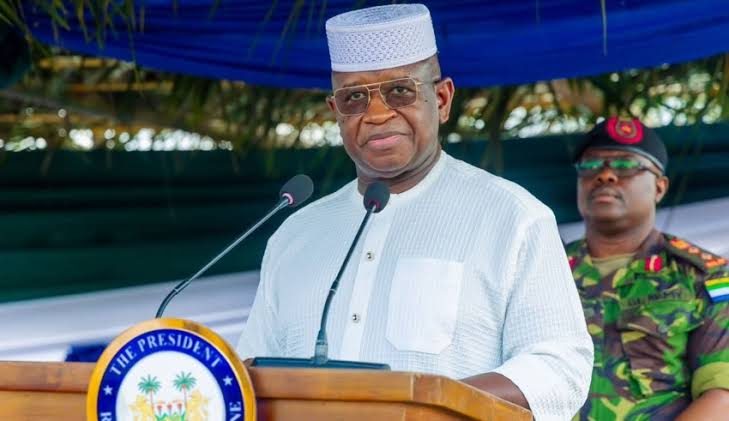
President Dr Julius Maada Bio has directed that a petition raising constitutional questions over the passage of the Constitution of Sierra Leone (Amendment) Bill be referred to the Supreme Court for a judicial opinion before he takes a final decision on the legislation.
The directive represents an unprecedented invocation of Section 122(1) of the Constitution of Sierra Leone, 1991, which permits the President to refer a petition requiring his final decision to the Supreme Court for its judicial opinion.
The development comes as the Supreme Court of Sierra Leone has scheduled October 7, 2026, for the hearing of all matters filed before it in connection with the constitutional amendment process.
A public notice issued by the Registry of the Supreme Court stated that the cases would be handled expeditiously to ensure their timely resolution in accordance with the laws of Sierra Leone.
“The Supreme Court of Sierra Leone hereby informs the general public that all matters filed in the Court relating to the Constitutional Amendment shall be heard on the 7th day of October, 2026,” the notice stated.
The announcement, signed by Acting Registrar of the Supreme Court Peter M. Kamara, comes amid heightened national and legal interest in the proposed constitutional amendments and the parliamentary process through which the legislation was passed.
According to a State House release issued on Monday, September 14, 2026, President Dr Julius Maada Bio received the Constitution of Sierra Leone (Amendment) Act, 2026, from the Clerk of Parliament on September 10, 2026, for presidential assent.
Before receiving the legislation, President Dr Julius Maada Bio had, on September 4, 2026, received a petition from the Institute for Governance Reform raising constitutional questions about the process through which the Bill was passed by Parliament.
State House said President Dr Julius Maada Bio had also been closely following the national debate surrounding the legislation, including the differing positions expressed by supporters and opponents of its passage.
The Presidency stated that legislation of such significance, touching on Sierra Leone’s constitutional and democratic foundations, requires broad national consensus and clear constitutional interpretation to strengthen public trust and confidence in the constitutional review process.
Consequently, acting under Section 122(1) of the 1991 Constitution, President Dr Julius Maada Bio directed that the petition concerning the legislation be referred to the Supreme Court for its judicial opinion.
President Dr Julius Maada Bio also instructed Attorney-General and Minister of Justice Alpha Sesay to facilitate the referral to the country’s highest court.
Commenting on the decision, Alpha Sesay said the action demonstrates President Dr Julius Maada Bio’s commitment to ensuring that any determination on whether to assent to the legislation is constitutionally sound, legally defensible and in the best interests of Sierra Leone.
Alpha Sesay disclosed that three separate matters have already been filed before the Supreme Court challenging the constitutional validity of the process through which the legislation was passed.
According to Alpha Sesay, the State takes the legal challenges seriously and will respond fully through the appropriate judicial processes. He said the Office of the Attorney-General and Minister of Justice is actively preparing the State’s response to the applications.
Alpha Sesay further revealed that the State has filed papers seeking the consolidation of the three applications because they raise substantially similar constitutional questions.
The Attorney-General and Minister of Justice described the proceedings as neither unexpected nor unwelcome in a constitutional democracy. He said they represent a legitimate exercise of judicial oversight and provide an important opportunity for the Supreme Court to offer authoritative clarity on the constitutional issues raised.
State House has also notified the Clerk of Parliament that if the Supreme Court’s judicial opinion is not received within 14 days of the presentation of the legislation, the President’s final decision will be communicated to Parliament at the earliest opportunity after the Court’s opinion has been received.
The Presidency described the referral as an unprecedented step reflecting President Dr Julius Maada Bio’s commitment to ensuring that matters of major national importance are handled with due diligence, transparency and fidelity to the Constitution.
The Supreme Court’s decision to hear all related matters on October 7, 2026, is expected to allow the respective parties to present their legal arguments on the constitutional questions arising from the amendment process.
The Judiciary has assured the public that the matters will receive prompt attention and that the proceedings will be conducted and determined in accordance with the laws of Sierra Leone.
With three legal challenges and the presidentially referred petition now before the Supreme Court, national attention is increasingly turning to the country’s highest court for authoritative guidance on the validity of the parliamentary process and the broader constitutional issues surrounding the legislation.