

By Amin Kef Sesay
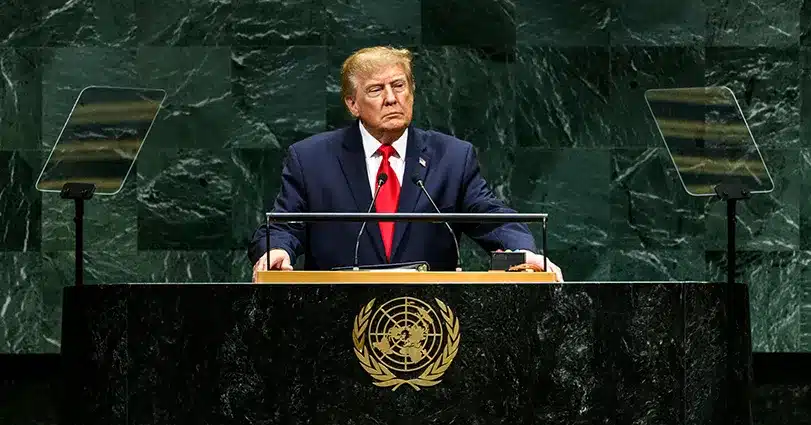
United States President Donald J. Trump has used his address to the 81st Session of the United Nations General Assembly to defend his administration’s foreign policy record and reaffirm an “America First” approach centred on national sovereignty, security, military strength and US economic interests.
President Donald J. Trump addressed the General Assembly on September 22, 2026, telling world leaders that the United States had become stronger under his leadership and arguing that Washington was taking decisive action on international security challenges. The White House followed the speech with a September 23 release highlighting what it described as major achievements of the administration.
During his address, President Donald J. Trump said his administration would continue confronting threats to the United States while resisting international arrangements that, in his view, undermine American sovereignty.
The President devoted significant attention to Iran, defending US military action and maintaining that his administration would not allow Tehran to acquire a nuclear weapon. His position on Iran and the wider conflict has remained controversial, with critics questioning the consequences of the military campaign while the administration argues that its actions were necessary to confront the Iranian nuclear threat.
The White House also used its September 23 statement to highlight changes in Washington’s relationship with the United Nations. It said the administration had reduced US expenditure connected to the UN system by more than $1 billion and ended what it characterised as open-ended commitments to some international programmes and peacekeeping activities.
The administration further highlighted President Donald J. Trump’s decision to withdraw the United States from dozens of international organisations and arrangements it said no longer served American interests.
Among them were the United Nations Framework Convention on Climate Change and the Global Forum on Migration and Development, according to the White House statement. The administration has presented such withdrawals as part of its broader effort to place US sovereignty and domestic economic interests ahead of multilateral commitments.
The White House also defended its withdrawal from and withholding of funding for the United Nations Human Rights Council and the United Nations Relief and Works Agency for Palestine Refugees. The administration has criticised both organisations, while supporters of continued US engagement with multilateral institutions have argued that withdrawal can reduce Washington’s ability to influence them.
President Donald J. Trump also used his UN appearance to emphasise security developments in the Arctic. His administration announced a strategic agreement involving the United States, Denmark and Greenland that would expand American security interests and military access in Greenland. Danish officials have stressed that the agreement remains subject to parliamentary approval and does not transfer Danish sovereignty over Greenland.
Another major element of the administration’s foreign policy message concerned the Western Hemisphere.
The White House said President Donald J. Trump’s policies had strengthened US influence across the region and intensified pressure on drug-trafficking organisations. It highlighted the designation of cartels as Foreign Terrorist Organisations and military operations against vessels suspected of trafficking fentanyl and other narcotics.
The administration also pointed to the establishment of what it calls the “Shield of the Americas,” describing the initiative as a major economic and national security alliance aimed at combating organised crime and strengthening cooperation among participating countries.
Venezuela featured prominently in the White House account of the President’s foreign policy record. The administration said the United States had strengthened its relationship with Venezuela’s current leadership following the capture of Nicolás Maduro and had secured substantial US interests in the country’s vast oil reserves.
President Donald J. Trump also highlighted his administration’s approach toward Cuba, Mexico and Panama. The White House said Washington was targeting what it described as Cuban government-linked networks operating in the United States and increasing pressure on Mexican cartels.
It also credited President Donald J. Trump with pressuring Panama to withdraw from China’s Belt and Road Initiative, presenting the development as part of Washington’s wider effort to limit Beijing’s strategic influence in the Western Hemisphere.
The President further promoted his administration’s Middle East record, with the White House saying he had helped end several conflicts and secured the release of remaining hostages in Gaza.
The United Nations Security Council has also backed elements of the Trump administration’s Gaza peace initiative, according to the White House, which said the initiative included a 20-point peace plan and the creation of a Board of Peace involving dozens of countries.
European security and the North Atlantic Treaty Organisation were another focus of the administration’s account.
The White House said President Donald J. Trump had pushed NATO members toward significantly higher defence expenditure and secured major investments by allied countries in the US defence industry.
The administration argues that increased allied defence spending will strengthen NATO while reducing the disproportionate financial burden it says the United States has historically carried.
President Donald J. Trump also pointed to measures against the Houthis and branches of the Muslim Brotherhood, which his administration has designated as Foreign Terrorist Organisations in specified cases. The administration maintains that the measures give US authorities stronger tools to address threats to American citizens and national security.
Beyond military and diplomatic issues, the President presented industrial capacity as an important component of national security.
The White House said the administration was rebuilding the US defence industrial base, expanding domestic shipbuilding and encouraging critical manufacturing industries to relocate production to the United States. It attributed trillions of dollars in announced investments to its broader economic and industrial policies.
President Donald J. Trump’s address ultimately presented a vision of international relations based heavily on national sovereignty, military deterrence, economic leverage and selective engagement with international institutions.
The White House described the approach as evidence that the United States was again asserting its interests internationally and argued that the administration’s policies were protecting American jobs, strengthening national security and increasing US influence.
The speech, however, came against a backdrop of continuing debate in the United States and internationally over the consequences of President Donald J. Trump’s foreign policy, particularly the war with Iran, relations with traditional allies and Washington’s reduced participation in some multilateral institutions.
For President Donald J. Trump and his administration, the central message delivered at the United Nations was that US engagement abroad would continue to be judged primarily by whether it advances American security, sovereignty and economic interests.