

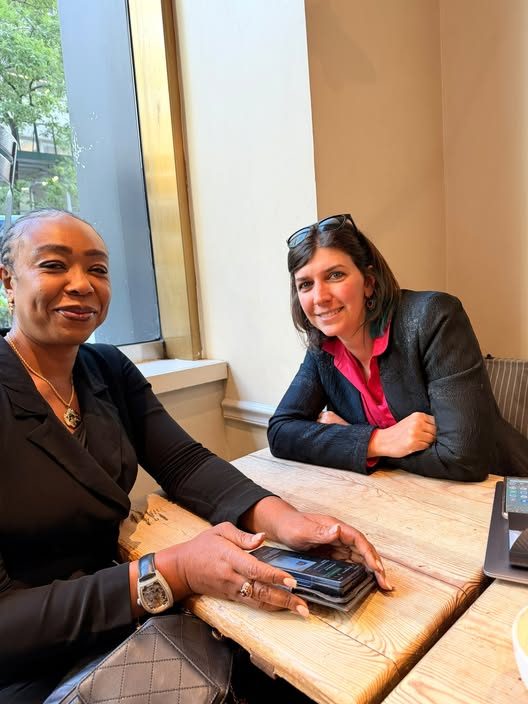
Executive Secretary of the Independent Commission for Peace and National Cohesion (ICPNC), Hawa Sally Samai, has used a series of high-level engagements in New York to advance Sierra Leone’s conflict prevention priorities, strengthen international partnerships and share the country’s experience in building sustainable peace through strong national institutions.
The engagements, held on the margins of the 81st Session of the United Nations General Assembly, brought Hawa Sally Samai into discussions with officials and experts from the United Nations Peacebuilding Fund, the New York University Center on International Cooperation (NYU CIC) and participants at the 2026 International Forum on African-Caribbean Leadership.
A major focus of the engagements was Sierra Leone’s renewed eligibility for support from the United Nations Secretary-General’s Peacebuilding Fund and the country’s efforts to develop its first National Prevention Strategy.
On Thursday, 24 September 2026, Hawa Sally Samai met with Chief of the Peacebuilding Fund, Brian J. Williams, at the United Nations Secretariat in New York, where discussions centred on Sierra Leone’s prevention priorities and the need to build sustainable national systems capable of identifying and addressing emerging risks before they develop into conflict.
The meeting provided an opportunity for Hawa Sally Samai to express appreciation to the Peacebuilding Fund and the Peacebuilding Support Office for their longstanding partnership with Sierra Leone, particularly their contribution to the country’s transition from post-war recovery towards a broader national approach to conflict prevention and social cohesion.
Sierra Leone’s eligibility for support from the Peacebuilding Fund has been renewed for another five years, through the end of 2030. The renewed partnership includes an initial US$3 million allocation to support the development and implementation of the country’s first National Prevention Strategy in collaboration with the United Nations Development Programme (UNDP), United Nations Children’s Fund (UNICEF) and UN Women.
The support is expected to strengthen efforts aimed at preventing conflict, promoting social cohesion, expanding the participation of women and young people, improving cross-border cooperation and addressing security risks associated with climate change and environmental pressures.
During the discussions, Hawa Sally Samai highlighted the conflict analysis undertaken by the Independent Commission for Peace and National Cohesion and the United Nations system, which helped inform Sierra Leone’s application for renewed eligibility.
Attention was also placed on establishing a coordinated prevention system that connects early warning mechanisms, mediation, community peace structures, women and youth networks, traditional leaders and national institutions. Such an approach is intended to ensure that emerging disputes and grievances can be identified and addressed before they escalate into violence.
Hawa Sally Samai further outlined ongoing work with the New York University Center on International Cooperation aimed at examining how Sierra Leone’s peace infrastructure could be strengthened and more firmly embedded within national institutions.
Brian J. Williams welcomed the emphasis on national ownership and sustainability, highlighting the importance of developing systems capable of continuing their work beyond the lifespan of individual projects.
The engagement also reflected on Sierra Leone’s longstanding relationship with the United Nations Peacebuilding Fund. Since 2007, the Fund has invested approximately US$84 million in Sierra Leone, supporting initiatives related to institution building, conflict prevention, social cohesion, women and youth empowerment, dialogue and community peacebuilding.
Hawa Sally Samai explained that Sierra Leone’s objective is to move beyond viewing peace simply as the absence of war and instead build a more resilient society in which institutions and communities can identify risks early, address grievances peacefully and prevent disagreements from developing into violence.
Both sides underscored the importance of continued coordination with the United Nations Country Team in Freetown and the United Nations Peacebuilding Commission in New York as work on Sierra Leone’s National Prevention Strategy progresses.
The meeting with the Peacebuilding Fund Chief formed part of a broader series of engagements undertaken by Hawa Sally Samai in New York to deepen Sierra Leone’s prevention agenda and strengthen cooperation with international partners.
On 23 September 2026, Hawa Sally Samai held discussions with Céline Monnier, Associate Director for Prevention and Peacebuilding at the New York University Center on International Cooperation and Lead of the Peace Policy Pillar at NYU PREP.
Their discussions focused on strengthening Sierra Leone’s approach to preventing conflict before tensions escalate into violence and examining how research, policy and practical experience could contribute to more effective national prevention mechanisms.
Hawa Sally Samai and Céline Monnier reflected on work undertaken by NYU CIC and its partners in Sierra Leone over the years, particularly around National Prevention Strategies, while exploring how lessons from research and practical experience could be translated into measures capable of identifying emerging risks and responding to tensions at an early stage.
The approach closely aligns with the mandate of the Independent Commission for Peace and National Cohesion, which works with communities, institutions and other stakeholders to address emerging disputes through dialogue, mediation and reconciliation. The Commission also promotes peaceful coexistence and national cohesion while supporting mechanisms designed to prevent disagreements from developing into wider conflicts.
Opportunities for continued collaboration with NYU CIC were also discussed, particularly in strengthening Sierra Leone’s existing peace structures and developing sustainable national approaches to conflict prevention.
Hawa Sally Samai subsequently took Sierra Leone’s experience to a wider international audience on Thursday, 24 September 2026, when she participated in the 2026 International Forum on African-Caribbean Leadership in New York.
Convened by the African Leadership Organisation during United Nations General Assembly Week, the forum brought together leaders from Africa, the Caribbean and the diaspora to promote cooperation around governance, development and common global challenges.
Held at the New York Marriott Marquis under the theme, “The Global African Alliance: Reimagining Solidarity, Sovereignty & South-South Cooperation,” the gathering featured discussions around stronger institutions, investment, sustainable development and cooperation across the Global South.
Participating as a special guest and panelist on Social Development, Gender and Strategic Partnerships, Hawa Sally Samai used the platform to highlight Sierra Leone’s growing emphasis on preventing conflict before tensions reach crisis level.
“Peace is not an event; it is a process that must be continuously protected, invested in and owned by the people,” Hawa Sally Samai said.
She stressed that dialogue must be supported by credible institutions, inclusive participation and sustained political commitment, pointing to the work of the Independent Commission for Peace and National Cohesion in early warning, mediation and community-based conflict prevention.
“The lesson is: build the relationships and institutions that prevent conflict before the conflict becomes a crisis,” Hawa Sally Samai stated.
Drawing on her experience in grassroots advocacy involving women and children, Hawa Sally Samai also emphasized the need for women to be recognized not merely as beneficiaries of peace and development programmes, but as decision-makers, peacebuilders and leaders with an important role in shaping national development.
She further underscored the importance of international partnerships that strengthen national institutions and local capacity without weakening domestic ownership of the peacebuilding process.
“International partners can bring resources, expertise and solidarity, but Sierra Leoneans must own the peace, lead the process and build the institutions that sustain it,” Hawa Sally Samai said.
The series of engagements highlighted Sierra Leone’s evolving approach to peacebuilding, with greater emphasis being placed on prevention, early intervention, inclusive participation and the development of institutions capable of responding to emerging threats before they undermine national stability.