

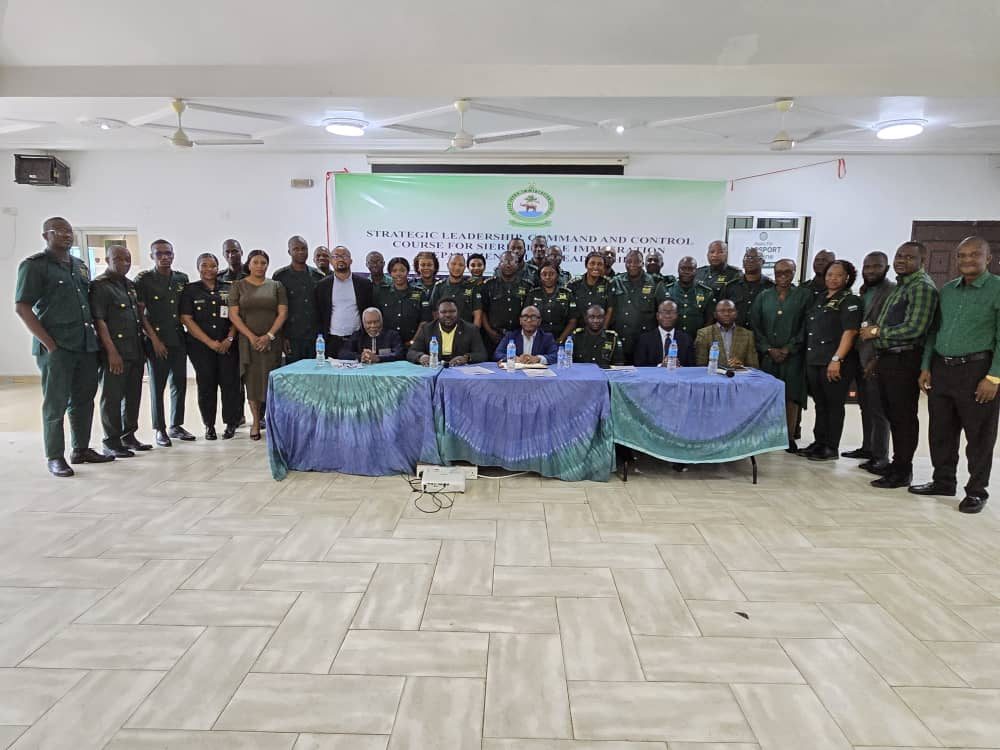
The Sierra Leone Immigration Department (SLID) has commenced a three-day Strategic Leadership, Command and Control Training programme for senior immigration officers, Regional Commanders, District Heads and Heads of Command Posts as part of efforts to strengthen leadership and advance the Department’s ongoing institutional transformation.
The training, which opened in Makeni on Thursday, 24 September 2026, is being conducted under the theme, “Commanding the Transition.” It is designed to strengthen leadership capacity, command structures, institutional discipline, accountability and strategic decision-making as SLID prepares for its transition to the Sierra Leone Immigration Service (SLIS).
Using case studies, group discussions, leadership exercises and interactive sessions, the programme provides senior officers with practical knowledge and skills to effectively manage their respective commands and contribute to the Department’s transformation agenda.
Delivering the opening remarks, Director of Finance and Administration, Swaray Junisa, welcomed participants on behalf of the Chief Immigration Officer and the Management of SLID. He underscored the importance of the training and encouraged participants to take the sessions seriously and apply the knowledge acquired to improve leadership and service delivery across the Department.
Regional Commander for the Northern Region, Osman Kamara, welcomed participants to Makeni and expressed appreciation to Management for selecting the region to host the programme. He assured participants of a conducive and secure environment throughout the training.
Speaking on behalf of the consulting team, lead consultant Tidiane Traore recalled the team’s earlier engagement with SLID in Kenema, where the Department’s strategic goals were identified. He stressed that achieving those objectives would require effective leadership and strong institutional structures.
Deputy Chief Immigration Officer, Amadu Bah, described institutional transformation as a continuous process that began with the Department’s engagement in Kenema. He noted that successive leadership teams have championed reforms but emphasized that meaningful transformation can only be sustained through effective leadership.
Amadu Bah also reminded officers that the responsibilities of the Sierra Leone Immigration Department extend far beyond passport services to include several critical immigration and national security functions. He encouraged participants to fully engage in the training and apply the knowledge gained within their respective areas of responsibility.
The programme continued on Friday, 25 September 2026, with Chief Immigration Officer, Dr. Moses Tiffa Baio, Esq., addressing participants on the importance of credible, competent and responsible leadership as SLID prepares for its transition into the Sierra Leone Immigration Service.
Dr. Moses Tiffa Baio, Esq., said the transformation requires leaders capable of managing immigration operations effectively while maintaining professional and institutional standards. He stressed the importance of a clear chain of command, defined lines of authority and effective structures to ensure discipline, order and accountability.
“Leadership is not only about the title you carry but the responsibility you bear. What matters most is how you honour that responsibility,” Dr. Moses Tiffa Baio, Esq., told participants.
He identified competence and integrity as essential foundations of effective leadership and urged senior officers to earn the respect of personnel under their command through professionalism, sound judgement and responsible decision-making.
According to Dr. Moses Tiffa Baio, Esq., leaders must also demonstrate exemplary conduct because their actions, both publicly and privately, can influence the attitudes and behaviour of officers under their supervision.
He encouraged participants to regard the training as an investment in their professional development and challenged them to transfer the knowledge acquired to officers at their respective command posts. Drawing on the biblical account of Moses leading his people towards the Promised Land, he urged officers to embrace the Department’s transformation agenda and remain committed to its institutional vision.
Proceedings on the second day also included an interactive review of lessons from the opening sessions. Amadu Bah commended participants for their active involvement and understanding of the subjects covered.
Module Four of the programme, focusing on Command and Control, was facilitated by lead consultant Laud Kwasi Ofori Affrifah, Esq., former Deputy Comptroller General of Operations of the Ghana Immigration Service.
Participants were divided into three groups and assigned separate case studies requiring them to analyse practical command challenges and propose appropriate solutions. The exercise was intended to promote critical thinking, teamwork and the practical application of leadership principles.
Discussions also focused on effective communication, clearly defined authority, responsible decision-making and accountability within the chain of command.
The three-day programme forms part of the Sierra Leone Immigration Department’s wider institutional transformation drive aimed at developing a professional, competent and accountable leadership cadre capable of delivering effective immigration services and successfully steering the transition to the Sierra Leone Immigration Service.
The training concluded in Makeni on Saturday, 26 September 2026.