

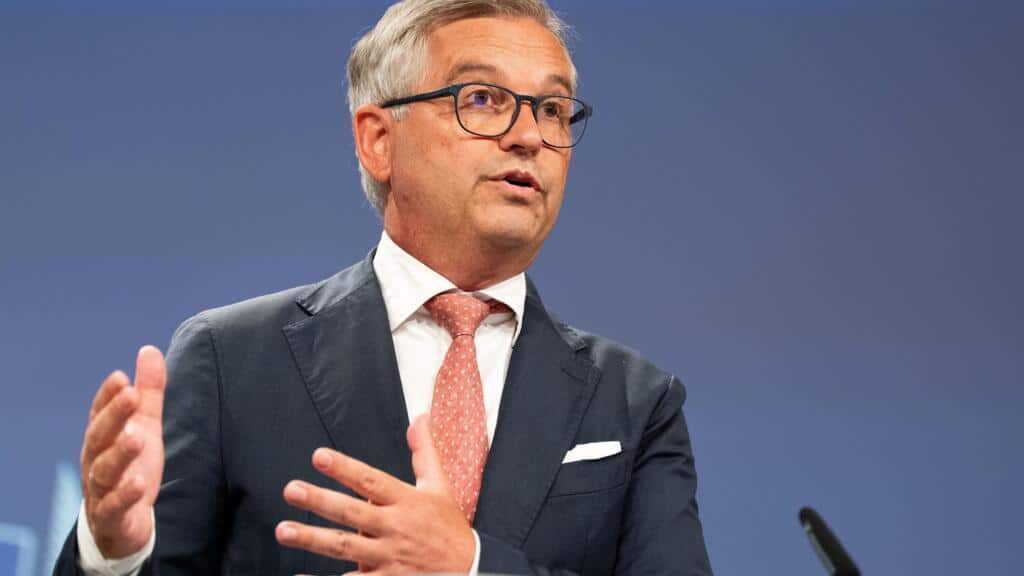
European Union Commissioner for Internal Affairs and Migration, Magnus Brunner, has attributed the current hold on European Union budget support to Sierra Leone to “technical reasons,” while separately acknowledging concerns within the European Union over drug trafficking, transnational organized crime and countries accused of harbouring wanted drug traffickers.
Magnus Brunner made the remarks following a meeting of European Union Justice and Home Affairs Ministers in Luxembourg on Thursday, 1 October 2026, amid conflicting accounts over why €18 million in European Union budget support expected by Sierra Leone this year has not been disbursed.
Speaking about the broader fight against organized crime, Magnus Brunner told reporters: “I think what we need is action against third countries that harbour drug traffickers.” He also expressed concern about drug trafficking, transnational crime and organized crime trends in Sierra Leone.
However, when addressing the specific question of the European Union budget-support payment, Magnus Brunner offered a different explanation, stating: “When it comes to the suspension of the support, that’s due to technical reasons.”
Magnus Brunner did not publicly establish a direct connection between the €18 million budget-support decision and the controversy surrounding convicted Dutch drug trafficker Jos Leijdekkers. His comments therefore presented two distinct issues: the technical circumstances surrounding the budget-support payment and the European Union’s wider concerns about organized crime and drug trafficking.
His explanation differs from the account initially given by Dutch Minister of Justice and Security David Van Weel. David Van Weel told Dutch media that the €18 million payment had been withheld as part of efforts to pressure Sierra Leone over Jos Leijdekkers, who is wanted by authorities in the Netherlands.
David Van Weel, on 1 October 2026, said the European Commission had suspended the payment because of Sierra Leone’s alleged failure to arrest and hand over Jos Leijdekkers. David Van Weel also suggested that a further €22.5 million expected in 2027 could be affected if the dispute remained unresolved.
However, subsequent reporting on 2 October added another dimension to the disagreement. David Van Weel acknowledged that the European Commission’s explanation that the funding decision was based on administrative or technical grounds was formally correct, but maintained that discussions over Jos Leijdekkers and efforts to combat drug-related organized crime had taken place alongside the funding issue.
European Commission sources, however, reportedly disputed the way David Van Weel had characterized the decision, maintaining that the formal basis for the funding hold was administrative rather than a sanction imposed over Jos Leijdekkers.
The Government of Sierra Leone has similarly maintained that the postponement resulted from procedural issues surrounding the financing arrangement rather than the Jos Leijdekkers controversy.
In a statement issued through the Ministry of Information and Civic Education on 1 October 2026, the Government said the European Commission had formally communicated its decision concerning the 2026 disbursement in July.
According to the Government, the reasons communicated by the European Commission concerned the timing of Sierra Leone’s request for an amendment to the Financing Agreement and the difficulty of completing the required procedures within the 2026 reporting cycle.
The Government said the European Commission consequently proposed rescheduling the 2026 and 2027 disbursements to 2027 and 2028 respectively, with targets for the 2027 disbursement already agreed.
While acknowledging that postponement of the 2026 payment represents a setback, the Government stressed that the development does not amount to a suspension of the broader relationship between Sierra Leone and the European Union.
The Government further maintained that European Union representatives had indicated during subsequent engagements that the decision concerning the 2026 disbursement was not taken because of discussions involving any particular individual. It therefore rejected reports portraying the July decision as a new punitive measure connected directly to the Jos Leijdekkers case.
Jos Leijdekkers is a convicted Dutch cocaine trafficker wanted by European authorities. The Netherlands has been seeking his arrest and extradition, while allegations concerning his presence in Sierra Leone have generated considerable international attention.
The latest statements therefore reveal differing explanations surrounding the €18 million payment. Magnus Brunner and the Government of Sierra Leone point to technical or procedural reasons as the formal basis for the delayed disbursement, while David Van Weel maintains that pressure over Jos Leijdekkers formed part of the broader political discussions surrounding Sierra Leone.
Importantly, Magnus Brunner’s remarks do not necessarily contradict each other. His call for action against third countries that harbour drug traffickers relates to the European Union’s wider response to organized crime, while his statement that the budget-support hold resulted from technical reasons addresses the specific €18 million disbursement.
Magnus Brunner’s position is therefore consistent with the Government of Sierra Leone’s account that the formal basis for postponing the 2026 budget-support disbursement was technical or procedural. At the same time, his wider remarks demonstrate that concerns about drug trafficking, transnational organized crime and cooperation with third countries remain separate matters under discussion within the European Union.
The distinction is significant because it avoids treating the technical explanation for the budget-support decision as proof that the wider Jos Leijdekkers controversy has no bearing on relations between Sierra Leone, the Netherlands and the European Union. What remains disputed is whether those broader political concerns influenced the funding decision beyond the formal technical grounds publicly stated by Magnus Brunner and communicated to the Government of Sierra Leone.