

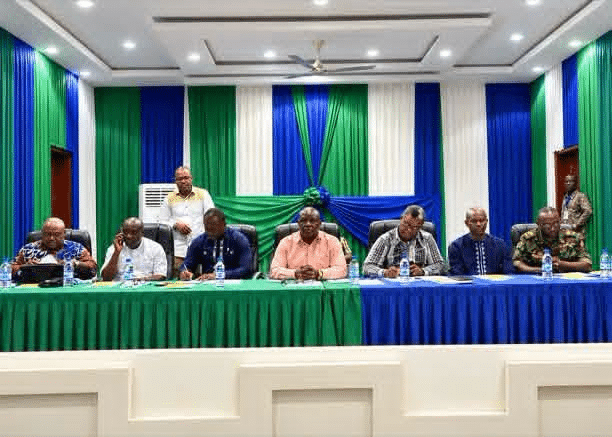
The Electoral Commission for Sierra Leone (ECSL) has engaged stakeholders in the Northern Region in the validation of its proposed 2025–2029 Strategic Plan and four institutional policies, as part of nationwide consultations aimed at strengthening transparency, participation and public confidence in electoral administration.
The engagement, held on Thursday, 1 October 2026, at the Bombali District Council Hall in Makeni, brought together representatives of political parties, traditional authorities, local councils, civil society organisations, security agencies, women and youth groups, transport unions, religious leaders and development partners.
The consultation followed similar engagements in Kenema on 28 September and Bo on 29 September, with Port Loko hosting the North-West regional engagement on Friday, 2 October.
Addressing stakeholders in Makeni, Chief Electoral Commissioner and Chairman of ECSL, Edmond Sylvester Alpha, said the Commission wanted participants to critically examine its plans rather than simply endorse them.
“We are not here to ask for your applause. We are here to ask for your scrutiny. Test us. Challenge us,” he said.
Edmond Sylvester Alpha stressed that the Strategic Plan should reflect realities across Sierra Leone and incorporate the experiences and concerns of communities in Bombali, Tonkolili, Koinadugu and Falaba. He said meaningful stakeholder participation is necessary to ensure that the final document is responsive to the country’s electoral needs.
The proposed Strategic Plan is anchored on four pillars: Institutional and Staff Development; Electoral Education, Communication and Participation; Electoral Operations; and ICT and Data Management Systems.
Under those areas, the Commission intends to strengthen professional and merit-based staffing, expand year-round civic and voter education, improve preparedness throughout the electoral cycle, address electoral misinformation and modernize its digital infrastructure and data-management systems.
ECSL says the proposed plan was developed from institutional assessments, lessons from previous elections and recommendations from local and international election observation missions. The Commission’s 2024 Annual Report confirms that it reviewed the implementation of its previous 2020–2024 Strategic Plan and began preparations for developing the 2025–2029 plan.
Stakeholders in Makeni also reviewed four institutional policies covering Stakeholder Engagement, Regulation Making, Information Management and Ad-Hoc Staff Recruitment and Management.
The Stakeholder Engagement Policy seeks to establish structured and continuous dialogue with actors across the electoral process, while the Regulation Making Policy is intended to promote clarity, fairness and predictability in developing electoral rules. The Information Management Policy focuses on access to electoral information within the limits of the law, while the Ad-Hoc Staff Recruitment and Management Policy addresses transparent and merit-based recruitment and management of temporary election personnel.
ECSL committed itself to documenting feedback from the Makeni consultation and considering the contributions in finalizing the Strategic Plan ahead of its national launch.
“We are not asking for blind trust. We are asking for a working relationship; one built on evidence, follow-through and respect,” Edmond Sylvester Alpha told stakeholders.
The consultation reflects ECSL’s broader engagement with political parties, civil society organisations and other stakeholders as part of its electoral mandate. The Commission identifies accountability, credibility, independence, integrity, impartiality, professionalism and transparency among its guiding principles.
In Port Loko, stakeholders continued the validation process at the Port Loko District Council Hall on Friday, 2 October 2026. Feedback from the regional consultations is expected to contribute to the final Strategic Plan that will guide the Commission’s work through 2029.