

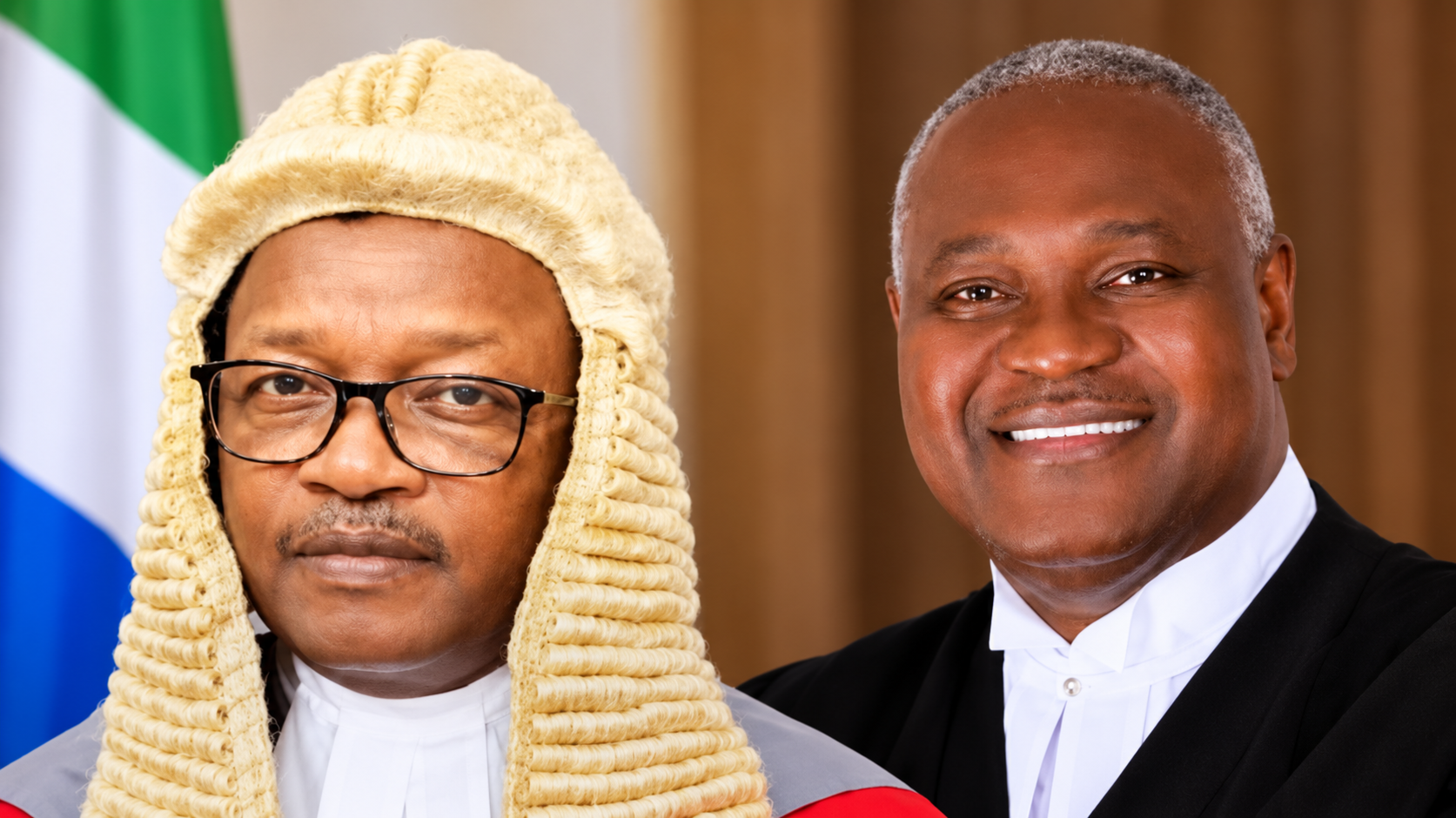
The Supreme Court of Sierra Leone has brought the contempt proceedings against prominent lawyer and former Attorney General and Minister of Justice, Joseph Fitzgerald Kamara Esq., popularly known as JFK, to an end after Chief Justice Komba Kamanda accepted his formal apology and retraction on Tuesday, 13 October 2026.
The decision followed a period of heightened public attention surrounding the detention of Joseph Fitzgerald Kamara Esq., who is representing Honourable Osman Timbo in the ongoing constitutional amendment proceedings. The incident had generated considerable discussion within legal circles and among members of the public, particularly over courtroom conduct, judicial authority and the professional relationship between lawyers and the Judiciary.
Chief Justice Komba Kamanda ordered the detention of Joseph Fitzgerald Kamara Esq. on Thursday, 8 October 2026, following a disagreement arising from remarks made during proceedings on Wednesday, 7 October 2026. The development temporarily shifted attention from the substantive constitutional questions before the Supreme Court to the conduct of counsel and the authority of the court to maintain order during judicial proceedings.
Appearing before the Supreme Court on Tuesday 13 October 2026, Joseph Fitzgerald Kamara Esq. acknowledged that the incident had distracted attention from the constitutional issues being considered. He expressed sincere regret, formally withdrew the remarks that had given rise to the contempt matter and assured the court that such conduct would not occur again.
Following the apology and retraction, Chief Justice Komba Kamanda discharged the contempt proceedings against Joseph Fitzgerald Kamara Esq., allowing the court to return its attention to the substantive constitutional case.
Before announcing his decision, Chief Justice Komba Kamanda addressed the significance of the constitutional proceedings, explaining that the issues before the Supreme Court were of national importance and required careful judicial consideration.
He emphasized that the interpretation of the Constitution was a responsibility entrusted to the Supreme Court and that the court would exercise its authority in the interest of justice, constitutional order and the people of Sierra Leone.
Chief Justice Komba Kamanda observed that constitutional matters were not limited to the interests of the parties directly involved in litigation but concerned the State and every citizen whose rights and responsibilities are governed by the Constitution.
He therefore urged members of the public to exercise restraint when commenting on matters pending before the court, particularly where such comments could affect public confidence in the administration of justice.
“Some of the statements have the tendency to undermine the administration of justice,” Chief Justice Komba Kamanda cautioned.
While recognizing the considerable public interest in the constitutional amendment proceedings, Chief Justice Komba Kamanda stressed that the importance of the case made it necessary for all parties to respect the judicial process and allow the Supreme Court to carry out its constitutional responsibilities without interference.
He reminded citizens that the Supreme Court remains the institution constitutionally empowered to provide authoritative interpretations of the Constitution and encouraged the public to exercise patience as the proceedings continued.
The Chief Justice also reaffirmed the court’s commitment to dealing with the constitutional matter expeditiously, assuring that its determination would be guided by the law and the interests of justice.
Meanwhile, counsel representing Joseph Fitzgerald Kamara Esq. in the contempt proceedings, S.K. Koroma Esq., supported his client’s apology and formally retracted the remarks that had led to the disagreement.
S.K. Koroma Esq. expressed regret over the incident and assured Chief Justice Komba Kamanda that the longstanding professional relationship between the Bar and the Bench would be maintained.
He emphasized the importance of mutual respect between legal practitioners and judicial officers, recognizing their shared responsibility to uphold the rule of law and ensure the proper administration of justice.
The dispute arose from the Supreme Court’s consideration of legal challenges relating to the Constitution of Sierra Leone (Amendment) Bill, 2025, which has generated disagreement over the procedure Parliament followed in approving the proposed constitutional changes.
At the centre of the substantive case is whether the proposed amendments were passed in accordance with the requirements of the 1991 Constitution, particularly the provisions governing parliamentary voting and constitutional amendments.
The proceedings involve questions concerning Sections 91 and 108 of the Constitution, including whether the amendments required a simple majority of Members of Parliament present and voting or the support of at least two-thirds of Parliament’s entire membership. The dispute followed Parliament’s approval of the proposed amendments in August 2026, which opposition Members of Parliament challenged on constitutional grounds.
During the hearing on Wednesday, 7 October 2026, Joseph Fitzgerald Kamara Esq., appearing for Honourable Osman Timbo, raised a preliminary objection concerning the participation of the Office of the Attorney-General and Minister of Justice in the proceedings.
Joseph Fitzgerald Kamara Esq. argued that the State had failed to file certain documents required for the hearing, including a Statement of Case and questioned whether the Attorney-General’s Office should be permitted to proceed without meeting the relevant procedural requirements.
He maintained that his legal team had prepared its submissions in accordance with the court’s requirements and expected the State to demonstrate similar preparedness.
The objection led to a disagreement between Joseph Fitzgerald Kamara Esq. and Chief Justice Komba Kamanda, who cautioned that the Supreme Court was not a political forum and emphasized the need for lawyers appearing before the court to maintain professional conduct and respect for judicial authority.
The exchange reportedly became tense, prompting a temporary break in proceedings. The Supreme Court subsequently overruled the preliminary objection and allowed the consolidation of the constitutional references before it.
When proceedings resumed on Thursday, 8 October 2026, attention turned to remarks made by Joseph Fitzgerald Kamara Esq. during the previous day’s hearing.
According to courtroom reports, Chief Justice Komba Kamanda required Joseph Fitzgerald Kamara Esq. to apologize and formally retract the remarks, which the court considered inappropriate and capable of undermining its integrity.
Joseph Fitzgerald Kamara Esq. reportedly offered an apology and indicated that he was withdrawing his earlier statement. However, Chief Justice Komba Kamanda considered the apology insufficient, expressing concern that it did not adequately demonstrate the remorse expected by the court.
The Chief Justice subsequently directed Joseph Fitzgerald Kamara Esq. to remove his lawyer’s wig and proceed to the dock, a development that attracted considerable attention from lawyers and other persons present in the courtroom.
Police officers were called upon to enforce the court’s directive, and Joseph Fitzgerald Kamara Esq. was subsequently taken into custody and transferred to the Male Correctional Centre on Pademba Road in Freetown.
The detention prompted interventions by senior members of the legal profession, who sought to resolve the disagreement and secure the lawyer’s release.
Reports indicated that senior legal practitioners and representatives of the Bar made representations concerning the matter, while the Attorney-General and Minister of Justice also sought an opportunity for discussions aimed at addressing the situation.
The proceedings were subsequently adjourned, with the constitutional matter scheduled to resume on Tuesday, 13 October 2026.
Following the resolution of the contempt matter on Tuesday, 13 October 2026, Joseph Fitzgerald Kamara Esq. briefly addressed journalists outside the courthouse, expressing gratitude to God.
The acceptance of his apology brought the separate contempt proceedings to a close, although the substantive constitutional questions remain before the Supreme Court for determination.