
President Dr Julius Maada Bio has undertaken a series of agricultural field visits and symbolic harvesting ceremonies across Moyamba District, highlighting the contributions of private farmers, women-led agribusinesses and the Republic of Sierra Leone Armed Forces (RSLAF) to the Government’s flagship Feed Salone initiative.
The visits, conducted on Saturday, 17 October 2026, formed part of efforts to showcase progress in domestic food production, encourage greater investment in agriculture and recognize the contributions of individuals and institutions working to strengthen Sierra Leone’s food security.
During the engagements, President Julius Maada Bio inspected major agricultural operations involving commercial hybrid maize cultivation, irrigation-supported rice seed multiplication and large-scale rice production by the military. The visits provided an opportunity for the President to interact with farmers, agricultural entrepreneurs and institutional stakeholders while participating in symbolic harvesting activities.
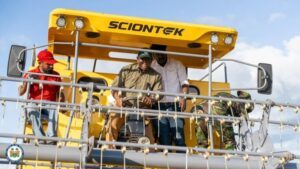
At Vaama Farm in Bai Largo, Moyamba District, President Julius Maada Bio visited Sherilyn’s Enterprise for National Change (SLENC) Limited, a women-led agricultural company that has significantly expanded its operations from an initial five-acre pilot project to 120 hectares of mechanized hybrid maize cultivation.
The enterprise currently supplies maize for poultry feed production, helping to strengthen the domestic livestock industry while reducing dependence on imported agricultural inputs. Its operations have also created employment opportunities for more than 200 young people, demonstrating the potential of commercial agriculture to generate jobs and stimulate economic activity in rural communities.
President Julius Maada Bio commended the leadership of SLENC Limited for its investment in mechanized farming and its contribution to agricultural value-chain development, particularly through the participation of women and young people.
The President subsequently visited SMART Farms in Moyamba District, where an irrigation-supported rice seed multiplication initiative is advancing the production of improved rice varieties developed by the Sierra Leone Agricultural Research Institute (SLARI).
The initiative seeks to improve farmers’ access to quality planting materials while demonstrating the importance of agricultural research, irrigation technology and modern farming practices in increasing productivity.
Through the integration of research-based seed varieties and irrigation infrastructure, SMART Farms are contributing to efforts to strengthen rice production and improve the reliability of agricultural activities beyond traditional rain-fed cultivation.
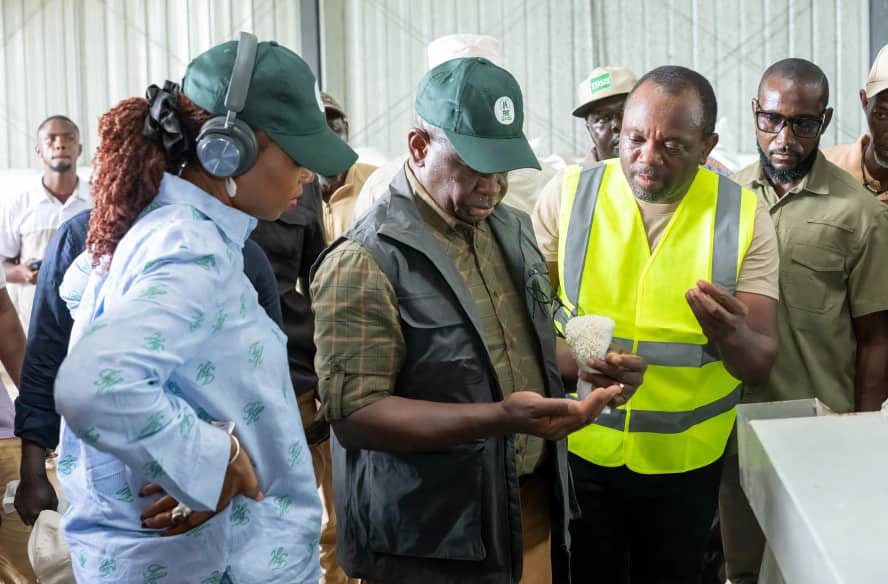
A major highlight of the presidential tour was the symbolic harvesting ceremony at Yoni in Kamajei Chiefdom, where the Republic of Sierra Leone Armed Forces has undertaken extensive rice cultivation as part of its contribution to the Feed Salone initiative.
The military has cultivated rice across approximately 4,227 hectares, with production expected to yield about 59,900 bags of clean rice.
Under an off-taker agreement between the Republic of Sierra Leone Armed Forces and the Ministry of Finance, the harvested rice is expected to meet the Armed Forces’ food requirements for six months.
The arrangement demonstrates how institutional agricultural investment can support food self-sufficiency, reduce pressure on public expenditure and contribute to broader national food security objectives.
The military’s agricultural programme extends beyond Yoni, covering rice and cashew production at six locations across the country. These include Makally, Mankana and Rumbeh in Port Loko District; Masang in Tonkolili District; and Yoni and Tormabum in Moyamba District.
The initiative represents an expansion of the Armed Forces’ contribution to national development, complementing its constitutional responsibility for safeguarding Sierra Leone’s territorial integrity and national security.
Addressing stakeholders during the engagements, President Julius Maada Bio expressed appreciation to farmers, agricultural entrepreneurs, research institutions and the military for responding positively to his Government’s call to increase domestic food production.
He explained that the visits were intended not only to recognize existing achievements but also to encourage greater participation in agriculture, particularly among young people and private-sector investors.
President Julius Maada Bio emphasized that transforming Sierra Leone’s agricultural sector requires sustained investment in mechanization, irrigation, improved seeds, commercial farming and stronger partnerships between public institutions and private enterprises.
He further reaffirmed his Government’s commitment to supporting agricultural investments capable of expanding production, creating employment and strengthening connections between commercial farmers and smallholder out-growers.
The President particularly praised the Republic of Sierra Leone Armed Forces for demonstrating that military institutions can make meaningful contributions to economic development and national food security while maintaining their primary defence responsibilities.
“We are here to celebrate our farmers, especially the Military, for protecting and feeding our nation at the same time,” President Julius Maada Bio stated.
He also commended SLENC Limited and SMART Farms for demonstrating the importance of private-sector innovation, women’s participation and agricultural research in advancing the country’s food production objectives.
The Feed Salone initiative remains a central component of the Government’s development agenda, with emphasis on increasing domestic agricultural output, reducing reliance on imported food, strengthening value chains and creating sustainable economic opportunities.
The presidential visits highlighted the complementary roles of commercial agricultural enterprises, research institutions and public-sector organisations in achieving those objectives.
They also underscored the importance of coordinated investment in modern farming technologies, irrigation systems, improved planting materials and market development to address longstanding challenges affecting agricultural productivity.
The engagements, held shortly after World Food Day on 16 October, reinforced the Government’s message that sustainable food security requires collective action, increased domestic investment and the active participation of farmers, entrepreneurs, young people and national institutions.
Through the expansion of agricultural production and the promotion of strategic partnerships, the Government hopes to position Sierra Leone towards greater food self-sufficiency while creating employment opportunities and strengthening the resilience of the national economy.