

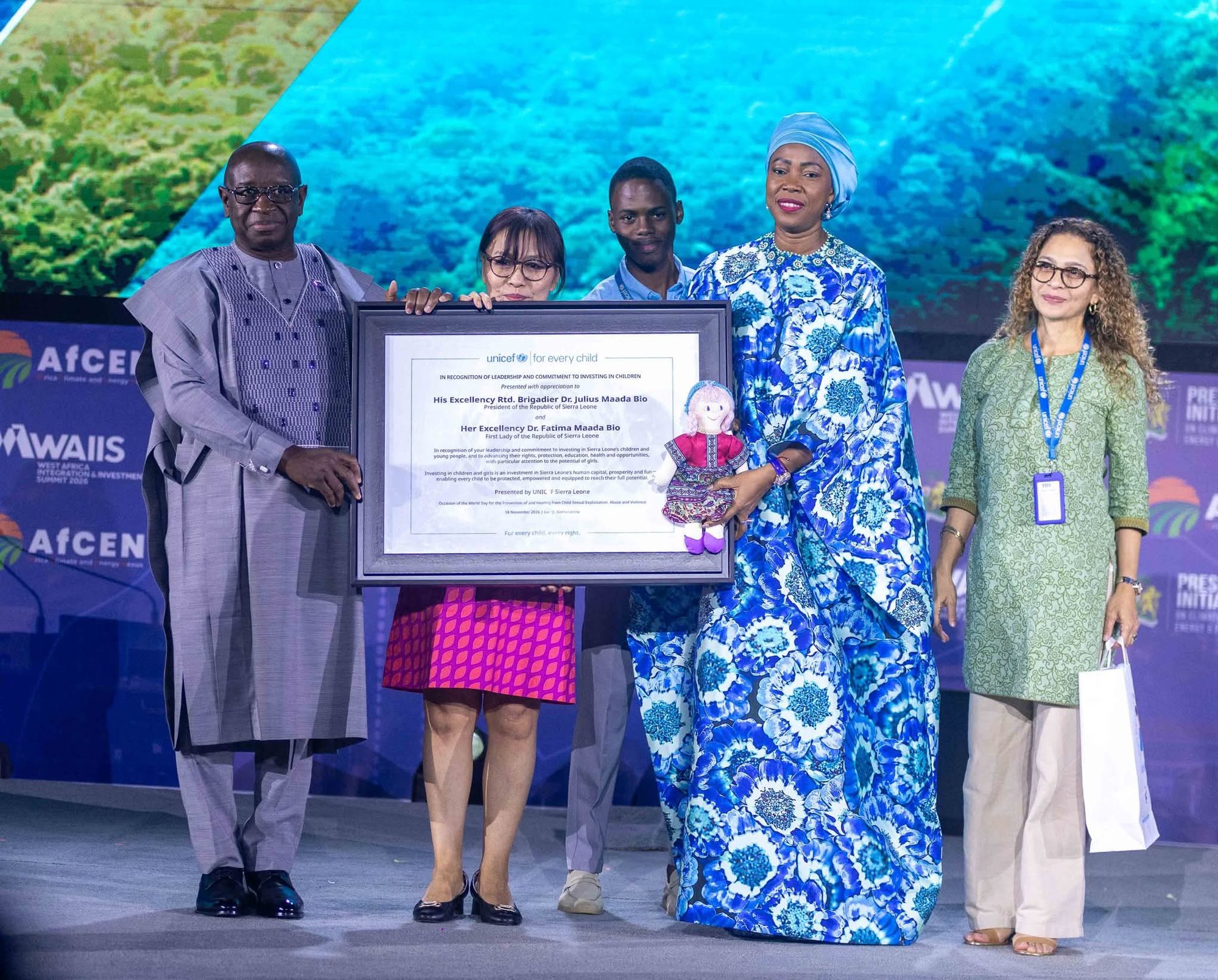
UNICEF Sierra Leone has honoured President Julius Maada Bio and First Lady Dr Fatima Maada Bio with a commemorative plaque in recognition of their leadership and commitment to advancing the rights, welfare and protection of children in Sierra Leone.
The presentation was made during the concluded West Africa Integration and Investment Summit (WAIIS) 2026, where the country commemorated the Day for the Prevention and Healing from Child Sexual Exploitation, Abuse and Violence, drawing attention to the urgent need for stronger protection systems and survivor-centred interventions.
UNICEF Sierra Leone Country Representative, Mariko Kagoshima, presented the plaque to the First Couple on behalf of the United Nations Children’s Fund, describing their advocacy and leadership as important contributions to the national effort to end violence against children.
Speaking during the presentation, Mariko Kagoshima said the recognition reflected the importance of political leadership in addressing child sexual exploitation, abuse and violence, stressing that protecting children requires sustained commitment from Government, institutions, families and communities.
“On behalf of UNICEF, I would like to recognize your leadership and your personal commitment to the children of Sierra Leone,” Mariko Kagoshima said.
She further noted that when the highest leadership of a country speaks decisively against violence against children, it sends a powerful message throughout society.
“When the highest leadership of the country speaks clearly about violence against children, it sends a powerful message. Violence is never acceptable. Survivors must never be blamed or silenced and the protection of children is a responsibility we all share,” the UNICEF representative stated.
In her address, First Lady Dr Fatima Maada Bio reaffirmed her longstanding commitment to protecting women and girls, describing the campaign against sexual violence, child marriage, teenage pregnancy and exploitation as both a personal conviction and a national responsibility.
She explained that her own life experiences had shaped her understanding of how harmful practices, unequal power relations and interrupted childhoods could negatively influence the future of young girls.
According to her, the determination to challenge those practices inspired the launch of the Hands Off Our Girls campaign in December 2018, which was established to confront sexual violence, teenage pregnancy, exploitation and other forms of abuse affecting girls across Sierra Leone.
“I could no longer accept a society in which sexual violence, teenage pregnancy, exploitation and the abuse of girls are treated as problems we could simply learn to live with. I wanted to challenge the silence. I wanted to challenge the excuses,” she stated.
She maintained that girls must never be regarded as commodities or have their futures determined by exploitation, insisting that every child deserves dignity, protection, education and the opportunity to determine his or her own destiny.
Reflecting on the campaign’s progress, the First Lady said she had engaged with survivors, families seeking justice and girls whose education had been interrupted by abuse and harmful practices. She noted that poverty, social stigma and institutional weaknesses continue to expose children to exploitation while preventing many survivors from accessing justice and essential support.
However, she acknowledged the progress achieved through collective advocacy involving Government institutions, traditional and religious leaders, Civil Society Organisations, young people and communities.
Among the significant legislative developments she highlighted was the enactment of the Prohibition of Child Marriage Act, 2024, which establishes 18 years as the minimum age for marriage and provides legal protection against child marriage and related practices.
The First Lady stressed that the passage of legislation must be accompanied by effective enforcement, adequate institutional resources and accessible support services for survivors, warning that laws alone would not eliminate violence against children without practical implementation.
She further linked child protection to national development, arguing that a country’s investment in human capital would remain incomplete if children continue to experience abuse, trauma and discrimination that undermine their education, health and future opportunities.
Addressing investors and business leaders attending the summit, she called for a broader understanding of responsible investment, urging the private sector to make child safeguarding an essential component of corporate governance and business operations.
“Responsible investment must be measured not only by financial returns it generates but also by the human dignity it protects,” she emphasized, calling on companies to strengthen safeguards across supply chains, workplaces and digital platforms.
She also encouraged investors to support safe schools, community-based protection initiatives and survivor-centred services, noting that children who receive appropriate protection and support are better positioned to complete their education, acquire skills and contribute meaningfully to national development.
On the issue of healing, the First Lady underscored that preventing abuse must go hand in hand with supporting children who have already experienced violence. She called for accessible healthcare, trauma-informed psychosocial counselling, legal assistance, safe reporting mechanisms and educational opportunities for survivors.
She particularly cautioned against blaming, humiliating or silencing survivors, insisting that children who report abuse must be believed, protected and given the necessary assistance to rebuild their lives.
The First Lady also called on political leaders to strengthen child protection legislation and adequately fund relevant institutions, while urging traditional and religious leaders to use their influence to challenge harmful cultural practices and the stigma surrounding sexual abuse.
She also urged development partners to sustain investments in prevention programmes, survivor support and institutional capacity, while calling on communities to create safe environments where children could freely report abuse without fear of intimidation or discrimination.
Beyond Sierra Leone, Dr Fatima Maada Bio advocated stronger regional cooperation among West African countries, warning that human trafficking, cross-border exploitation and online abuse require coordinated responses that transcended national boundaries.
She argued that regional integration should not be measured exclusively by the movement of goods, services and capital but also by the ability of countries to protect their citizens, particularly children and other vulnerable groups.
Her position aligns with UNICEF Sierra Leone’s broader child protection priorities. According to the Agency’s 2023 annual report, the Police Family Support Unit registered 3,547 cases involving children, including 1,508 cases of sexual violence. The report also indicated that more than 5,552 children received case management, psychosocial support, alternative care and gender-based violence services, while the 116 Helpline handled more than 20,000 calls.
These figures underscore the scale of the child protection challenge and the importance of strengthening prevention, reporting, investigation, prosecution and rehabilitation mechanisms. UNICEF has consistently identified violence, abuse, exploitation, harmful social norms and limited access to essential services as major barriers to children’s well-being and development in Sierra Leone.
Concluding her address, the First Lady called for the commemoration to produce measurable commitments rather than remain an occasion for speeches and ceremonial activities. She challenged Governments, businesses, regional institutions and communities to demonstrate what concrete actions and resources they were prepared to commit towards ending violence against children.
“A child is not an interruption to our development agenda. A child is the very reason that agenda exists,” she declared, adding that children are not merely future leaders but human beings with rights who deserve protection, justice and opportunities in the present.
She also commended President Julius Maada Bio for what she described as his strong leadership and advocacy for the protection of women and children, expressing appreciation for his commitment to advancing their rights in Sierra Leone and beyond.
The UNICEF recognition therefore comes amid continuing national and international efforts to strengthen child protection frameworks, promote accountability and ensure that survivors of sexual exploitation and violence receive the support necessary to recover and rebuild their lives.
The presentation of the commemorative plaque reinforces the importance of sustained political leadership and collaboration between Government, development partners, civil society and the private sector in building a society where every child can grow up safely, access education and realize their full potential.