

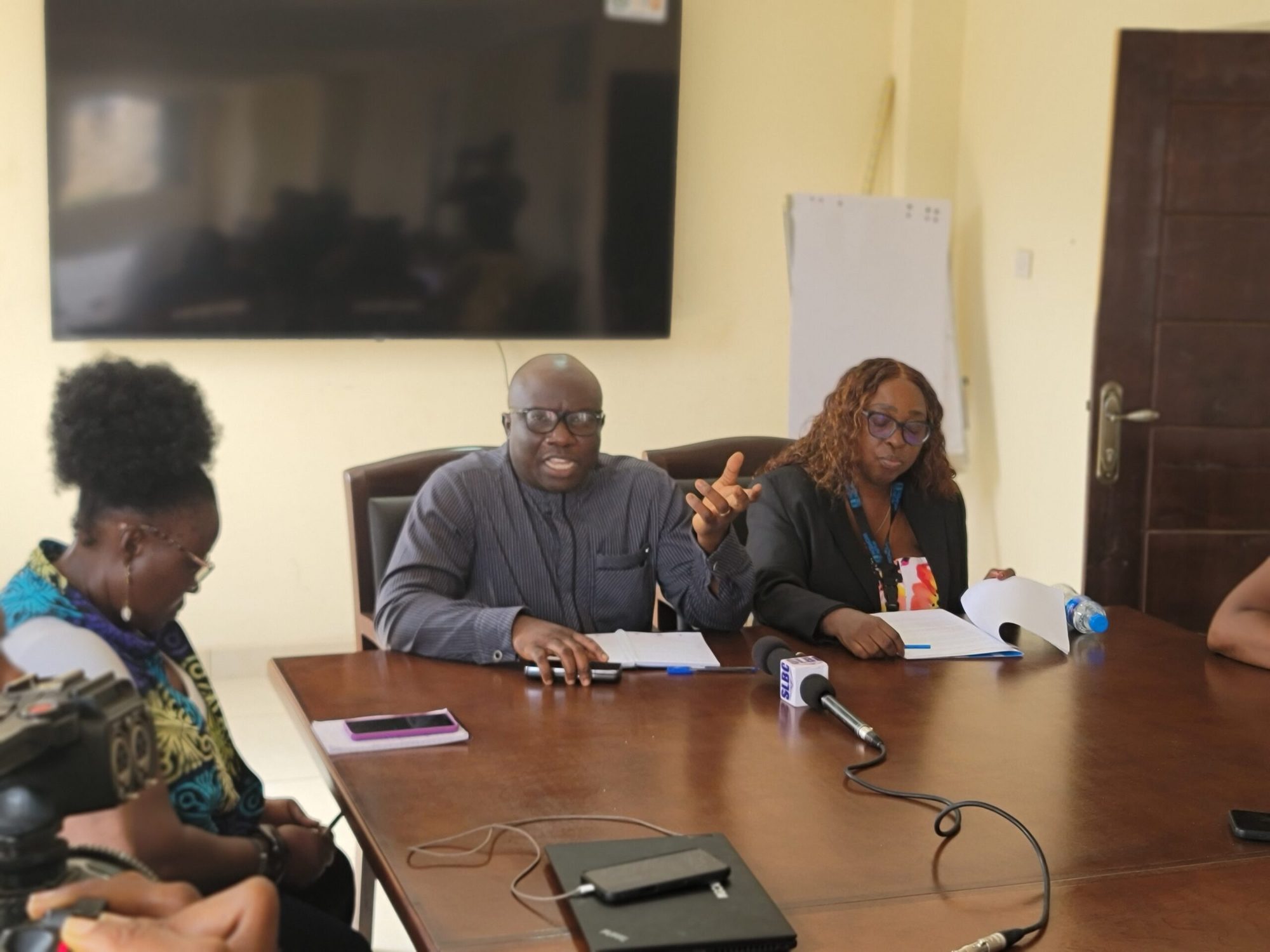
Sierra Leone will today, Wednesday, November 25, launch the 16 Days of Activism Against Gender-Based Violence campaign, with the Ministry of Gender and Children’s Affairs and UN Women calling for collective efforts to end violence against women and girls.
The campaign, which will be officially launched today Wednesday 25th November, 2026 at the Miatta Civic Centre in Freetown, will focus on ensuring justice for survivors, protecting women and girls from abuse and ending impunity. It will run until December 10, when the country joins the rest of the world to commemorate World Human Rights Day.
Speaking at a press conference organized by the Ministry and UN Women on Tuesday, November 24, 2026, Charles B. Vandi, Chief Director of Protection at the Ministry of Gender and Children’s Affairs, said the campaign requires the collective responsibility of Government, development partners, communities and individuals.
He said this year’s theme emphasizes the need to unite in order to end violence against women and girls, ensure justice, protect survivors and end impunity.
Charles B. Vandi highlighted several legislative measures introduced by the Government to strengthen the protection of women and girls, including the Domestic Violence Act of 2007, the Devolution of Estates Act of 2007 and the Registration of Customary Marriage and Divorce Act of 2009.
He also referenced the Sexual Offences Act of 2012, which was amended in 2019, as part of the Government’s efforts to strengthen the legal framework for addressing Sexual and Gender-Based Violence.
The Chief Director of Protection identified the establishment of the 116 hotline for reporting gender-based violence, one-stop centres providing free medical examinations, treatment and psychosocial support and five sexual offences model courts as some of the mechanisms put in place to improve access to services and justice for survivors.
Charles B. Vandi also disclosed that a delegation from Namibia had recently visited Sierra Leone to learn about its Gender-Based Violence Information Management System (GBVIMS), which he said was first introduced in the country.
On the role of the media, he urged journalists to report cases of sexual and gender-based violence professionally, particularly amid the growing influence of social media bloggers who may lack the necessary training emphasizing that the dignity and privacy of survivors must be protected when reporting such cases.
Providing a global perspective, Baindu Massaquoi, Officer-In-Charge of UN Women, said violence against women and girls remain a serious concern worldwide.
Citing the 2026 femicide report released by UN Women and the United Nations Office on Drugs and Crime (UNODC), she said approximately 47,000 women and girls were killed intentionally by intimate partners or family members in 2025.
She further noted that about 60 per cent of the estimated 78,000 femicides recorded globally during the year were committed by intimate partners or family members, representing approximately five women and girls killed every hour.
Baindu Massaquoi described the home, which should ordinarily be a place of safety, as the most dangerous environment for many women and girls because of violence perpetrated by intimate partners and family members.
She commended the Ministry of Gender, women’s rights organisations, civil society groups, traditional and religious leaders and the media for their contributions towards addressing gender-based violence in Sierra Leone.
However, she cautioned that the existence of laws and policies do not automatically guarantee the protection of women and girls, noting that such measures are only meaningful when they translate into safety and justice in their daily lives.
She further raised concerns about online violence, calling for women and girls to participate freely and safely in digital spaces without harassment, abuse or intimidation.
Meanwhile, she disclosed that the National Women’s Movement Strategy on Ending Violence Against Women, developed with support from UN Women, would be launched on Wednesday by First Lady Dr Fatima Maada Bio.
The strategy is one of the key milestones under the four-year EU-UN Spotlight Initiative to End Violence Against Women and Girls, which involves four UN agencies working across different areas.
Under the initiative, UNDP is responsible for policy and data, UNICEF focuses on prevention, UNFPA handles response, while UN Women leads efforts on women’s movement-building.
Baindu Massaquoi urged journalists to use the 16 Days of Activism to go beyond routine reporting by challenging harmful social norms, exposing injustice and amplifying the voices of women and girls.