

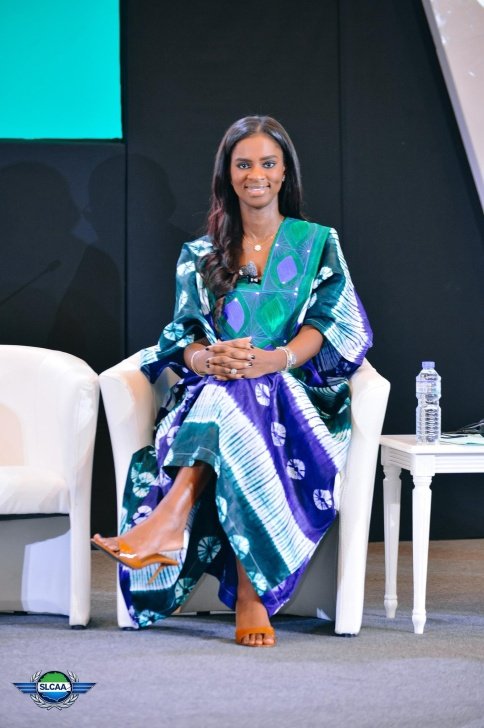
The Director General of the Sierra Leone Civil Aviation Authority (SLCAA), Madam Musayeroh Barrie, has called for greater grassroots action and personal responsibility to accelerate women’s leadership and participation in Africa’s aviation sector, stressing that sustainable transformation cannot rely solely on government policies and interventions.
Madam Musayeroh Barrie made the remarks during the Women, Youth and Skills Development session at the African Air Transport Convention and Expo 2026, held from 15 to 19 June 2026 in Lomé, Togo.
The continental event, organised by the African Civil Aviation Commission (AFCAC) in collaboration with the African Union Commission (AUC) and other partners, brought together ministers responsible for transport and aviation, civil aviation regulators, airline executives, airport operators, investors, development partners and industry experts to discuss strategies for advancing the Single African Air Transport Market (SAATM) and strengthening the continent’s aviation industry through improved connectivity, sustainability, innovation and human capital development.
Addressing participants during the high-level session, Madam Musayeroh Barrie challenged women and other stakeholders to move beyond dependence on government directives and embrace personal initiative in driving meaningful change.
She acknowledged that governments have significant responsibilities in creating policies, providing leadership and establishing enabling environments for development. However, she argued that waiting for instructions from presidents, ministers or other public officials before taking action often delays progress.
“Action begins with us,” she told delegates. “While governments have responsibilities, real transformation comes when individuals take bold action without waiting for directives.”
She encouraged participants to adopt a proactive mindset by taking responsibility within their homes, workplaces and communities, noting that sustainable development begins with individual commitment and collective action.
According to the SLCAA Director General, meaningful implementation of development programmes should not be confined to national institutions alone but must also be reflected in communities where lasting social and economic change takes place. She maintained that empowering women at the grassroots level remains critical to building a stronger, more inclusive and competitive aviation industry capable of supporting Africa’s broader economic transformation.
Madam Musayeroh Barrie further stated that women possess the leadership potential, innovation and resilience needed to contribute significantly to the growth of Africa’s aviation sector. She urged governments, private sector institutions and development partners to continue creating opportunities that enable women and young people to acquire the necessary skills and leadership experience to thrive in the industry.
While acknowledging the progress already being made in promoting gender inclusion across the continent, she cautioned that Africa must accelerate the pace of implementation if it is to achieve its ambitions under the Single African Air Transport Market and other continental development frameworks.
She called on women, youth organisations, professional bodies and community leaders to work collectively in promoting leadership, skills development and mentorship initiatives that will prepare more women to occupy strategic positions within the aviation sector.
Madam Musayeroh Barrie’s address was widely regarded as a strong call for a shift in mindset from dependence to self-driven leadership. Her message reinforced the importance of community participation, women-led initiatives and local ownership in advancing aviation development and ensuring that Africa’s aviation industry becomes more inclusive, innovative and sustainable. She emphasised that while supportive government policies remain essential, lasting transformation will ultimately be driven by individuals who are willing to act, inspire others and create opportunities within their own communities.