

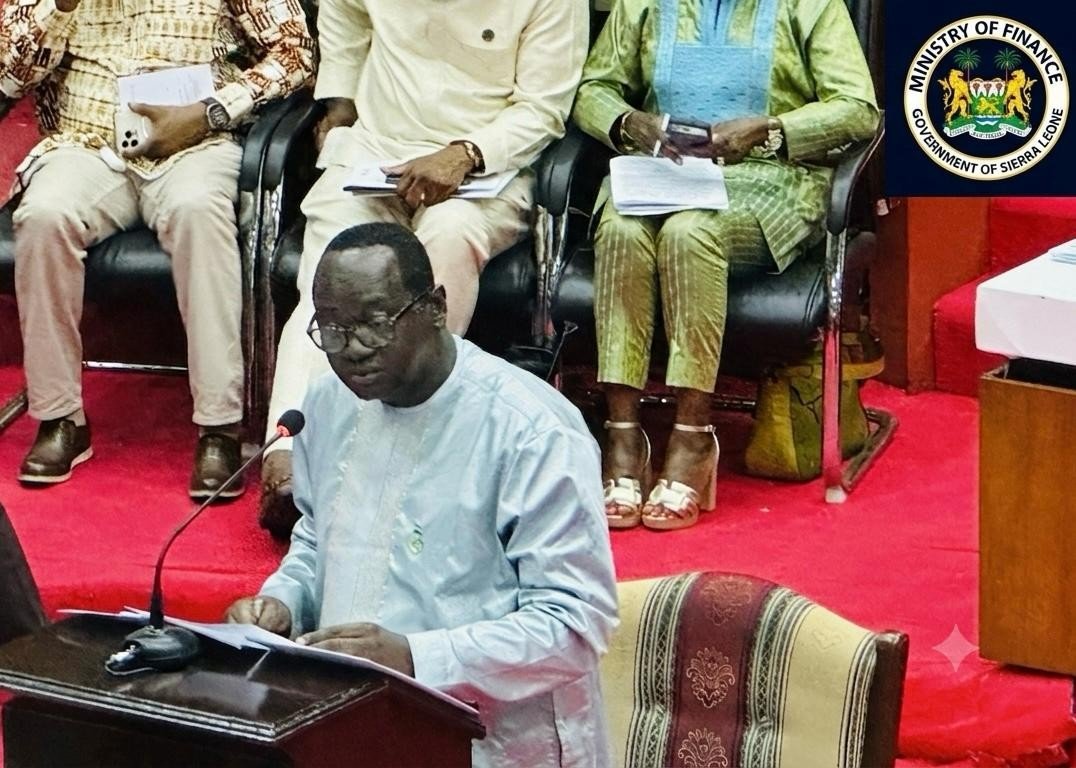
Minister of Finance, Sheku Ahmed Fantamadi Bangura, has declared that Sierra Leone urgently needs a new seaport, stating that the country’s existing port infrastructure is no longer capable of supporting the demands of the growing economy.
Responding to concerns raised by Members of Parliament following the presentation of the 2026 Supplementary Budget and Statement of Economic and Financial Policies, the Finance Minister acknowledged that congestion at the country’s main port has become a significant challenge to trade, revenue generation and economic expansion.
“The Port is too small for Sierra Leone’s economy. The country needs a new port. We need even more than one port. The Port is congested and we need a new port,” Sheku Ahmed Fantamadi Bangura told lawmakers, stressing that expanding the nation’s port infrastructure has become an economic necessity rather than a future aspiration.
His remarks came after he presented the Supplementary Budget to Parliament, outlining Government’s response to emerging fiscal challenges brought about by global economic shocks, particularly the impact of the Middle East crisis on international oil prices. The revised budget seeks to strengthen macroeconomic stability, protect livelihoods and improve domestic revenue mobilization while maintaining critical public services.
The Minister’s comments placed renewed attention on the strategic importance of Sierra Leone’s maritime infrastructure, particularly as Government intensifies efforts to increase customs revenue, improve trade facilitation and attract private investment.
The Supplementary Budget outlines several reforms aimed at strengthening customs administration and improving efficiency at the country’s ports. Those include the implementation of a Customs Revenue Enhancement Plan, expansion of risk-based inspections, increased post-clearance audits and measures to improve compliance in import and export operations.
Government also plans to fully operationalize the National Electronic Single Window and an end-to-end customs processing platform before the end of September 2026. The reforms are expected to speed up cargo clearance, improve coordination among border agencies, enhance transparency and reduce delays experienced by importers and exporters.
In addition, the National Revenue Authority will integrate the Integrated Tax Administration System with Electronic Cash Registers, commercial banks and SICPA’s Product Tracking System, while linking the ASYCUDA customs platform with the Fuel Marking System. Those reforms are designed to improve monitoring of imports, reduce revenue leakages and strengthen accountability at the country’s ports.
The Minister noted that Government is also strengthening oversight of petroleum imports by introducing a real-time integrity system to monitor revenue generated from the downstream petroleum sector and reconcile fuel imports with payments made by Oil Marketing Companies.
Although the Supplementary Budget focuses primarily on maintaining fiscal stability amid global economic uncertainty, Sheku Ahmed Fantamadi Bangura’s call for a new port signals Government’s recognition that expanding maritime infrastructure will be essential to supporting future economic growth, increasing trade volumes and positioning Sierra Leone as a more competitive regional trading hub.
His statement is expected to reignite discussions on long-term investments in port infrastructure, with many stakeholders viewing expanded port capacity as critical to reducing congestion, facilitating commerce and unlocking the country’s economic potential.