

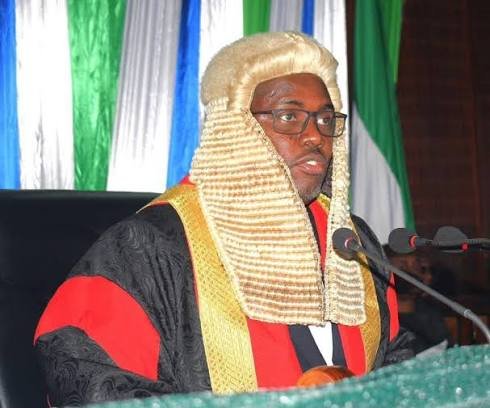
Parliament is expected to resume debate on the Constitution of Sierra Leone (Amendment) Bill, 2025, as lawmakers continue deliberations on one of the country’s most far-reaching constitutional reform packages since the adoption of the 1991 Constitution. The proposed legislation, which has already passed its Second Reading after an intensive parliamentary session stretching from Tuesday, July 28, into the early hours of Wednesday, July 29, is now poised to undergo detailed clause-by-clause scrutiny during the Committee Stage before its Third Reading and eventual vote for passage into law.
The Bill has ignited nationwide debate, with Government presenting the reforms as essential to strengthening democracy, modernizing governance and improving political inclusion, while the Opposition has raised concerns over several key electoral provisions, arguing that some proposals depart from previous national consensus and could alter Sierra Leone’s democratic landscape.
Presenting the Bill, Attorney-General and Minister of Justice, Alpha Sesay, described the constitutional review as a historic opportunity to transform Sierra Leone’s governance framework from what he called “a constitution of survival to a constitution of prosperity.”
According to him, the 1991 Constitution successfully guided Sierra Leone through years of political instability and civil conflict but now requires modernization to reflect the country’s democratic progress and evolving national aspirations.
Tracing the history of constitutional reform, Alpha Sesay reminded Parliament that calls for constitutional review date back to the 1999 Lomé Peace Agreement and were later reinforced by recommendations contained in the Truth and Reconciliation Commission Report. He noted that successive administrations under Presidents Ahmad Tejan Kabbah, Ernest Bai Koroma and Julius Maada Bio all pursued constitutional reform initiatives.
The Attorney-General explained that the current Bill is principally informed by two major national reform processes: the Justice Edmond Cowan Constitutional Review Committee Report of 2013, which followed one of the country’s largest public consultation exercises involving more than 10,000 citizens, over 130 stakeholder engagements and approximately 70,000 consultation forms and the Tripartite Committee Report, which produced 18 consensus recommendations jointly developed by representatives of Government, the All People’s Congress (APC) and other national stakeholders following post-election political dialogue.
He further disclosed that Government also reviewed additional submissions received from citizens and institutions after the Bill was gazetted through a technical committee comprising representatives of both Government and the APC.
Among the most significant reforms contained in the Bill is the proposal to reduce the presidential election threshold from the current 55 percent requirement to a simple majority of 50 percent plus one valid vote, while requiring a successful presidential candidate to secure at least 20 percent of valid votes in two-thirds of Sierra Leone’s districts.
The legislation also proposes the constitutional introduction of district-block proportional representation for parliamentary elections, recognition of independent presidential candidates, fixed election dates, mandatory 30 percent women’s representation in Parliament and local councils, reforms affecting political parties and governance institutions, and amendments intended to strengthen democratic accountability and institutional integrity.
Alpha Sesay argued that proportional representation would significantly expand opportunities for women, young people, minority groups and other traditionally underrepresented citizens to participate meaningfully in governance. He reaffirmed Government’s commitment to implementing recommendations contained in the Women’s Manifesto and praised Deputy Minister of Justice, Madam Saptieu Elizabeth Saccoh, for her advocacy on women’s constitutional rights.
Rejecting suggestions that the reforms are politically motivated, the Attorney-General maintained that introducing constitutional amendments well before the next general elections aligns with international democratic standards promoted by the African Union, ECOWAS and the United Nations, giving political parties and voters sufficient time to prepare for any constitutional changes.
Describing the Bill as “not partisan, but generational,” he urged Members of Parliament to rise above political differences and support reforms that would strengthen Sierra Leone’s democratic institutions for future generations.
During the marathon parliamentary debate, lawmakers from both sides of the House expressed sharply differing views on several provisions of the Bill.
Chairman of Parliament’s Legislative Committee, Hon. Abdul Sulaiman Marray-Conteh, welcomed provisions aimed at increasing women’s representation but opposed allowing independent presidential candidates and recommended extending the proposed six-month resignation requirement for certain public officials seeking elective office to one year.
Deputy Leader of the Opposition, Hon. Daniel Brima Koroma, described several proposals as politically motivated. He opposed proportional representation, arguing that it had previously been introduced only during periods of national crisis, rejected reducing the period for filing presidential election petitions from seven days to three days and insisted that the presidential election threshold should remain at 55 percent.
Representing Kailahun District, Hon. Hindolo Moiwo Gevao strongly supported proportional representation, describing it as inclusive, cost-effective and consistent with recommendations contained in both the Justice Edmond Cowan Constitutional Review Committee Report and the Tripartite Agreement. He also called for retaining Section 32(3) of the Constitution while seeking greater clarity on constitutional provisions relating to consultation.
Hon. Mohamed Bangura of Karene District described proportional representation as “the idea of the people” and proposed introducing a five percent electoral threshold for political parties seeking parliamentary representation while endorsing the proposed 50 percent plus one presidential threshold.
Other lawmakers questioned whether proportional representation should become a permanent feature of Sierra Leone’s electoral system. Hon. Aminata Sesay of Port Loko District argued that increased women’s representation resulted primarily from the Gender Equality and Women’s Empowerment Act rather than proportional representation, while Hon. Mariama Bangura defended the constituency-based First-Past-the-Post (FPTP) system as providing stronger accountability between Members of Parliament and their constituents.
However, President of the Parliamentary Female Caucus, Hon. Bernadette Wuyatta Songa, strongly defended proportional representation, noting that women’s representation in Parliament increased from approximately 12 percent under the constituency system to 30 percent under proportional representation. She argued that the system creates opportunities for professional women, entrepreneurs and community leaders who may lack the financial resources required for constituency campaigns.
Government lawmakers consistently defended the proposed reforms.
Deputy Leader of Government Business, Hon. Bashiru Silikie, described the proposed 50 percent plus one presidential threshold as an internationally recognized democratic standard and urged Parliament to complete constitutional reforms initiated by previous Governments.
Deputy Leader of Government Business, Hon. Emerson Saa Lamina, informed Parliament that many of the proposals align with democratic practices adopted across Africa and ECOWAS member states. Drawing on consultations held in Kono District, he said the Bill reflects public demand for constitutional modernization while advocating greater constitutional recognition of Sierra Leoneans living in the diaspora.
Majority Leader and Leader of Government Business, Hon. Mathew Sahr Nyuma, reminded Parliament that the Legislature derives its authority from the Constitution itself and therefore bears responsibility for reviewing and amending laws in the national interest. He defended proportional representation as already recognized under the Public Elections Act, 2022, arguing that it reduces election costs, minimizes political tension and promotes more inclusive representation, particularly for women.
On the Opposition benches, Leader of the Opposition, Hon. Abdul Kargbo, reaffirmed the APC’s commitment to constitutional reform while insisting that every amendment must genuinely reflect national consensus. He reminded Parliament that constitutional amendments require the support of at least two-thirds of all Members under Section 108 of the Constitution.
Hon. Abdul Kargbo questioned the proposed presidential election formula, arguing that earlier consultations had focused on different district requirements. He strongly defended the First-Past-the-Post electoral system, maintaining that constituency elections provide greater accountability because elected representatives remain directly answerable to their constituents. He also rejected suggestions that the APC opposes women’s participation in politics, noting that the party has already adopted a 30 percent women’s quota within its constitution and supported the Gender Equality and Women’s Empowerment Act.
Meanwhile, the Human Rights Commission of Sierra Leone (HRC-SL) has submitted a comprehensive Position Paper to Parliament welcoming several progressive provisions in the Bill while recommending additional safeguards to strengthen democratic governance and human rights protection.
Among its recommendations, the Commission proposed removing the requirement that independent presidential candidates demonstrate “sufficient financial capacity,” arguing that such a condition could unfairly exclude qualified candidates. It also recommended reducing the proposed district threshold for presidential elections from 20 percent to 15 percent, extending the period for filing presidential election petitions from three days to fourteen calendar days, requiring presidential inauguration within 90 days of election results and removing political party membership as a constitutional ground for the removal of a President or Vice President.
The Commission acknowledged that the Bill contains numerous progressive reforms capable of improving democratic governance but urged Parliament’s Legislative Committee to carefully examine provisions requiring further refinement before final passage.
With the Bill now advancing to the Committee Stage, Members of Parliament are expected to undertake detailed clause-by-clause examination of every proposed amendment before the legislation returns for its Third Reading.
The resumed debate is expected to focus heavily on electoral reforms, women’s political participation, governance structures, constitutional safeguards, political representation and democratic accountability. Given the significance of the proposed reforms, the eventual outcome is widely expected to shape Sierra Leone’s constitutional, political and democratic landscape for generations to come.