
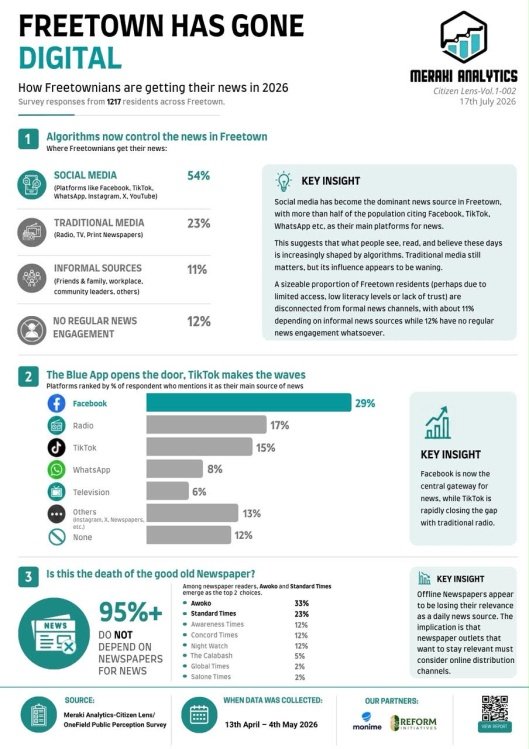
A new public perception survey conducted by Meraki Analytics has revealed a major transformation in the way residents of Freetown access news, with social media firmly establishing itself as the city’s primary source of information. The findings indicate that digital platforms have overtaken traditional media, reshaping the country’s media landscape and raising important questions about the future of journalism in Sierra Leone.
The report, titled: “Freetown Has Gone Digital: How Freetownians Are Getting Their News in 2026,” forms part of the Citizen Lens Vol. 1-002 series and is based on responses from 1,217 residents across Freetown. Data for the survey was collected between 13 April and 4 May 2026 through the OneField Public Perception Survey, in partnership with Monime and Reform Initiatives.
According to the survey, 54 percent of respondents identified social media platforms, including Facebook, TikTok, WhatsApp, Instagram, X and YouTube, as their main source of news. Traditional media, comprising radio, television and newspapers, accounted for 23 percent, while 11 percent relied on informal sources such as friends, family members, colleagues and community leaders. Another 12 percent reported having no regular engagement with news.
Meraki Analytics noted that the findings demonstrate how algorithms on digital platforms are increasingly influencing what people see, read and believe. While traditional media continues to play an important role in informing the public, its influence appears to be gradually declining as more citizens consume news through social media.
The report also observed that a significant number of residents remain disconnected from formal news channels. Researchers suggested that factors such as limited internet access, literacy challenges and declining public trust in conventional media may explain why some people continue to rely on informal sources or avoid news altogether.
Among individual platforms, Facebook emerged as the leading source of news, with 29 percent of respondents naming it as their preferred platform. Radio followed with 17 percent, while TikTok ranked third with 15 percent, highlighting its growing influence as a news platform. WhatsApp accounted for 8 percent, television received 6 percent, while 13 percent mentioned other sources, including Instagram, X and newspapers. Another 12 percent said they did not regularly consume news.
Researchers described Facebook as the country’s principal digital gateway for news dissemination, while noting that TikTok is rapidly narrowing the gap with traditional radio, particularly among younger audiences who increasingly consume short-form video content.
The survey also paints a concerning picture for Sierra Leone’s newspaper industry. It found that more than 95 percent of respondents do not depend on printed newspapers for their daily news, underscoring the rapid decline of print readership.
Among the small percentage who still read newspapers, Awoko ranked first with 33 percent, followed by Standard Times at 23 percent. Awareness Times, Concord Times and Night Watch each recorded 12 percent, while The Calabash accounted for 5 percent. Global Times and Salone Times each attracted 2 percent of newspaper readers.
Meraki Analytics concluded that the findings highlight the urgent need for newspaper publishers to strengthen their digital presence if they hope to remain competitive in an increasingly online media environment. The report suggests that digital distribution is no longer optional but essential for sustaining audience reach.
Reflecting on the broader implications of the findings, the report notes that the question is no longer whether Sierra Leoneans are getting their news online, but how that transition is shaping public trust, influencing opinions and redefining civic engagement.
Meraki Analytics announced that additional editions of the OneField Citizen Lens series will further examine the implications of those changing media consumption habits for journalists, policymakers, businesses, media institutions and the wider public. The organisation encouraged citizens to engage with the findings and participate in ongoing discussions about the future of journalism and information sharing in Sierra Leone.