

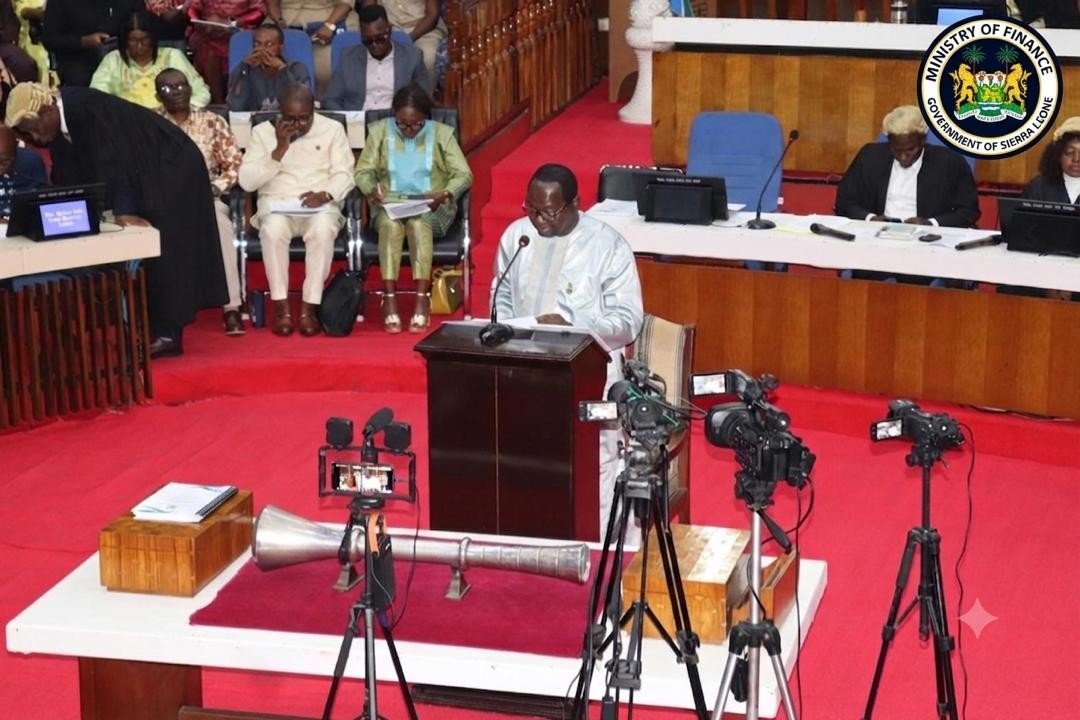
Parliament has approved Sierra Leone’s Supplementary Budget for the 2026 Financial Year, introducing significant revisions to the country’s fiscal framework in response to rising global oil prices, declining domestic revenue and growing economic pressures associated with the conflict in the Middle East.
Minister of Finance Sheku Ahmed Fantamadi Bangura presented the Supplementary Budget and Statement of Economic and Financial Policies to Parliament on Friday, 31 July 2026. The revised financial plan is anchored on the theme: “Strengthening Budget Credibility to Safeguard Macroeconomic Stability and Protect Livelihoods of Citizens.”
Sheku Ahmed Fantamadi Bangura explained that although Parliament approved the original 2026 National Budget in December 2025, unforeseen global developments had weakened some of the assumptions on which the initial fiscal framework was based. He said the sharp rise in international oil prices since March 2026 had affected economic growth, inflation, revenue collection and Government expenditure.
According to Sheku Ahmed Fantamadi Bangura, international oil prices rose above the Government’s original projection of US$70 per barrel following heightened geopolitical tensions in the Middle East. The increase placed considerable pressure on Sierra Leone as a petroleum-importing country, raising transportation, production and distribution costs across the economy.
The Minister of Finance informed lawmakers that the Government introduced fuel subsidies in April 2026 to reduce the impact of rising petroleum prices on consumers. Additional resources were also allocated to the Electricity Distribution and Supply Authority to enable it to meet payment obligations to Independent Power Producers and prevent a sharp increase in electricity tariffs.
He said the combined effect of fuel and electricity subsidies, lower petroleum consumption and slowing economic activity had increased pressure on public finances. Revenue shortfalls recorded during the first half of 2026 are expected to persist, particularly in collections from the Goods and Services Tax, customs duties and road user charges.
Sheku Ahmed Fantamadi Bangura stressed that the revised budget was designed to restore credibility to the fiscal framework, maintain essential public services and protect citizens from the adverse effects of external economic shocks. He added that the Government would rationalize the domestic capital budget and align expenditure with an updated Public Investment Programme.
Reviewing Sierra Leone’s economic performance in 2025, the Minister said the country entered 2026 on a stronger economic footing after recording significant improvements in growth, inflation, debt sustainability and fiscal management.
The economy grew by 4.8 percent in 2025, exceeding the projected rate of 4.5 percent and surpassing the average growth rate for Sub-Saharan Africa. Sheku Ahmed Fantamadi Bangura attributed the performance to increased agricultural production under the Feed Salone Programme, higher iron ore output and expansion in the manufacturing and services sectors.
Inflation also declined sharply to 4.4 percent in December 2025, compared with 13.8 percent in December 2024 and 52.2 percent in 2023. The improvement was attributed to tight monetary policy, fiscal consolidation, a relatively stable exchange rate, increased domestic food production and the easing of global food and oil prices.
Sierra Leone’s external trade position also improved during 2025 as export earnings increased and imports declined, reducing the country’s trade deficit. Public debt fell to 44.7 percent of Gross Domestic Product from 48.4 percent in 2024, while the overall fiscal deficit narrowed.
The Government also recorded its first domestic primary budget surplus since the COVID-19 pandemic. Reduced domestic borrowing contributed to a decline in interest rates, providing commercial banks with more opportunities to extend credit to private businesses.
Sheku Ahmed Fantamadi Bangura further highlighted Sierra Leone’s progress under the International Monetary Fund’s Extended Credit Facility programme. He said the IMF Executive Board completed the third review of the programme in June 2026, resulting in the disbursement of US$31.7 million.
The Minister also disclosed that a US$211.5 million Resilience and Sustainability Facility had been approved to help Sierra Leone strengthen climate resilience and address long-term structural challenges.
Despite those gains, Sheku Ahmed Fantamadi Bangura said the global oil shock had altered the country’s economic outlook. The Government consequently revised its 2026 economic growth projection from 4.5 percent to 4 percent.
Inflation, which had fallen considerably by the end of 2025, rose during the first half of 2026, reaching 14.8 percent in June. The increase was attributed mainly to higher fuel, transportation, housing and rental costs. Although foreign exchange reserves increased slightly and the Leone remained relatively stable, external pressures continued to affect government finances and economic activities.
Domestic revenue collected during the first six months of 2026 amounted to NLe10.3 billion, falling below the revised target. Improved income tax receipts, mining revenue and collections by Treasury Single Account agencies, however, partially offset weaker receipts from other sources.
The Government also received NLe1.4 billion in grants from development partners, including European Union budgetary support and financing for development projects. Total public expenditure during the period reached NLe16.4 billion, including spending on roads, infrastructure, rural water supply and preparations for the 2026 Population and Housing Census.
Under the revised fiscal framework, domestic revenue projections have been reduced by approximately NLe651 million to reflect weaker economic activity and lower-than-expected tax collections. Grants from development partners have been revised upwards following additional commitments from external partners.
Recurrent expenditure has increased by about NLe1.4 billion, mainly to finance fuel subsidies for Oil Marketing Companies and electricity subsidies for the Electricity Distribution and Supply Authority. The Government maintained allocations for public-sector salaries and reaffirmed its commitment to financing the Free Quality School Education Programme, including school feeding.
The revised framework projects an overall budget deficit of 2.8 percent of Gross Domestic Product, compared with the original target of 2.3 percent. The deficit will be financed through foreign borrowing and additional domestic financing, alongside efforts to reduce borrowing from the Bank of Sierra Leone.
To improve revenue collection, the Government plans to broaden the Goods and Services Tax base, strengthen customs operations, introduce GST on digital services, improve mining-sector compliance and roll out 10,000 Electronic Cash Registers. It also intends to establish a Revenue Court to expedite tax disputes and prosecute tax evasion.
Sheku Ahmed Fantamadi Bangura said expenditure controls would be strengthened through tighter wage management, improved cash planning, transparent public spending and more rigorous project selection.
The Government has also secured a US$60 million trade finance facility from the Arab Bank for Economic Development in Africa to support the importation of essential commodities. Negotiations are continuing for an additional US$100 million facility to strengthen fuel supplies.
Members of Parliament from the ruling Sierra Leone People’s Party and the opposition All People’s Congress commended the Minister of Finance and his team for the policies that helped stabilise the economy. They nevertheless called for stronger domestic revenue mobilisation, prudent expenditure management and greater accountability in the use of public funds.
The approved Supplementary Budget is expected to help the Government respond to emerging fiscal pressures, maintain critical services and protect Sierra Leoneans while preserving the economic gains recorded in recent years.