

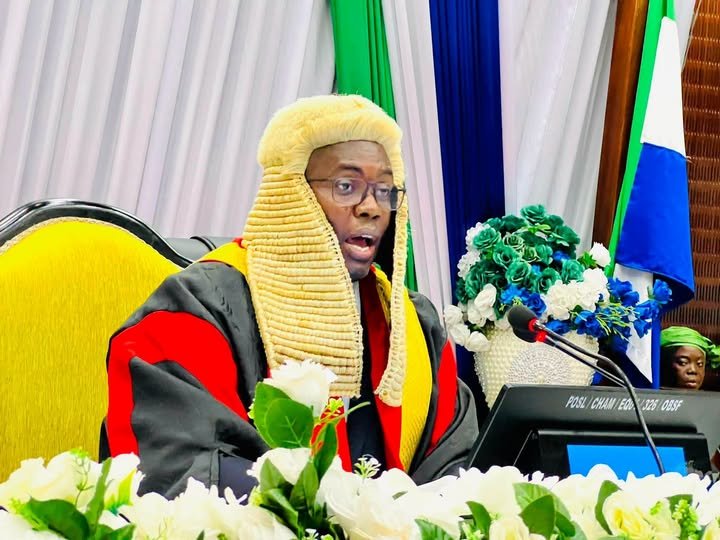
A major constitutional debate has erupted in Sierra Leone following Speaker of Parliament, Rt. Hon. Segepoh Solomon Thomas’, ruling on the Constitution of Sierra Leone (Amendment) Bill 2025, and his subsequent referral of a key legal question to the Supreme Court for an opinion.
The controversy centres on whether non-entrenched provisions of the 1991 Constitution can be amended through a simple majority under Section 91(1) or whether every constitutional amendment Bill must receive the support of at least two-thirds of all Members of Parliament under Section 108(2).
The Speaker declared the Bill passed following a parliamentary vote conducted after Members of Parliament representing the main opposition All People’s Congress walked out of the Chamber.
In the concluding paragraph of his ruling, the Speaker acknowledged the significant public interest surrounding the applicable voting threshold and referred the question to the Supreme Court.
“However, since the question whether or not a non-entrenched constitutional provision can be altered by recourse only to Section 91(1) of the Constitution of Sierra Leone, 1991, is of grave public interest, I refer this question to the Supreme Court for an opinion to be referred to this House not later than three months today to guide future discussions on this matter,” the Speaker stated.
He concluded: “I so rule.”
Although a Speaker’s ruling is generally treated as final for the conduct of proceedings in Parliament, the constitutional question raised by the decision has triggered widespread legal and political debate. Critics maintain that the Supreme Court’s interpretation should have been obtained before the Bill was declared passed.
The APC has rejected and distanced itself from what it described as the “purported passage” of the Bill.
In a Press Release dated 11 August 2026 and signed by APC National Secretary General, Lansana Dumbuya Esq., the party argued that the voting procedure was inconsistent with Section 108(2)(b) of the Constitution.
According to the APC, the provision requires a constitutional amendment Bill to receive the support of not less than two-thirds of all Members of Parliament at its Second and Third Readings.
With Parliament comprising 149 members, the party calculated that at least 100 affirmative votes were required. It claimed that only 96 lawmakers supported the Bill and therefore maintained that the constitutional threshold was not satisfied.
The party also argued that Section 91(1), which permits decisions by a majority of members present and voting, begins with the qualification, “Except as otherwise provided in this Constitution.”
It said Section 108 provides such an exception and must consequently take precedence over the general parliamentary voting rule.
The APC explained that its lawmakers withdrew from the Chamber because they did not want to participate in or legitimize a process they considered constitutionally defective.
“No Government, political party, Speaker or Parliament stands above the Constitution,” the party declared.
Several legal and Civil Society Organisations have raised similar concerns.
The Campaign for Human Rights and Development International said the Constitution cannot be amended through the procedures ordinarily used to enact regular legislation.
In a civic education briefing, CHRDI identified prior publication in the Government Gazette, approval by two-thirds of all Members of Parliament and, where entrenched provisions are involved, endorsement through a national referendum as essential constitutional safeguards.
The organisation argued that Parliament’s Standing Orders remain subordinate to the Constitution and cannot reduce or replace the voting requirements contained in Section 108.
The Institute for Legal Research and Advocacy for Justice also questioned the decision to refer the matter to the Supreme Court only after the Bill had been declared passed.
ILRAJ maintained that obtaining judicial interpretation before the parliamentary vote would have provided clearer guidance and prevented uncertainty over the legality of the process.
The institute also demanded an explanation of reports that civil-society representatives and members of the public observing the proceedings were removed from Parliament because of an alleged security threat.
The Lawyers’ Society similarly argued that a simple majority could not satisfy a constitutional requirement expressly demanding the support of two-thirds of Parliament’s total membership.
It recalled the Speaker’s earlier distinction between “two-thirds of Parliament” and “two-thirds in Parliament” during proceedings concerning the removal of former Auditor-General Lara Taylor-Pearce.
According to the Society, “two-thirds of Parliament” refers to the institution’s total membership, while “two-thirds in Parliament” may refer to the number of lawmakers present or participating in a particular vote.
Amid the growing controversy, the Sierra Leone Association of Journalists has urged restraint, respect for democratic institutions and reliance on the appropriate legal processes.
In a statement signed by SLAJ Secretary General, Edward Farah Marrah, the Association welcomed the Speaker’s decision to seek the Supreme Court’s interpretation.
SLAJ called on political parties, public institutions, Civil Society Organisations and citizens to avoid inflammatory rhetoric or actions that could heighten political tension and undermine national cohesion.
The Association also urged media institutions to continue providing accurate, balanced, fair and contextualized reporting while the constitutional dispute proceeds through the relevant legal channels.
SLAJ President, Alhaji Manika Kamara, said constitutional reform must go beyond winning or losing a political contest and should instead strengthen the institutions, rights and democratic principles on which every Sierra Leonean depends.
Public attention will now turn to the Supreme Court, which is expected to present its opinion to Parliament within three months. Its interpretation could provide important guidance on the relationship between Sections 91 and 108 and shape the procedure for future constitutional amendments in Sierra Leone.