

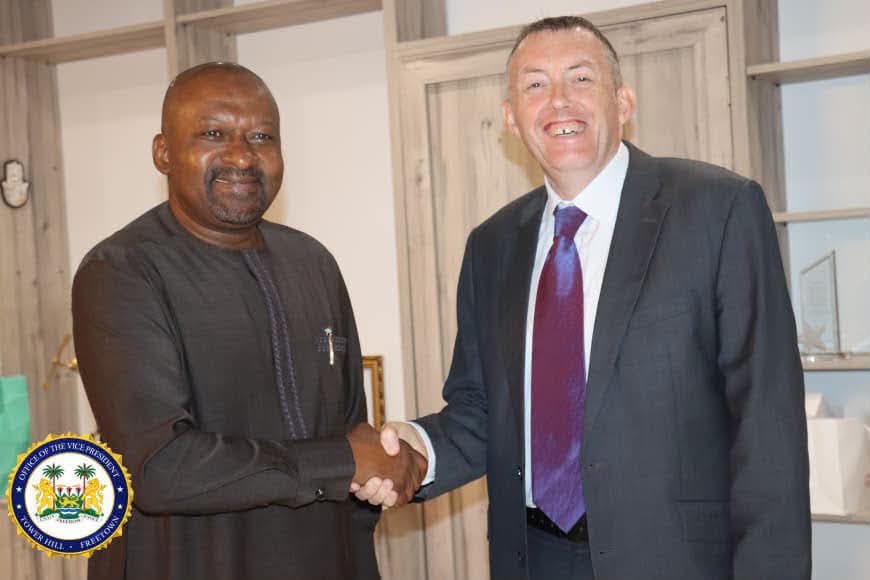
Vice President, Dr. Mohamed Juldeh Jalloh, has reaffirmed the Government of Sierra Leone’s commitment to strengthening its longstanding partnership with international humanitarian organisation, Trócaire, following high-level discussions with the organization’s Chief Executive Officer, Seán Farrell, on 28 July 2026.
The meeting focused on reinforcing collaboration in key development sectors, including gender equality, climate resilience, sustainable livelihoods and community development, areas that remain central to Sierra Leone’s national development agenda.
Speaking after the meeting, Vice President Dr. Mohamed Juldeh Jalloh described the engagement as productive, noting that discussions centred on Trócaire’s enduring partnership with Sierra Leone and its ongoing programmes aimed at improving the lives of vulnerable communities across the country.
“I met with Mr. Seán Farrell, the CEO of Trócaire, to discuss the organization’s longstanding partnership with Sierra Leone and its ongoing programmes supporting gender equality, climate resilience, sustainable livelihoods and community development,” the Vice President stated.
The discussions also highlighted the importance of maintaining strong cooperation between the Government and development partners in addressing pressing socio-economic and environmental challenges while promoting inclusive and sustainable growth.
For more than three decades, Trócaire has worked alongside the Government of Sierra Leone and local civil society organisations to implement programmes that improve livelihoods, strengthen community resilience and protect the rights of vulnerable populations.
Since establishing operations in Sierra Leone in 1995, the Irish-based international development agency has focused its interventions on climate and environmental justice, women’s and girls’ empowerment, humanitarian response and institutional capacity building through partnerships with local organisations.
A major area of Trócaire’s work has been climate and environmental justice, where the organisation supports communities in tackling the root causes of food insecurity while promoting climate-smart agriculture and sustainable natural resource management. The agency also supports initiatives that address climate-related loss and damage, helping vulnerable communities adapt to the increasing impacts of climate change.
The organisation has also made significant investments in women’s empowerment and leadership, implementing programmes designed to combat gender-based violence, strengthen the prevention of sexual and gender-based violence and increase women’s participation in political and socio-economic decision-making processes.
According to Trócaire, more than 22,000 people have benefited from its women’s empowerment programmes, which aim to promote equal opportunities, strengthen women’s leadership and improve access to economic opportunities across participating communities.
Humanitarian preparedness and localization remain another cornerstone of Trócaire’s operations in Sierra Leone. Rather than implementing projects directly, the organisation works through local Civil Society Organisations, including the Agency for Advocacy and Development Sierra Leone (AAD-SL) and the Kambia District Development and Rehabilitation Organisation (KADDRO), particularly during emergency responses.
Through those partnerships, Trócaire continues to strengthen the institutional and technical capacities of local organisations, enabling them to respond more effectively to humanitarian emergencies while promoting community ownership and sustainable development.
The meeting between Vice President, Dr. Mohamed Juldeh Jalloh and Seán Farrell underscores the shared commitment of the Government of Sierra Leone and Trócaire to expanding cooperation in areas that directly improve the welfare of citizens, particularly women, young people and climate-vulnerable communities.
Observers say the continued partnership reflects the important role international development organisations play in supporting Sierra Leone’s efforts to achieve inclusive economic growth, strengthen community resilience and advance the Sustainable Development Goals through locally driven development initiatives.