

By Foday Moriba Conteh
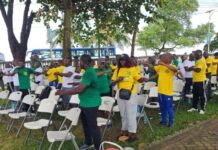
A broad coalition of Civil Society Organizations (CSOs), including community-based groups, trade unions, the Inter-Religious Council, professional bodies and the media, has presented a unified position following a two-day national dialogue on Sierra Leone’s preferred electoral system.
Held on the 11th and 12th of June 2025 at the Bank of Sierra Leone Complex in Freetown, the dialogue was convened to deliberate on Recommendation 78 of the Tripartite Committee Report, which calls for a national conversation on the appropriate electoral system between the district-based Proportional Representation (PR) and the First-Past-The-Post (FPTP) for both Parliamentary and Local Council elections. The recommendation further calls for ensuring a minimum of 30% female representation in line with the Gender Equality and Women’s Empowerment (GEWE) Act and adequate representation of youth and persons with disabilities.
The dialogue attracted a wide range of civil society stakeholders and electoral experts who expressed mixed views on which system would best serve Sierra Leone’s democratic growth. Many participants argued that systemic issues such as lack of transparency, limited public understanding and political exclusivity were more significant obstacles to fair elections than the choice of electoral system itself.
However, after deliberations and presentations, the majority of CSO representatives expressed a clear preference for the First-Past-The-Post (FPTP) system, with 57.9% voting in favor. A mixed method combining elements of both FPTP and PR received 31.6% support while the Proportional Representation system garnered only 10.5%.
Supporters of FPTP highlighted its simplicity and familiarity to voters, noting that it allows citizens to directly choose their representatives. They also emphasized the transparency of the process, which allows constituents to verify results and hold specific individuals accountable.
Many participants criticized the PR system implemented in the 2023 elections as confusing and inaccessible. Concerns included:
- A high threshold that limited participation by smaller parties and independent candidates.
- Lack of clarity on how candidates were selected and seats allocated.
- The over-concentration of power among political party leaders.
- Weak connections between elected officials and the communities they serve.
In addition, the breakdown of ward committees post-2023 elections was cited as evidence that PR had failed to strengthen grassroots governance and accountability.
Participants who supported PR acknowledged that it could work if adapted appropriately. They recommended a constituency-based open-list PR system with a lower or no threshold to encourage broader inclusion. They argued that this could promote diversity and ensure marginalized groups such as women, youth and persons with disabilities are well represented.
Supporters of a mixed electoral model proposed a hybrid approach: FPTP for electing Presidents, Mayors/Chairpersons and Councilors, and PR for Members of Parliament. They argued that such a system would balance local accountability with broader representation and enhance inclusion.
Civil Society concluded that any electoral system must:
- Be easily understood by the general population.
- Guarantee citizen-led selection of leaders, not just decisions by party elites.
- Ensure 30% women’s representation in accordance with the GEWE Act.
- Uphold transparency and accountability in both process and outcomes.
- Create a level playing field for all political parties, especially smaller ones and independents.
- Include mechanisms to verify and accept results across the board.
Civil society further urged the Office of the Attorney General and Minister of Justice to incorporate those findings when drafting any future electoral framework. Importantly, they emphasized that no electoral system can function effectively in isolation; broader reforms in governance, civic education and electoral integrity are crucial to ensuring credible, peaceful and inclusive elections in Sierra Leone.