
By Amin Kef (Ranger)
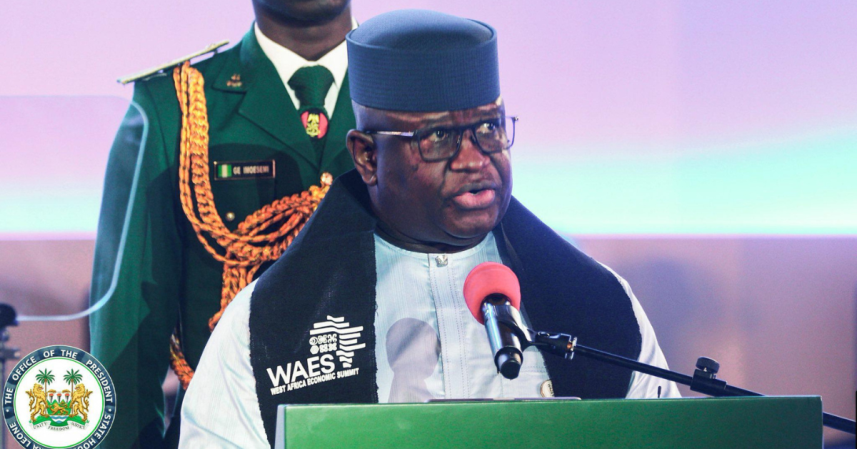
Sierra Leone’s President, Dr. Julius Maada Bio, has once again found himself at the center of regional and international politics. On June 22, 2025, he was unanimously elected as Chairman of the Economic Community of West African States (ECOWAS), a position that comes at a critical time for the region. His appointment underscores both his stature as a leader and the trust regional peers place in his ability to balance diplomacy with decisiveness.
According to The Africa Report Series, Patrick Smith, Editor of Africa Confidential, makes a compelling case on the progress achieved under the leadership of President Dr. Julius Maada Bio.
Patrick Smith, outlining the significance of his leadership. Smith noted that President Bio embodies “a rare blend of soldier and statesman,” recalling his role in ushering Sierra Leone into multiparty democracy in 1996. He emphasized that Bio’s current mandate as ECOWAS Chair places him at the center of regional decision-making at a time when West Africa is confronting some of its most difficult political, security, and economic challenges in recent history.
There is a striking symmetry in Bio’s political journey. Nearly 30 years ago, as a young military leader, he seized power in Sierra Leone but soon after supervised the country’s transition to civilian rule by handing over to President Ahmad Tejan Kabbah in 1996. That act of relinquishing power, almost unique in West Africa at the time, earned him credibility as a reform-minded soldier who put country before personal ambition.
Today, that legacy lends weight to his new role. ECOWAS is grappling with existential challenges: Mali, Burkina Faso, and Niger—all under military rule—have quit the bloc’s political structures and suspended security cooperation. At the same time, violent extremist groups linked to Al-Qaeda and the Islamic State continue to destabilize the Sahel, posing threats to neighboring states.
“Bio’s dual identity as a former soldier and a democratic reformer may prove vital,” Smith explains. “He has the military background to engage frankly with junta leaders, and the democratic credentials to reassure civilian governments.”
Bio inherits a fractured regional organization. ECOWAS, long regarded as a stabilizing force, has been weakened by successive coups and waning public confidence. Yet analysts believe Bio’s chairmanship could help bridge the widening divide.
“The credibility of ECOWAS depends on its ability to maintain dialogue while upholding democratic values,” Smith notes. “If Bio can encourage cooperation between civilian leaders and military juntas, the bloc’s authority in regional security will be restored.”
His task will not be easy. As Ghana’s former President John Dramani Mahama recently argued, any attempt to pressure juntas too aggressively could backfire, pushing them further into isolation. Bio’s challenge will be to foster coordination among West African militaries while convincing regimes to return to democratic pathways.
At home, President Bio’s focus is firmly on strengthening Sierra Leone’s economy. Agriculture lies at the heart of his development strategy. With more than 60 percent of Sierra Leoneans relying on farming, the government is investing in mechanization, irrigation, and value chains to boost productivity.
“The Bio government is targeting farming as a means to drive growth and jobs,” Patrick Smith explains. “The success of these initiatives will be measured not just in output, but in their ability to lift households out of poverty.”
Mining, traditionally the backbone of Sierra Leone’s economy, remains critical. The country’s rich deposits of diamonds, rutile, iron ore, and bauxite attract investors, yet Bio is pushing for a shift away from raw exports toward local processing and value addition. This approach, while ambitious, is seen as essential for broad-based development.
Sierra Leone’s economic reforms are being shaped by a $250 million three-year program with the International Monetary Fund (IMF), designed to support the government’s 2024–2030 National Development Plan. The program emphasizes fiscal discipline, deficit reduction, and subsidy cuts.
While these measures have stabilized public finances, they have also imposed hardship. The leone has depreciated sharply, from Le14,048 per US dollar in 2022 to a projected Le25,989 in 2025. Inflation remains stubbornly high—nearly 13 percent—driven by dependency on food and fuel imports. Foreign reserves cover less than two months of imports, leaving the economy vulnerable to external shocks.
“The IMF program is designed to restore macroeconomic stability,” Smith observes. “But it constrains the government’s ability to respond to public demands for relief, especially as citizens face rising prices and falling real incomes.”
Despite fiscal pressures, Bio has kept education at the center of his domestic agenda. His flagship Free Quality School Education programme, launched in 2018, has become a cornerstone of national policy. Today, over 3.5 million children—more than 75 percent of school-age population—are enrolled, up by one million since the program began. More than 12,000 teachers have been recruited, and education’s share of the national budget doubled to 21 percent in 2019.
“The success of the education programme will be judged by its practical relevance,” Smith notes. “If the system produces skilled graduates who find jobs in agriculture, mining, or new industries, then Bio’s reforms will be truly transformative.”
Healthcare is another priority. The government is commissioning hospitals in Jembe, Port Loko, and Kono, as well as a new pediatric center in Freetown. Electricity access has improved, rising from 16 percent in 2018 to 31 percent today, though frequent outages and financial losses at the state utility remain obstacles.
“These are the building blocks of inclusive development,” Smith stresses. “Improving health, power, and education may not grab international headlines, but they are essential for long-term prosperity.”
Beyond domestic reforms, Sierra Leone has steadily raised its international profile. The country currently holds a non-permanent seat on the United Nations Security Council, where it advocates for Africa’s voice in global governance. Diplomats such as Lansana Gberie have championed reforms of the IMF and World Bank to reflect the interests of developing nations.
“On the global stage, Sierra Leone now punches above its weight,” Smith observes. “Its principled positions on democracy and economic reform have won it respect far beyond its size.”
President Bio’s dual role—as Sierra Leone’s head of state and ECOWAS chair—will define the next phase of his presidency. At home, he must deliver jobs, food security, and educational opportunities. Abroad, he must repair ECOWAS’s fractured credibility while defending democracy in a region buffeted by coups and extremism.
Smith concludes: “In 1996, Bio facilitated Sierra Leone’s transition to democracy. In 2025, as ECOWAS chair, he is once again called upon to defend democracy—this time across an entire region.”
The symmetry of Bio’s career is striking: from soldier to reformer, from coup-maker to elected president, and now from national leader to regional statesman. His trajectory mirrors both Sierra Leone’s turbulent past and its aspirations for stability.
“The next three years will be decisive,” Smith warns. “President Bio’s legacy will be judged not only on whether he can deliver prosperity at home, but also on whether he can restore ECOWAS’s role as a credible force for peace and democracy in West Africa.”