
By Amin Kef (Ranger)
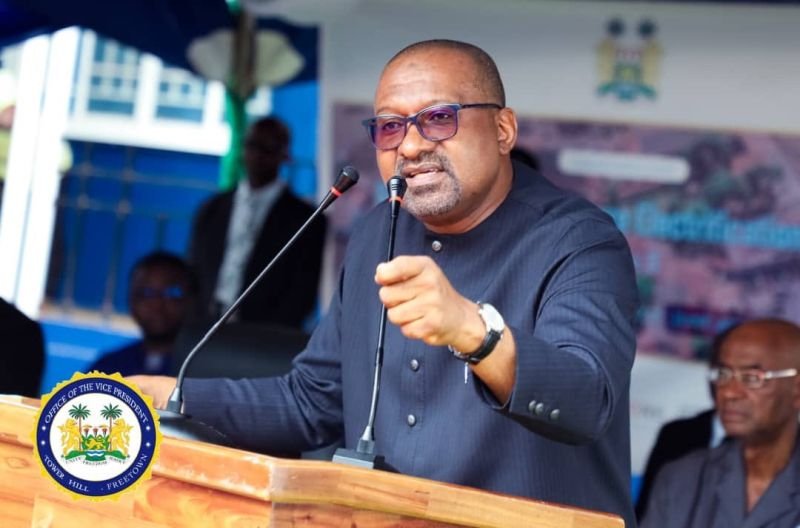
Vice President, Dr. Mohamed Juldeh Jalloh, has emerged as one of the most influential deputy leaders in Sierra Leone’s political history, steering reforms in health, education, governance and private sector development under President Julius Maada Bio. Traditionally seen as a ceremonial role, the office of the Vice President has been transformed into a powerhouse of policymaking and national oversight.
For decades, Sierra Leone’s Vice Presidency was regarded as marginal. That changed in 2018 when President Julius Maada Bio broadened the responsibilities of his deputy, Dr. Mohamed Juldeh Jalloh. He was entrusted with weighty national portfolios, from internal affairs and decentralization to education and health reforms.
“My responsibility is to ensure that devolution and decentralization take place and work,” the Vice President explained, reflecting the expanded mandate of his office. His tenure has proven that the Vice Presidency can function as a vital pillar of governance, driving strategic reforms and guiding national resilience.
One of the Vice President’s proudest achievements has been overseeing maternal health reforms. When the Sierra Leone People’s Party took power in 2018, the country recorded one of the world’s highest maternal mortality rates at 1,078 deaths per 100,000 live births. Within two years, that figure dropped to 773. Today, it stands at 334 per 100,000 live births.
“We have saved the lives of more than 700 mothers in just five years,” Dr. Mohamed Juldeh Jalloh told The Africa Report. “That is a record in sub-Saharan Africa.”
The success stems from increased investment in healthcare, with more than 8,000 new healthcare workers, nurses, midwives and doctors, recruited since 2018. Midwives have been retrained to manage complications during childbirth, while rural health facilities now receive ambulances to transport expectant mothers to hospitals.
Vice President, Dr. Mohamed Juldeh Jalloh, also played a crucial role during Sierra Leone’s recent mpox outbreak. With daily infections averaging 100 cases across 16 districts, he mobilized health workers, launched vaccination campaigns and coordinated community outreach. By June 2025, cases had sharply declined and the outbreak was brought under control.
Such rapid mobilization underscored his capacity for crisis management. He had shown similar leadership during the violent insurrection of August 2022, when he swiftly returned from abroad to help restore order while President Bio was on official travel.
Another flagship area of his leadership is education. President Bio’s administration has dedicated 22% of GDP to the sector, resulting in nearly one million new enrollments. For the first time in the country’s history, Sierra Leone has achieved gender parity in schools.
“We have more girls in junior secondary schools than boys and the girls are doing better in public exams,” Dr. Mohamed Juldeh Jalloh revealed. More classrooms have been built, more teachers recruited and science education for girls has expanded significantly.
“Within the next 20 years, nine out of ten Sierra Leoneans will be able to read and write,” he added, reflecting confidence in the country’s Free Quality School Education programme.
Beyond health and education, Dr. Mohamed Juldeh Jalloh has championed private sector development as the engine of sustainable job creation. President Bio’s administration has committed to generating 500,000 jobs and much of that depends on new investments in infrastructure, agriculture and energy.
Dr. Mohamed Juldeh Jalloh played a central role in negotiating Sierra Leone’s acceptance into the Millennium Challenge Corporation (MCC), resulting in a $480 million compact to transform the energy sector. Improved electricity is seen as key to boosting private sector growth and attracting foreign investment.
He also provides oversight of the Extractive Industries Transparency Initiative (EITI), ensuring transparency in the country’s natural resource governance.
Before entering politics, Dr. Mohamed Juldeh Jalloh built an impressive international career. He earned a PhD in political science from the University of Bordeaux and worked for the United Nations in Mali and Kosovo. He also served as Special Adviser to the UN Secretary-General’s representative in West Africa.
Fluent in French and experienced in governance, he was handpicked by President Bio as running mate in 2018. Despite his cosmopolitan background, Dr. Mohamed Juldeh Jalloh describes himself as “a politician at heart,” deeply connected to Sierra Leone’s aspirations.
“I came into this position with vast governance experience from several nations,” he explained. That experience, he said, has shaped his approach to Sierra Leone’s governance challenges, particularly in health, decentralization and service delivery.
With less than two years before the end of President Bio’s second term, Dr. Mohamed Juldeh Jalloh remains focused on consolidating reforms and ensuring continuity. The administration’s priorities include sustaining gains in maternal health, expanding access to quality education, boosting job creation through private sector partnerships and ensuring Sierra Leone’s decentralization agenda delivers results for rural communities.
For Dr. Mohamed Juldeh Jalloh, the success of the administration will be judged not only by the promises made but by the impact felt by ordinary Sierra Leoneans. “The key to job creation is in the private sector,” he reiterated. “We are laying the groundwork to ensure that governance and transparency provide the enabling environment for investors, while also delivering services to our people.”
Vice President Dr. Mohamed Juldeh Jalloh has reshaped the office once considered symbolic, proving it can be a cornerstone of national transformation. Under his watch, Sierra Leone has broken records in reducing maternal mortality, expanded education opportunities and set the stage for long-term economic growth.