

By Foday Moriba Conteh
In an exclusive interview with the Press, Engineer Edmond Benjamin Nonie, Deputy Minister I at the Ministry of Energy, provided updates on the Ministry’s ongoing initiatives to improve energy availability and infrastructure across Sierra Leone.
Deputy Minister Engineer Edmond Benjamin Nonie explained that the Ministry has been working closely with donor partners to reform the energy sector and enhance electricity distribution for both institutions and households. “We are continuously assessing the system to identify areas that need improvement and collaborating with Management to achieve these goals,” he stated.
He emphasized that Sierra Leone before was not making use of the CLSG power line but said now Sierra Leone is receiving electricity through the CLSG power line, which connects the country to Cote d’Ivoire and Guinea, as well as generating the bulk of electricity domestically. However, the Ministry is actively working to expand domestic generation. “By January next year, we plan to add at least 60 megawatts of additional electricity from ongoing projects, including new solar installations and generator upgrades,” Engineer Edmond Benjamin Nonie revealed.
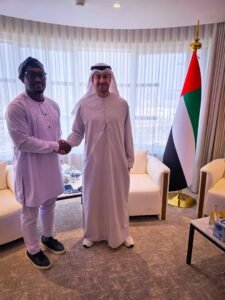
Speaking on international partnerships, the Deputy Minister detailed a recent visit to the United Arab Emirates (UAE), where he met with officials from Global South Utilities (GSU), a company that works on solar projects in Africa. The discussions focused on enhancing existing solar power initiatives, particularly the 6-megawatt Newton solar plant initiated in 2019. GSU has committed to supplying additional battery storage to complement the solar capacity, aiming to ensure more reliable energy supply.
“GSU has offered batteries that will enhance the efficiency of our solar projects. For instance, for the Newton and Lungi solar plants, we are receiving supplementary batteries to achieve the full intended capacity, which will allow us to maximize solar energy utilization,” he explained.
Engineer Edmond Benjamin Nonie also clarified the operational aspects of solar energy. He noted that solar systems generate electricity during daylight hours and battery storage is essential for providing power when sunlight is unavailable. “With these batteries, we can store energy during the day and use it when needed, ensuring a more stable power supply,” he said.
The Deputy Minister further discussed the Ministry’s strategy for project implementation. Following the signing of Memoranda of Understanding (MOUs) with GSU in November, technical studies and system designs will commence immediately. He highlighted the efficiency of GSU’s projects in the UAE, where they can deploy up to 50 megawatts per day, suggesting a rapid implementation timeline for Sierra Leone. “If we move fast with these projects, we expect substantial improvements in energy availability by early next year,” Engineer Edmond Benjamin Nonie said.
Addressing the financial and operational framework, he explained that the partnership involves GSU providing battery systems, which are then sold to the national utility, EDSA, at low tariffs. EDSA subsequently distributes electricity to consumers, ensuring affordability while supporting sustainable energy expansion.
Deputy Minister Engineer Edmond Benjamin Nonie also provided updates on other critical infrastructure projects, including upgrades at Kingtom and Black Hall Road, the installation of transformers and rehabilitation of transmission lines to ensure reliable electricity distribution. “We are systematically prioritizing projects to improve generation, transmission and distribution across key areas,” he noted.
The interview underscored the Ministry’s commitment to expanding access to electricity, leveraging renewable energy solutions and strengthening partnerships with international firms to address Sierra Leone’s energy challenges. Deputy Minister Engineer Edmond Benjamin Nonie reaffirmed that those initiatives are part of a broader strategy to ensure sustainable and reliable power supply for both urban and rural communities.