
By Amin Kef (Ranger)
President Dr. Julius Maada Bio on Thursday 9 April 2026 intensified Sierra Leone’s global advocacy for climate finance, energy access and green industrialization during two separate high-level engagements in Vienna, Austria, where he called for practical implementation of global commitments and stronger partnerships to transform Africa’s economic future.
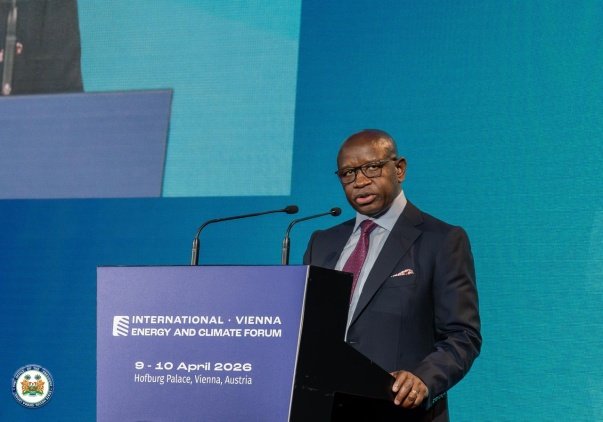
The first event took place at the Hofburg Palace in Vienna, where President Julius Maada Bio delivered a keynote statement at the International Vienna Climate and Energy Conference. Addressing world leaders, investors and development partners, the President stressed that the global energy transition must move beyond lofty declarations and produce real outcomes capable of generating jobs, creating value and improving lives across developing economies.
He underscored the strong link between prosperity, security and stability, noting that Africa must no longer be viewed merely as a source of raw materials but as a strategic centre for industrial expansion and value addition.
President Julius Maada Bio firmly stated that Africa should not serve as a warehouse for the global energy transition but must emerge as a hub for industrial growth, innovation and long-term value creation.
Speaking in his capacity as Chairman of the ECOWAS Authority of Heads of State and Government, President Julius Maada Bio highlighted ongoing regional efforts to reposition West Africa as an integrated, investment-ready bloc through policy harmonization, improved infrastructure connectivity and the development of coordinated industrial corridors.
He specifically pointed to the immense opportunities within the Mano River Union, bringing together Sierra Leone, Liberia, Guinea and Côte d’Ivoire, where integrated mining, transport, energy and port corridors could unlock large-scale industrialization, including aluminium refining and steel production.
At the national level, President Julius Maada Bio reaffirmed Sierra Leone’s commitment to energy transformation through the Mission 300 initiative, backed by the World Bank and the African Development Bank. He disclosed that Sierra Leone has developed a US$2.2 billion Energy Compact aimed at significantly expanding electricity access, scaling clean energy solutions and attracting increased private sector investment.
According to the President, Sierra Leone is targeting an increase in electricity access from 36 percent to 78 percent by 2030, while also expanding clean cooking access and ensuring no community is left behind through both grid and off-grid solutions.
He also made a strong case for affordable and accessible climate finance, lamenting that many viable African projects continue to struggle to reach financial closure because of high capital costs and persistent risk perceptions.
President Julius Maada Bio further announced plans for ECOWAS to deliver a pipeline of bankable cross-border energy and industrial projects within the next year, while also unveiling plans for a West Africa Integration and Investment Summit focused on execution and measurable outcomes.
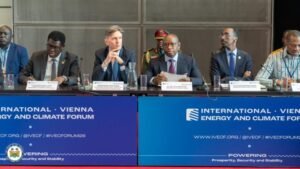
In a separate but equally significant event held in Vienna on the margins of the International Vienna Climate and Energy Forum, President Julius Maada Bio spoke at a high-level roundtable on “Green Industrialization for Stability and Shared Prosperity,” where he again linked energy development to economic transformation, particularly for Least Developed Countries and Landlocked Developing Countries.
At that roundtable, the President emphasized that energy access should not be treated as an end in itself but as a direct catalyst for production, employment creation and livelihood enhancement.
He highlighted Sierra Leone’s strategy of aligning energy development with productive sectors through flagship initiatives such as Feed Salone, which supports irrigation, agro-processing, cold storage and rural enterprises. According to him, this integration is central to increasing productivity, boosting incomes and strengthening resilience within local communities.
President Julius Maada Bio also noted that while national grid expansion remains vital, distributed renewable energy systems, including mini-grids and stand-alone solar solutions, provide the fastest route to scaling electricity access in rural and underserved communities.
He further cited Sierra Leone’s clean cooking transition as a practical example of green industrialization creating new value chains, enterprises and opportunities, especially for women and small-scale entrepreneurs.
Looking ahead, President Julius Maada Bio announced that within the next 12 months Sierra Leone will operationalize a Distributed Renewable Energy and Clean Cooking Acceleration Initiative under its Mission 300 Compact. The initiative, he said, will focus on scaling solar energy for productive use, widening access to clean cooking and mobilizing blended finance through development institutions and private investors.
He concluded by reaffirming Sierra Leone’s readiness to serve as a demonstration country for impactful and scalable energy solutions, stressing that the ultimate objective remains improved livelihoods, economic resilience and long-term national stability.
The strong engagements at two separate Vienna forums on the same day further reinforced President Julius Maada Bio’s growing international profile as a leading African voice on climate investment, regional energy integration and green industrial transformation.