
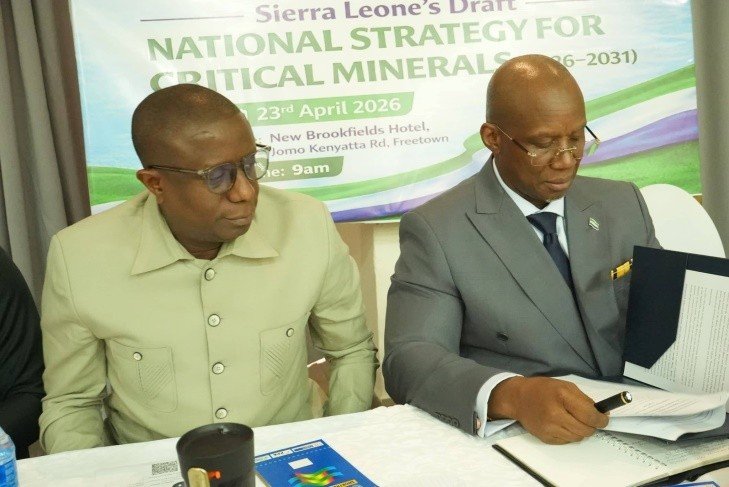
Sierra Leone has taken a decisive step toward transforming its mining sector, as the Ministry of Mines and Mineral Resources (MMMR) convened a high-level consultation to shape a new national strategy on critical minerals for the period 2026 to 2031.
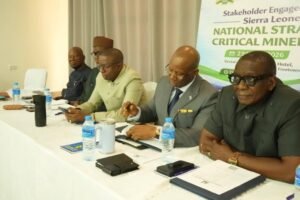
The engagement, hosted on April 23, 2026 at the New Brookfields Hotel, assembled a diverse cross-section of stakeholders drawn from Government institutions, private sector operators, academic institutions, Civil Society groups and international development partners. The meeting was presided over by Permanent Secretary, Charles T. Kamanda, who emphasized the need for broad-based input to ensure the strategy reflects national aspirations.
Setting the tone for deliberations, Deputy Minister, Umaru N. Kamara, called on participants to rigorously interrogate the draft document and contribute practical recommendations. He noted that the consultation process is central to building a credible and implementable framework capable of delivering long-term benefits to the country.
Contributors at the opening session, including the Director General of the National Minerals Agency, Ing. Hadji Dabo, alongside members of the Minerals Advisory Board and Parliament’s oversight committee, welcomed the initiative. They urged stakeholders to prioritize transparency, accountability and national interest throughout the review process.
Ing. Hadji Dabo described the initiative as a timely intervention aligned with the Government’s flagship development agenda, noting that the country stands at a critical juncture in redefining how it manages and benefits from its mineral resources. He stressed that the strategy signals a shift toward more intentional and value-driven exploitation of critical minerals.
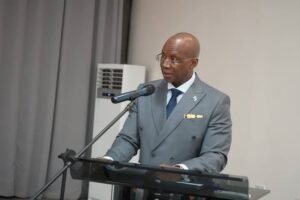
In his keynote address, Minister of Mines and Mineral Resources, Julius Daniel Mattai highlighted persistent structural weaknesses in the sector, particularly the continued export of raw minerals with minimal local value addition. He warned that such practices limit economic gains and undermine national development.
According to the Minister, the new strategy places strong emphasis on beneficiation, local processing, industrial linkages and innovation, with the broader aim of strengthening domestic capacity and ensuring that mineral wealth contributes more meaningfully to economic growth and job creation.
He further pointed out that global competition for critical minerals is increasingly influenced by geopolitical interests, cautioning that countries without clear strategies risk losing out in the evolving energy transition landscape. He described the framework as a necessary blueprint to safeguard Sierra Leone’s interests and maximize returns from its natural resources.
A technical presentation by Dr. John D. Cooper outlined the core structure of the draft, which is anchored on four strategic pillars: transformation of the sector, responsible resource management, shared economic benefits and strategic international partnerships.
Dr. John D. Cooper indicated that the strategy is designed to deliver tangible outcomes, including increased state revenues, expanded export earnings, job creation, improved infrastructure and greater inclusion of women and artisanal miners in the formal economy. He also highlighted projections tied to the global surge in demand for minerals used in renewable energy technologies, noting that Sierra Leone is well positioned to capitalize on these trends.
Estimates within the draft suggest the potential to generate about US$300 million in Government revenue and US$1.5 billion in exports, while creating up to 45,000 jobs and building a skilled workforce of approximately 15,000 individuals. He emphasized that attracting sustained investment will be critical to achieving those targets.
The strategy, he added, is aligned with national development priorities and envisions Sierra Leone emerging by 2031 as a responsible and competitive player in the global critical minerals market, supported by improved infrastructure and stronger mining communities.
Following the presentations, participants engaged in breakout sessions to examine specific aspects of the draft and propose refinements aimed at strengthening policy coherence and implementation mechanisms.
Bringing the session to a close, Minister Julius Daniel Mattai commended both the Ministry and the National Minerals Agency for steering the process and thanked stakeholders for their active participation. He reaffirmed the Government’s commitment to finalizing a strategy that is inclusive, practical and capable of unlocking sustainable value from the country’s mineral resources.