

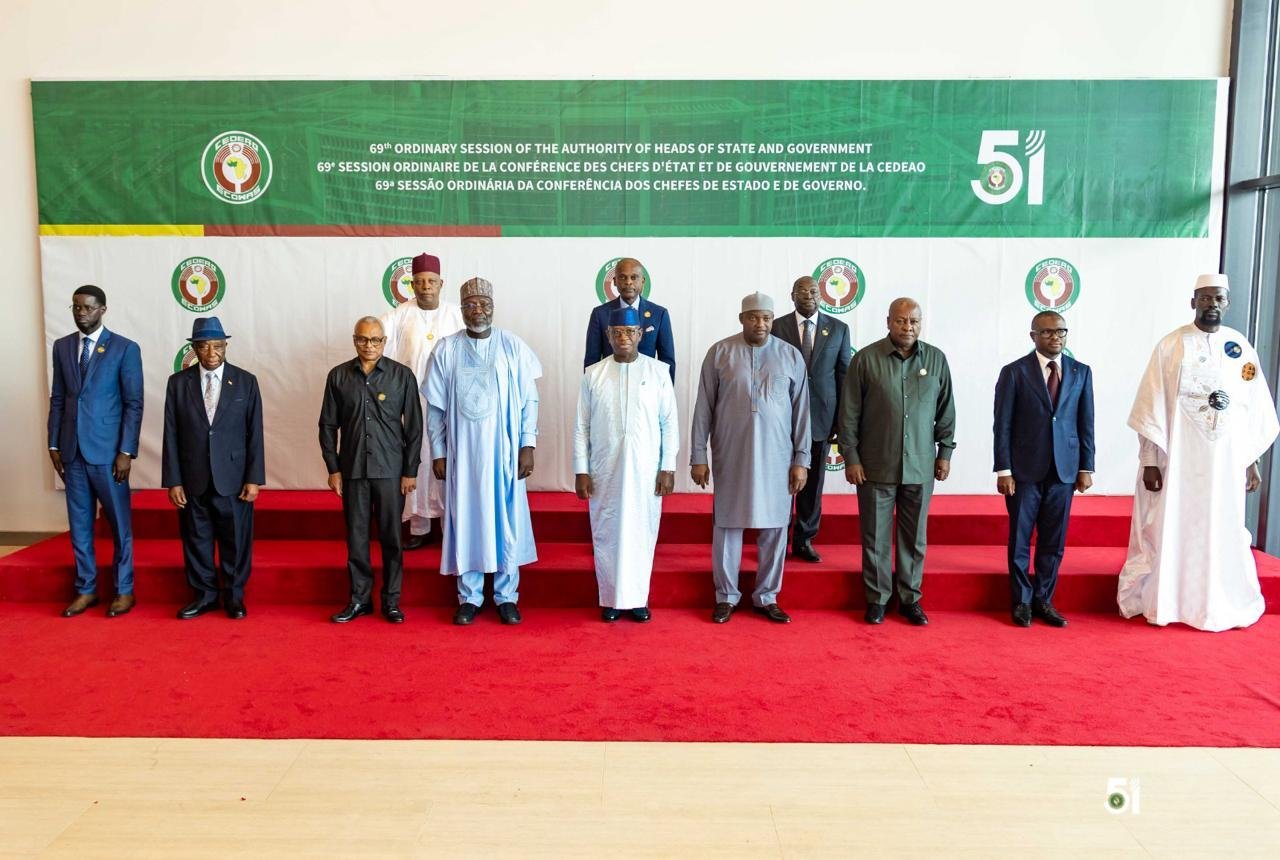
The Economic Community of West African States (ECOWAS) has concluded its Sixty-Ninth (69th) Ordinary Session of the Authority of Heads of State and Government in Lungi, Sierra Leone, with the adoption of a comprehensive Final Communiqué outlining ambitious decisions aimed at strengthening regional integration, democratic governance, peace, security and economic transformation across West Africa.
Held on Sunday, July 19, 2026, alongside the Summit on the Future of Regional Integration in West Africa at the Julius Maada Bio International Conference Centre, the meeting was chaired by President Dr. Julius Maada Bio of Sierra Leone in his capacity as outgoing Chair of the ECOWAS Authority. The summit brought together Heads of State, Vice Presidents, Ministers, senior regional officials and representatives of international organizations to deliberate on key political, economic and security challenges confronting the sub-region.
One of the landmark outcomes of the summit was the adoption of the Declaration of Commitment to the Compact on the Future of Regional Integration in West Africa, reaffirming the determination of Member States to deepen cooperation, preserve regional unity and accelerate sustainable development despite evolving geopolitical and economic challenges. Leaders also signed the Inter-Governmental Agreement on the African Atlantic Gas Pipeline (AAGP) and adopted the Presidential Declaration on Advancing Gender Parity in Political Representation, making gender equality one of the flagship legacy initiatives marking ECOWAS’ Golden Jubilee celebrations.
The Authority reviewed the 2026 Interim Report on the State of the Community, reports from the 56th Ordinary Session of the Mediation and Security Council, the 96th Ordinary Session of the ECOWAS Council of Ministers, and the report of the 13th Session of the ECOWAS Convergence Council for the Single Currency. Leaders commended the quality of the reports and endorsed recommendations designed to strengthen regional peace, political stability, economic integration and institutional resilience.
On economic matters, the Authority expressed satisfaction with the resilience of ECOWAS economies, noting favourable growth projections for 2026 supported by declining inflation and improved macroeconomic indicators. Heads of State reaffirmed their commitment to launching the long-awaited ECO single currency in 2027, agreeing that implementation would begin with Member States meeting the required convergence criteria while providing support for countries needing additional preparation. Leaders also welcomed the registration of the name “ECO” with the African Intellectual Property Organisation and directed the ECOWAS Commission to continue consultations with central bank governors on outstanding technical issues.
The Authority further expressed concern over outstanding Community Levy arrears and urged Member States to fulfil their financial obligations to ensure sustainable funding for Community programmes. It also highlighted food security as a regional priority, calling for accelerated implementation of the ECOWAS Rice Roadmap to reduce dependence on imported rice while addressing the impact of rising fertilizer prices on agricultural productivity.
Reaffirming one of ECOWAS’ core achievements, the Authority reiterated its unwavering commitment to the Protocol on the Free Movement of Persons, Right of Residence and Establishment, emphasizing that regional mobility remains fundamental to economic integration and cross-border trade. Leaders also cautioned Member States against entering bilateral trade agreements that undermine the ECOWAS Customs Union and instructed the Commission to coordinate common regional positions during international trade negotiations.
Infrastructure and energy development featured prominently in the communiqué. The Authority directed the ECOWAS Commission to prepare investment-ready regional infrastructure projects focusing on transport, energy, water and digital connectivity. It also welcomed the signing of the African Atlantic Gas Pipeline Agreement, describing the project as a strategic initiative that will strengthen energy security, industrialization and regional connectivity in partnership with the Kingdom of Morocco.
On aviation, Heads of State reiterated their determination to reduce the cost of air travel within West Africa. Côte d’Ivoire was commended as the only Member State to have removed applicable taxes in line with previous ECOWAS decisions, while other countries were urged to expedite reforms aimed at making regional air transport more affordable and accessible. The Authority also approved new regional digital governance measures, including a revised supplementary act on personal data protection and the establishment of a Regional Cybersecurity Coordination Mechanism.
Regarding political affairs, democracy and peace, the Authority noted steady progress in democratic governance across the region while acknowledging continuing geopolitical pressures. Sierra Leone received special commendation for progress in implementing the Agreement for National Unity between the Government and the opposition All People’s Congress (APC). The communiqué welcomed the easing of political tensions and specifically praised President Julius Maada Bio’s decision to discontinue legal proceedings against former President Dr. Ernest Bai Koroma as a significant statesmanlike contribution to national reconciliation. Leaders encouraged continued implementation of the Tripartite Committee recommendations ahead of the country’s 2028 general elections.
The Authority also addressed regional security concerns, expressing deep concern over persistent terrorist attacks across the Sahel and Lake Chad Basin. It reaffirmed its commitment to eliminating terrorism within the ECOWAS region, endorsed a revised roadmap for operationalizing the ECOWAS Counterterrorism Brigade by July 2027 and renewed the mandate of ECOWAS Special Envoy on Counterterrorism, Ambassador Baba Kamara, for an additional three years. Member States were urged to settle Community Levy arrears dedicated to financing the regional force.
On institutional matters, the Authority endorsed appointments to several senior positions within ECOWAS institutions for the 2026–2030 period and appointed General Birame Diop of Senegal as the next President of the ECOWAS Commission, effective September 1, 2026, succeeding Dr. Omar Alieu Touray of The Gambia. The Authority also endorsed Sierra Leone’s candidature for a seat on the International Court of Justice for the 2027–2036 term, reflecting confidence in the country’s growing international standing.
In another major decision, Heads of State elected President Bassirou Diomaye Faye of Senegal as the new Chairperson of the ECOWAS Authority of Heads of State and Government for a one-year term, succeeding President Julius Maada Bio. Leaders expressed profound appreciation to President Bio, the Government and the people of Sierra Leone for their exceptional hospitality, world-class hosting facilities and exemplary leadership throughout his tenure as Chair of the regional bloc.