

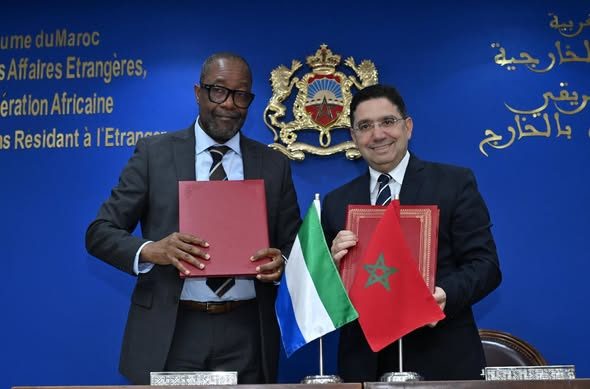
Sierra Leone and the Kingdom of Morocco have taken another significant step towards strengthening their longstanding diplomatic and economic relations following the signing of a Joint Communiqué and a three-year Cooperation Roadmap covering 2027 to 2029. The agreement seeks to expand collaboration in key development sectors, including agriculture, mining, fisheries, water resource management, trade and investment.
The landmark diplomatic engagement took place on Tuesday, 10 November 2026, at the Moroccan Ministry of Foreign Affairs in Rabat, where Sierra Leone’s Minister of Foreign Affairs and International Cooperation, Mohamed Rahman Swaray, held high-level discussions with his Moroccan counterpart, Nasser Bourita, Minister of Foreign Affairs, African Cooperation and Moroccans Living Abroad.
The signing represents a renewed commitment by both Governments to transform their traditional diplomatic friendship into a more comprehensive and results-oriented partnership capable of delivering tangible economic and social benefits to their citizens.
Speaking following the engagement, Mohamed Rahman Swaray described the agreement as an important milestone in advancing cooperation between Freetown and Rabat, particularly in areas that support economic transformation, regional connectivity and sustainable development.
He explained that the partnership reflects the common aspirations of President Dr Julius Maada Bio and Morocco’s King Mohammed VI to deepen bilateral relations through practical initiatives that promote shared prosperity and stronger African cooperation.
According to Mohamed Rahman Swaray, the newly adopted roadmap will provide a structured framework for implementing mutually beneficial programmes while strengthening institutional collaboration between the two countries.
Beyond economic cooperation, the discussions addressed important diplomatic and regional developments, including Morocco’s territorial integrity and ongoing efforts to promote stability across the African continent.
During the meeting, Mohamed Rahman Swaray reaffirmed Sierra Leone’s support for Morocco’s territorial integrity and its proposed autonomy arrangement for the Sahara region. He also underscored the diplomatic importance of establishing a Sierra Leonean Consulate General in Dakhla as part of efforts to strengthen bilateral engagement.
The Foreign Affairs Minister further welcomed progress on the regional gas pipeline initiative, describing the project as an important demonstration of South-South cooperation and Africa’s growing determination to develop interconnected infrastructure.
He observed that such initiatives could contribute to improved regional trade, stronger economic integration and greater resilience against fluctuations in international markets.
Mohamed Rahman Swaray noted that countries participating in regional infrastructure and energy projects, including Sierra Leone, stand to benefit from expanded economic opportunities and improved connectivity.
He also expressed support for the African Atlantic States Initiative and Morocco’s Royal Initiative aimed at facilitating access to the Atlantic Ocean for countries in the Sahel region.
According to the Minister, both initiatives offer opportunities to strengthen economic cooperation, improve transportation and trade networks and encourage sustainable development through regional solidarity.
He stressed that greater connectivity among African countries remains essential for unlocking economic opportunities, attracting investment and promoting long-term stability.
For his part, Nasser Bourita welcomed Sierra Leone’s continued diplomatic engagement with Morocco and commended the country’s contributions to regional peace, democratic governance and institutional cooperation within the Economic Community of West African States (ECOWAS).
The Moroccan Foreign Affairs Minister acknowledged Sierra Leone’s role in supporting efforts aimed at restoring constitutional governance, strengthening democratic institutions and advancing regional security cooperation.
He also highlighted the importance of accelerating economic integration and reinforcing the credibility of regional institutions as part of broader efforts to address Africa’s development challenges.
Nasser Bourita described relations between Morocco and Sierra Leone as longstanding and characterized by mutual trust, solidarity and shared diplomatic interests.
He expressed appreciation for Sierra Leone’s consistent support for Morocco’s position on territorial integrity, noting that Freetown could continue to play a meaningful diplomatic role in future discussions concerning the Sahara issue.
Both Ministers used the occasion to review the progress made under existing bilateral arrangements and identify additional areas where cooperation could produce measurable development outcomes.
Particular attention was given to agricultural development, fertilizer production and supply, mining, fisheries, water management and the blue economy, sectors considered important to Sierra Leone’s economic diversification and national development priorities.
The discussions also explored opportunities for increased private-sector investment, expanded commercial exchanges, cultural cooperation and technical capacity building.
Through the proposed cooperation framework, both Governments intend to encourage greater institutional engagement and facilitate the exchange of expertise in sectors where Morocco has developed significant technical experience.
Agricultural cooperation is expected to remain a central component of the partnership, particularly in improving productivity, strengthening food security and promoting modern farming practices.
Similarly, collaboration in fisheries and the blue economy could provide opportunities for the sustainable management of marine resources, while cooperation in mining and water management could support infrastructure development and responsible resource utilization.
The two Foreign Affairs Ministers further emphasized the importance of strengthening people-to-people relations through cultural exchanges, professional training and knowledge-sharing programmes.
They agreed that the successful implementation of the 2027–2029 Cooperation Roadmap would require sustained diplomatic engagement, effective institutional coordination and a clear commitment to translating agreed priorities into practical programmes.
The signing of the Joint Communiqué and Cooperation Roadmap signals a shared determination by Sierra Leone and Morocco to elevate their relationship beyond traditional diplomatic exchanges and establish a stronger strategic partnership anchored in economic opportunity, regional cooperation and sustainable development.
As both countries look towards the implementation period beginning in 2027, attention will increasingly focus on how the commitments outlined in Rabat are translated into concrete projects, investment opportunities and measurable benefits for their respective populations.
The latest agreement reinforces the growing importance of African-led partnerships in addressing common development challenges while strengthening diplomatic solidarity and economic cooperation across the continent.