

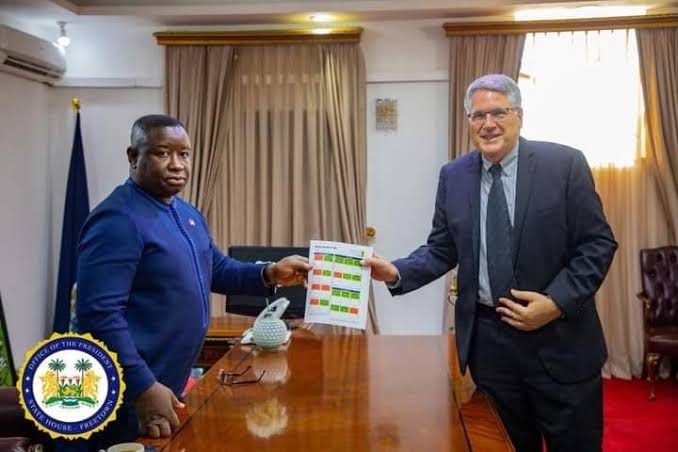
The Right to Access Information Commission (RAIC) has welcomed Sierra Leone’s continued strong performance in the Freedom of Information indicator of the United States Millennium Challenge Corporation (MCC) 2027 Scorecard, describing the achievement as a reflection of sustained efforts to promote transparency, accountability and citizens’ access to public information.
According to the newly released scorecard, Sierra Leone passed 11 out of 22 governance and development indicators, recording an impressive 84 percent in Freedom of Information. The Commission considers the result another important achievement in the country’s efforts to strengthen democratic governance and uphold the public’s right to information.
The MCC Freedom of Information indicator assesses Governments’ commitment to ensuring the free flow of information. It incorporates several measurements, including press freedom, the existence and implementation of national freedom of information legislation and restrictions on internet access and social media platforms.
As the institution mandated to implement Sierra Leone’s Right to Access Information Act of 2013, the RAIC plays a central role in promoting citizens’ access to public records, strengthening institutional transparency and ensuring that public authorities fulfil their legal obligations to disclose information.
Reacting to the latest scorecard, the Chairman and Information Commissioner of RAIC, Dr Ibrahim Seaga Shaw, described Sierra Leone’s performance as evidence of the Commission’s sustained commitment to making information more accessible to the public.
Dr Ibrahim Seaga Shaw explained that since assuming leadership of the Commission in late 2018, the number of information requests submitted nationwide has increased considerably, reflecting growing public awareness of the right to access information.
Providing statistics to demonstrate the progress, he disclosed that the Commission recorded 112 information requests in 2019, followed by 144 in 2020 and 369 in 2021.
The figures increased dramatically in 2022, when 13,016 requests were recorded nationwide. The upward trend continued in 2023, with 19,391 requests, while data submitted by public authorities indicated that 15,860 requests were received across the country in 2024.
According to Dr Ibrahim Seaga Shaw, those developments demonstrate increasing public confidence in the mechanisms established to facilitate access to information and the Commission’s efforts to encourage citizens to exercise their legal rights.
He attributed the progress to continuous public education, institutional engagement and stronger enforcement of the Right to Access Information Act.
The RAIC Chairman further highlighted Sierra Leone’s consistent performance in previous MCC assessments, noting that the country has maintained relatively high scores in Freedom of Information over several years.
Available figures presented by the Commission show that Sierra Leone recorded 71 percent in 2019 before improving to 85 percent in both 2020 and 2021. The country subsequently achieved 90 percent in 2022 and reached a remarkable 98 percent in 2023.
Although the score declined to 89 percent in 2024, Sierra Leone recovered to 91 percent in 2025 and further improved to 95 percent in 2026, before registering 84 percent in the latest 2027 assessment.
Despite the decline from the previous year, the Commission maintains that the country’s performance demonstrates continued commitment to protecting freedom of information and strengthening the legal and institutional framework supporting public access to Government information.
Dr Ibrahim Seaga Shaw explained that the RAIC has intensified its nationwide awareness campaigns to educate citizens about their rights under the 2013 legislation while engaging public authorities on their responsibilities to provide information.
He emphasized that the Commission continues to encourage both proactive disclosure, through which public institutions voluntarily publish relevant information, and reactive disclosure, which requires authorities to respond appropriately to requests submitted by citizens.
The Commission has also strengthened its enforcement mechanisms, including imposing penalties on public authorities that fail to comply with their statutory obligations.
Beyond its domestic achievements, the RAIC has expanded Sierra Leone’s participation in regional and international initiatives promoting access to information.
The Commission is a member of the African Network of Information Commissioners (ANIC) and the International Conference of Information Commissioners (ICIC), with Dr Ibrahim Seaga Shaw serving as an Executive Member of both organisations.
Those engagements have helped raise Sierra Leone’s profile in international discussions on transparency, public accountability and the protection of citizens’ information rights.
A major milestone was recorded in September 2026 when the RAIC, in collaboration with the United Nations Educational, Scientific and Cultural Organization (UNESCO), jointly hosted the 17th International Conference of Information Commissioners and activities commemorating the International Day for Universal Access to Information.
The occasion placed Sierra Leone among the few African countries to host the international gathering, becoming the second on the continent after South Africa, which hosted the conference in 2019.
The Commission described the simultaneous hosting of the two international events as a significant achievement that demonstrated Sierra Leone’s growing leadership in advancing the global right-to-information agenda.
The RAIC also acknowledged the importance of broader legal reforms in creating an enabling environment for freedom of expression and access to information.
Among those reforms was the repeal of Part V of the Public Order Act of 1965 in 2020, which removed criminal and seditious libel provisions that had long been criticized for restricting press freedom.
The repeal represented an important step towards strengthening media freedom and improving the environment in which journalists and citizens exercise their constitutional rights.
As press freedom forms part of the MCC Freedom of Information assessment, the Commission believes such legislative reforms have contributed to Sierra Leone’s performance over the years.
While welcoming the 2027 scorecard, the RAIC reaffirmed its determination to deepen public awareness, improve compliance among public institutions and strengthen mechanisms that guarantee citizens timely access to information.
The Commission maintains that ensuring the free flow of information is essential to promoting accountable leadership, encouraging public participation in governance and building greater trust between citizens and state institutions.
For Dr Ibrahim Seaga Shaw, sustaining Sierra Leone’s achievements will require continued cooperation among Government institutions, Civil Society Organisations, the media and the general public to ensure that access to information remains a fundamental pillar of democratic governance.