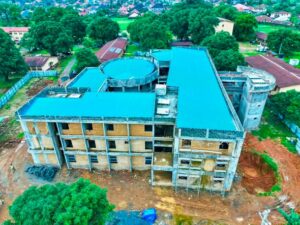

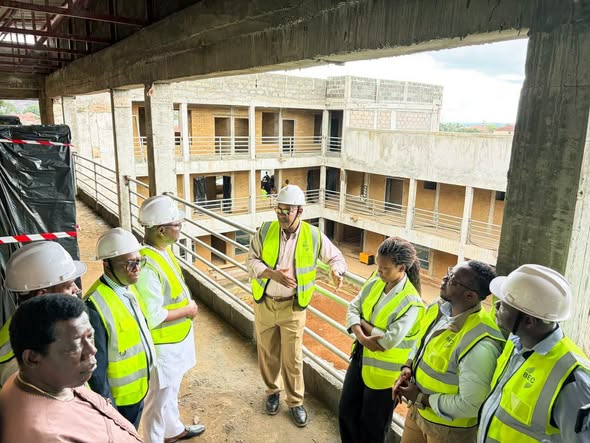
Minister of Health, Dr. Austin Demby, has inspected ongoing construction work on a modern Faculty of Basic Medical Sciences facility at the College of Medicine and Allied Health Sciences (COMAHS) in Jui, alongside other specialized health infrastructure projects at Lakkah.
The inspection, conducted on Monday, 17 August 2026, brought together senior officials and technical experts from the Ministry of Health. The delegation assessed the progress of the construction work and engaged contractors on outstanding activities and expected completion timelines.
Valued at approximately US$3.5 million, the new medical faculty is designed to accommodate about 1,500 students and serve as a centre of excellence for medical education, professional training, research and innovation.
The facility will feature advanced laboratories, interactive classrooms and modern research equipment intended to create an effective environment for teaching, practical training and scientific discovery.
Speaking during the inspection, Dr. Austin Demby said the development demonstrates the Government’s determination to strengthen healthcare education and build a competent workforce capable of addressing Sierra Leone’s changing health needs.
“We will use this facility to train the next generation of health professionals,” Dr. Austin Demby stated.
The Minister of Health and his delegation also visited specialized health infrastructure under construction at Lakkah. The projects form part of the Government’s broader strategy to connect infrastructure development with human-resource capacity and improved healthcare delivery.
Once completed and operational, the facilities are expected to significantly improve the learning and practical training experience of medical and allied health students. They will also expand Sierra Leone’s capacity to produce highly skilled healthcare professionals locally.
Minister of Technical and Higher Education, Dr. Haja Ramatulai Wurie, commended the cooperation between the Ministries of Health and Technical and Higher Education, describing the partnership as essential to strengthening medical training and expanding professional development opportunities within Sierra Leone.
Dr. Haja Ramatulai Wurie observed that Sierra Leone has historically spent considerable resources on sending medical and other specialized students abroad for further education. She noted that the country has sometimes faced difficulties ensuring that all beneficiaries return home to contribute to national development.
According to Dr. Haja Ramatulai Wurie, investing in modern domestic training facilities will reduce Sierra Leone’s dependence on overseas education, improve the use of public resources and establish a more sustainable supply of qualified professionals for the national healthcare system.
The Government believes the projects will provide an enabling environment for producing highly trained health workers while strengthening medical research, innovation and specialized healthcare delivery.
The ongoing developments at Jui and Lakkah represent a strategic investment in Sierra Leone’s human capital and support the long-term objective of establishing a resilient, self-sufficient and high-performing healthcare workforce.