

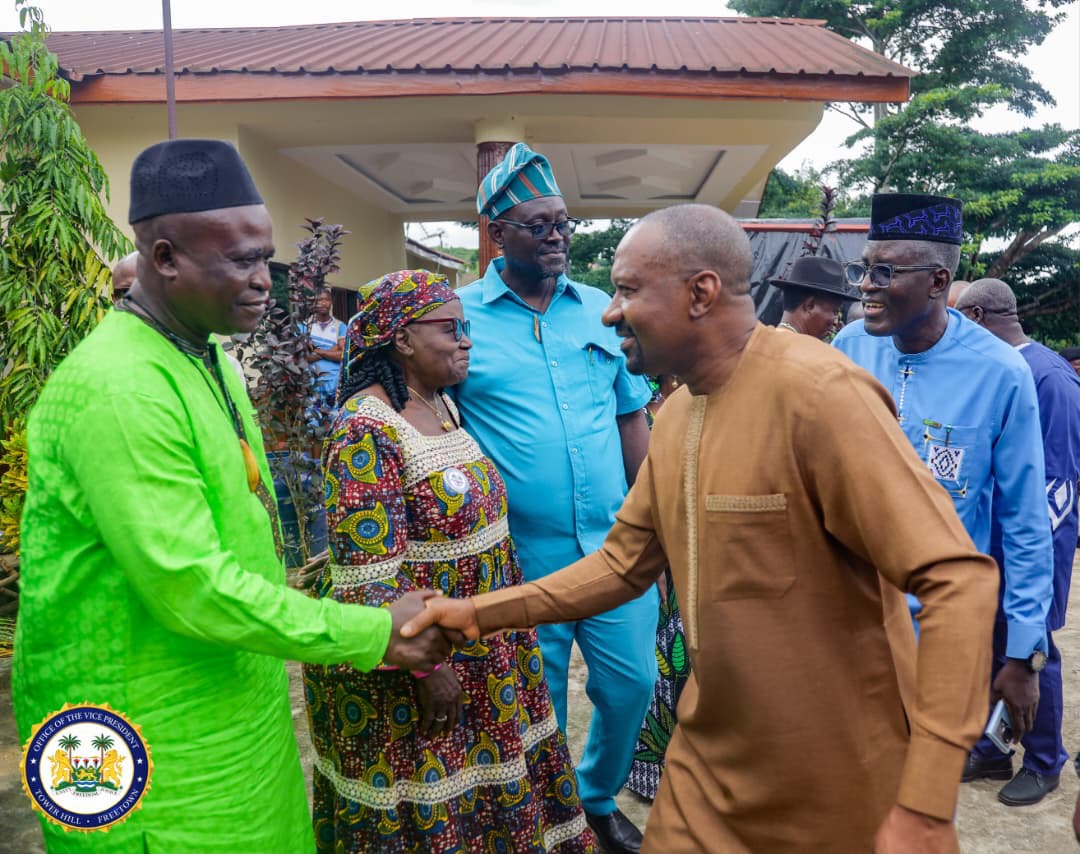
Vice President Dr. Mohamed Juldeh Jalloh’s recent engagement with local councils has renewed national attention on Sierra Leone’s decentralization programme and the need to strengthen institutions responsible for delivering essential services to citizens across the country.
Twenty-two years after Sierra Leone returned to elected local government, questions remain over whether decentralization has achieved the governance transformation envisioned when the system was revived.
The debate does not necessarily represent an indictment of decentralization. Rather, it reflects the reality that building effective local institutions is a long-term undertaking, particularly in a post-war country where restoring public confidence in state institutions remains crucial.
Decentralization was introduced to bring governance closer to citizens, increase public participation, strengthen accountability and enable local institutions to respond more effectively to community needs.
Scholars Pranab Bardhan and Dilip Mookherjee, in their work Decentralization and Local Governance in Developing Countries, argue that decentralization can expand political participation, improve accountability and strengthen the legitimacy of the state.
However, the effectiveness of the system largely depends on whether local institutions are given sufficient authority, resources and administrative capacity to perform their responsibilities.
Vice President Dr. Mohamed Juldeh Jalloh’s engagements with Mayors, District Council Chairpersons, Paramount Chiefs, Administrators and other local authorities provided an opportunity to assess the progress of decentralization, identify implementation challenges and explore possible solutions.
Five major lessons emerged from the engagements:
One of the clearest lessons from the tour was the importance of listening as a tool of governance.
Vice President, Dr. Mohamed Juldeh Jalloh’s consultations allowed local authorities to explain the realities they face while implementing national policies and providing services to their communities.
Policies developed in Freetown may appear effective on paper but encounter significant challenges when implemented in districts such as Falaba, Pujehun and other parts of the country.
Local authorities are often better positioned to identify communities experiencing rapid population growth, inadequate infrastructure and difficulties accessing essential services. They also understand where gaps exist between national policy and implementation.
The Vice President’s approach demonstrated that policymaking should be informed by evidence gathered from the communities where Government programmes are implemented.
When local authorities speak and the central Government listens, national policies can be adjusted to reflect practical realities. Effective consultation, therefore, is not merely a political gesture but an essential component of responsible public administration.
The engagements also highlighted the need for reciprocal respect and cooperation between central and local Government institutions.
Local councils are responsible for services that directly affect citizens, but they operate within a national system where the central Government continues to control policy, funding and several functions that are yet to be fully devolved.
Decentralization should therefore be viewed as a shared distribution of authority rather than simply the transfer of power from Freetown to the districts.
Some responsibilities have been devolved to councils, while others remain with Ministries, Departments and Agencies. In certain instances, responsibilities have reportedly been transferred without adequate financial and logistical resources.
Holding local institutions accountable for services they lack the authority or resources to deliver remains a major governance challenge.
By engaging directly with local leaders, Vice President Dr. Mohamed Juldeh Jalloh recognized councils as democratic institutions with their own responsibilities to citizens.
The central Government must provide the support required for councils to perform effectively. Local authorities, in turn, must demonstrate transparency, accountability and responsible management of the powers and resources entrusted to them.
Another major issue emerging from the engagements was the financial sustainability of local councils.
Population growth and urban expansion are increasing demand for waste management, drainage systems, roads, markets, healthcare facilities, sanitation and public spaces.
Communities that previously had relatively modest needs are developing into major population and commercial centres. However, the revenue available to councils has not always increased at the same pace.
Central Government transfers will continue to play an important role but sustainable local governance will also require stronger revenue mobilization, sound financial management, improved planning and expanded economic activity within localities.
The long-term success of decentralization will not depend only on the number of functions transferred to councils. It will also depend on whether local institutions have the financial and administrative capacity to manage those responsibilities.
Building the capacity of councils to raise and properly manage revenue could therefore become one of the most important tests facing Sierra Leone’s decentralization programme.
The Vice President’s tour also reinforced the view that the central Government does not have all the answers to the challenges facing communities.
One of the core principles of decentralization is that people closest to a problem are often best placed to understand it and develop appropriate solutions.
Some councils may have effective approaches to waste management, while others may have developed stronger systems for mobilizing revenue or involving residents in local decision-making.
Such initiatives should not be treated as isolated experiments. Successful practices developed by one council could be studied, adapted and introduced in other localities.
The role of central Government should therefore include identifying effective local solutions and creating the conditions necessary for them to be expanded.
Local councils can serve as centres of governance innovation, testing practical responses to community challenges and sharing successful approaches with the wider national system.
Vice President Dr. Mohamed Juldeh Jalloh’s consultations created an important platform for local experiences and ideas to influence the national conversation on governance reform.
Despite the difficulties facing local councils, there is still reason to believe in the potential of decentralization.
Sierra Leone rebuilt its local Government system following the civil war and councils have since become an important part of the country’s democratic and administrative structure.
They provide a channel through which citizens interact with the state and remain central to the delivery of essential services at the community level.
Challenges persist in relation to capacity, financing, accountability and the completion of the devolution process. However, institutional development is rarely straightforward and the system still has considerable room to grow.
Vice President Dr. Mohamed Juldeh Jalloh’s tour did not resolve every problem affecting local Government. Its significance rested in the Government’s willingness to listen, acknowledge existing challenges and explore solutions with those responsible for managing councils.
Democracy is often a slow process because it requires consultation, negotiation, compromise and the balancing of competing interests. Decentralization operates in much the same way.
The process can be difficult and sometimes produce disagreements over institutional responsibilities, resources and expectations. However, those challenges also reflect the involvement of more citizens and institutions in governance.
The tour demonstrated that decentralization remains unfinished business in Sierra Leone. Moving forward will require more meaningful devolution, sustainable financing, stronger accountability and adequate space for councils to innovate.
Government does not operate only in Freetown. Citizens experience the state in council offices, markets, healthcare facilities, schools and communities throughout the country.
By travelling to those communities and listening directly to local leaders, Vice President, Dr. Mohamed Juldeh Jalloh, reaffirmed that decentralization is more than an administrative arrangement. It is a democratic commitment to bringing responsive and effective governance closer to every citizen.