

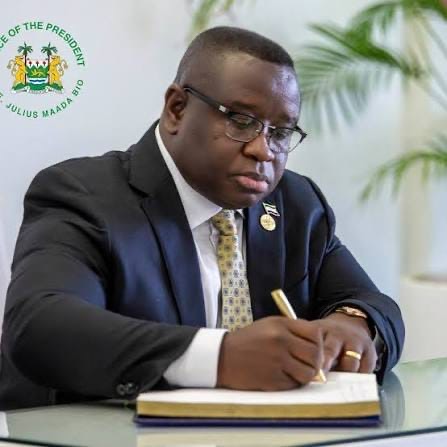
There is a version of this moment that presents a favourable outcome for everyone. Parliament has passed a Bill containing reforms Sierra Leone has pursued for more than two decades. These include a stronger electoral commission, guaranteed space for women’s political nomination and wider opportunities for dual citizens to participate in public life. President Julius Maada Bio would only need to sign the Bill to bring a long constitutional review process to an end.
I do not think it is that simple and I do not believe President Bio thinks so either.
The problem is not necessarily what Parliament did, but how it did it. Section 108(2)(b) of the 1991 Constitution requires any Bill seeking to amend the Constitution to receive the support of not less than two-thirds of Members of Parliament. In a House of 149 members, that amounts to 100 votes. It is a constitutional requirement that should not be adjusted whenever political circumstances make compliance difficult.
The opposition walked out of Parliament before the vote on 10 August 2026. The Speaker subsequently declared the Bill passed based on the votes of the members who remained in the chamber. In the same ruling, he referred the question of how the two-thirds threshold should be calculated to the Supreme Court.
That sequence is difficult to justify. Parliament effectively declared the outcome before asking the Supreme Court to determine the rule governing the vote. If the umpire is consulted only after the final score has been announced, the consultation appears to have come too late.
I understand why some people may regard this as another political dispute between the Government and the opposition. Sierra Leone’s politics is often reduced to a contest between red and green, with each side convinced that the other is acting in bad faith. However, the objections in this case have not come only from the All People’s Congress.
Nicol-Wilson and Co Firm has petitioned the Speaker, arguing that Parliament applied the wrong constitutional provision when determining the voting threshold. The Institute for Legal Research and Advocacy for Justice has described the process as a constitutional “fait accompli” because Parliament acted as though the question had already been settled before referring it to the Supreme Court.
The Sierra Leone Labour Congress, representing workers rather than politicians, has directly appealed to President Bio not to sign the Bill. Even a former Secretary-General of the ruling Sierra Leone People’s Party has described the episode as a “comedy of errors.”
When concerns are raised by legal practitioners, Civil Society Organisations, the labour movement and a former senior official of the governing party, I do not believe they can reasonably be dismissed as opposition complaints. Taken together, they represent a serious warning about the constitutional process.
I also understand the impatience of those supporting immediate presidential assent. The reform process can be traced to the 1999 Lomé Peace Agreement and has passed through the Peter Tucker Constitutional Review Commission, the Justice Edmond Cowan Constitutional Review Committee and the Tripartite Committee established after the disputed 2023 elections.
Sierra Leoneans have waited a long time for constitutional reform and I do not blame anyone for wanting the process completed. But there is a difference between a process that has taken decades and one that is rushed at the final stage simply because those involved have grown tired of waiting.
The 1991 Constitution gives the Supreme Court the authority to interpret constitutional questions. The disputed voting threshold has now been referred to the Court, which is expected to provide an authoritative interpretation. The only real question is whether the President should sign the Bill before or after that decision.
Signing it now would not end the uncertainty. It would merely transfer the dispute from Parliament to the courtroom. If the Supreme Court eventually finds that Parliament failed to secure the constitutionally required number of votes, President Bio would have assented to a Bill that was not validly passed.
I believe such an outcome would be far more damaging to the country and the President’s legacy than waiting a few months for the Supreme Court to determine the matter.
Withholding assent would not destroy the proposed reforms. The Bill would not expire, Parliament would remain in existence and its major provisions would still be achievable after the constitutional dispute had been resolved. The proposed electoral reforms, women’s nomination quota and safeguards relating to entrenched provisions would remain available for lawful enactment.
Waiting may slow political momentum and delay the satisfaction of declaring a major legislative achievement. I recognize that as a real political cost, but it is a small one compared with the possibility of adopting a landmark constitutional reform whose legitimacy could be challenged in court for years.
The Inter-Religious Council of Sierra Leone was right to remind the country that the Constitution belongs to present and future generations and should not be treated as the property of any political party.
The Citizens Advocacy Network also sought to convey a similar message through a planned peaceful march to State House, although the Sierra Leone Police reportedly denied the group clearance. I do not regard those voices as opponents of reform. I see them as citizens seeking to ensure that constitutional changes are made in a manner that protects them from future legal and political challenges.
President Bio has spent years presenting his administration as the one that would finally deliver constitutional modernization to Sierra Leone. He should not allow the final signature to cast doubt over that legacy.
In my view, this is not a choice between reform and no reform. It is a choice between reform enacted under unresolved constitutional uncertainty and reform founded on a process that commands legal and public confidence.
The Supreme Court has been asked a direct and important question. I believe the most responsible and patriotic decision President Bio can make is to wait for its answer before reaching for his pen.