
Africa must stop serving merely as a market for foreign technology and media content and become an influential producer of the innovations and stories shaping the modern world, Sierra Leone’s Minister of Information and Civic Education, Chernor Bah, has declared.
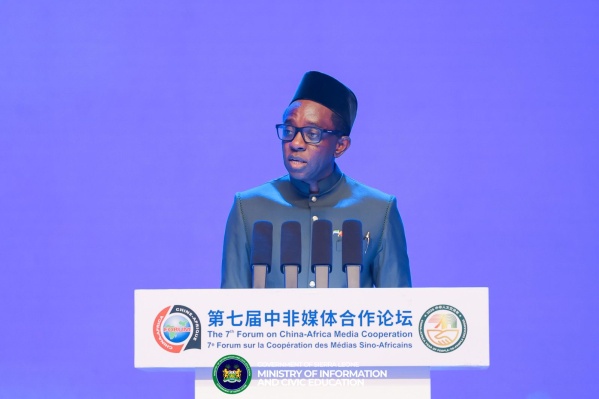
Speaking in China on 20 August 2026, Chernor Bah said the continent possesses the talent, creativity and youthful population required to play a leading role in the global media and technology industries. However, he noted that such potential could only be realized through deliberate investment in people, institutions and professional opportunities.
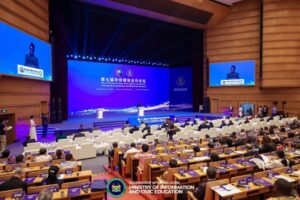
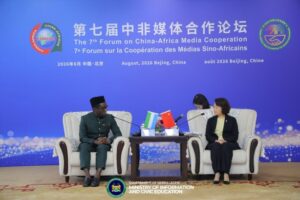
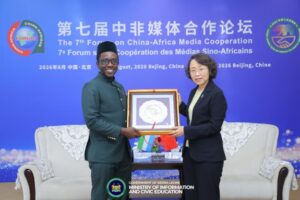
The Minister delivered the statement at the 7th Forum on China-Africa Cooperation in Radio, Television and Audiovisual Services. Ministers, Government officials and audiovisual industry representatives attended the gathering under the theme, “Share Development Opportunities, Shape the Audiovisual Future.”
Chernor Bah used his address to challenge the conventional approach to media development, which often places greater emphasis on equipment and physical infrastructure than on the professionals expected to operate and sustain them.
He maintained that modern television studios, broadcasting systems and digital platforms would produce limited results without qualified journalists, filmmakers, broadcasters, producers and technology specialists.
Investment in Africa’s audiovisual future, he argued, must therefore combine technological advancement with professional training, institutional development and ethical responsibility.
The Minister said Africa-China cooperation could make a significant difference by supporting modern broadcasting facilities, strengthening public broadcasters and creating regular training and exchange programmes for media practitioners.
For Sierra Leone, such cooperation could provide opportunities for journalists, broadcasters, filmmakers, producers and digital content creators to improve their skills and build professional relationships with their counterparts in China and other African countries.
Chernor Bah also called for increased joint production of films, documentaries and other audiovisual content. He said greater collaboration would allow Chinese audiences to gain a better understanding of African societies while enabling African audiences to learn more about China.
The Minister stressed that African countries must play a central role in determining how the continent is portrayed internationally.
For decades, he noted, much of Africa’s image abroad has been shaped by narratives produced outside the continent. He said African journalists and creative professionals must now be given the resources and platforms required to present their own experiences, cultures, achievements and aspirations.
Africa, he insisted, should not remain only the subject of stories told by other people.
The continent’s large youth population was a major focus of the Minister’s address. Chernor Bah described young Africans as the driving force behind a rapidly changing media and creative environment.
Across the continent, he said, young people are launching digital platforms, reporting news, producing films and documentaries and developing technology that is changing how African stories are created and shared.
Some are also building artificial intelligence applications with the potential to transform journalism, education, translation and content production.
“Our responsibility is to give them the tools, skills, institutions and opportunities to succeed,” he said.
Chernor Bah told the Forum that artificial intelligence could help Sierra Leone and other African countries overcome long-standing barriers in communication. The technology, he explained, could assist in preserving African languages, translating information and helping local journalists and creators connect with audiences around the world.
Despite those opportunities, the Minister warned against embracing AI without considering its possible consequences.
He said the ability of emerging technologies to distribute information quickly and widely could serve the public interest, but the same tools could also be manipulated to spread falsehoods and confusion on an unprecedented scale.
“The challenge, therefore, is not simply whether we embrace AI. It is whether we govern it wisely,” Chernor Bah stated.
He proposed stronger Africa-China collaboration in AI research, media innovation, professional training and the development of policies to guide the responsible use of new technologies.
The Minister said appropriate safeguards would be necessary to ensure that artificial intelligence promotes accurate information, social inclusion and human creativity instead of weakening professional standards and public trust.
Chernor Bah linked his message to Sierra Leone’s national development priorities, noting that credible information is important to President Dr Julius Maada Bio’s human capital development agenda.
He explained that the Government’s decision to establish the Ministry of Information and Civic Education reflected a broader understanding of the relationship between information and citizenship.
People must not only receive information, he said, but must also understand their rights, responsibilities and role in national development.
Professional and trusted media institutions, according to the Minister, help citizens make informed decisions, demand accountability and contribute constructively to public affairs.
He added that meaningful investment in human capital should give people access to reliable information, opportunities for participation and the digital resources required to function effectively in a technology-driven society.
Chernor Bah concluded by reaffirming Sierra Leone’s willingness to pursue practical partnerships with China and other African countries in broadcasting, audiovisual production, professional development and responsible artificial intelligence.
He said the objective should be to build a media sector capable of informing the public, strengthening institutions, supporting young creators and promoting Africa’s cultural identity.
“Together, let us not simply watch the future unfold. Let us inform it, tell it and shape it,” the Minister told delegates.