

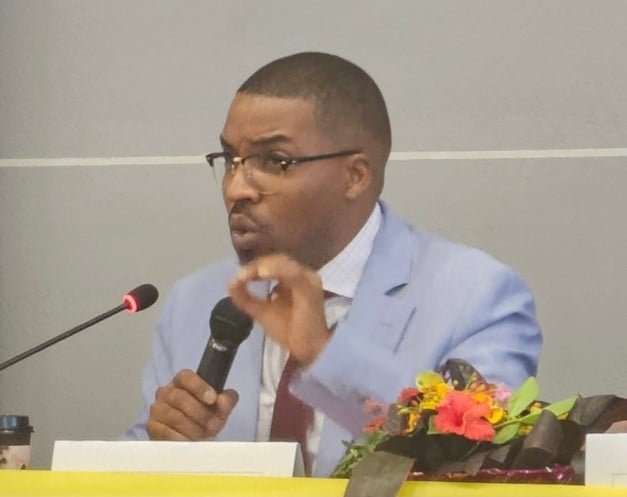
Sierra Leone has formally presented Prof. Dr. Charles Chernor Jalloh as its candidate for election to the International Court of Justice (ICJ), with Government officials calling for stronger African solidarity and greater representation of the continent in international institutions.
The call was made on Wednesday, September 2, 2026, at a high level symposium organized by the Center for International Law and Policy in Africa (CILPA) in collaboration with the Ministry of Foreign Affairs and International Cooperation at the Foreign Service Academy on Tower Hill in Freetown.
The symposium examined the contribution of the ICJ to the peaceful settlement of disputes in Africa and Sierra Leone’s engagement with international justice, ahead of the forthcoming election to the Court.
Attorney General and Minister of Justice, Alpha Sesay, said the ICJ remains particularly important to Africa and smaller states because it provides a credible avenue for resolving disputes through law rather than political or military power.
Delivering a keynote address on the role of the ICJ in Africa, Minister Alpha Sesay said the continent had experienced the devastating effects of conflict but had increasingly demonstrated a willingness to resolve disputes through judicial processes.
He cited cases involving Burkina Faso and Mali, Libya and Chad, and Cameroon and Nigeria over the Bakassi Peninsula as examples of African states using international adjudication to prevent disputes from escalating into armed confrontation.
According to him, Africa’s engagement with international institutions should, however, extend beyond using them to resolve disputes to ensuring greater representation within them.
Minister Alpha Sesay said equitable African representation remains a major foreign policy priority for Sierra Leone, pointing to the country’s advocacy for reform of the United Nations Security Council. He noted that Africa remains the only continent without permanent representation on the Council despite the significant number of African issues considered by the body.
He said the same principle of equitable representation should apply to the ICJ, while stressing that judicial independence and professional excellence must remain central to the selection of judges.
Minister Alpha Sesay argued that West Africa had a strong case for representation on the Court, given its population, number of states and contribution to international law. He said Sierra Leone’s candidature was therefore based not only on geography but also on the professional credentials of Prof. Dr. Charles Chernor Jalloh.
He commended Ghana and Nigeria, alongside other African states, for their support for Sierra Leone’s candidature and urged smaller and medium sized states to demonstrate solidarity by supporting qualified candidates from other countries.
The Minister said Sierra Leone’s own experience with international justice strengthened its case, citing the establishment of the Special Court for Sierra Leone following the country’s civil war, its membership of the UN Security Council in 2024 and 2025 and its participation in international climate change proceedings.
Minister of Foreign Affairs and International Cooperation, Mohamed Rahman Swaray, in his statement, formally presented Prof. Dr. Charles Chernor Jalloh as Sierra Leone’s candidate for the 2027 to 2036 term at the symposium.
Minister Mohamed Rahman Swaray said the candidature had received the endorsement of the Economic Community of West African States (ECOWAS) and the African Union, as well as support from states across the five geographical regions of the United Nations.
He highlighted Prof. Dr. Charles Chernor Jalloh’s extensive legal education and professional experience, including his studies in civil and common law at York University in Canada and his doctorate in international law from the University of Amsterdam.
Mohamed Rahman Swaray also pointed to Prof. Dr. Charles Chernor Jalloh’s experience with the Department of Justice of Canada, international judicial institutions and the United Nations International Law Commission, where he has contributed to the codification and progressive development of international law.
He further credited Prof. Dr. Charles Chernor Jalloh with establishing CILPA as a platform for strengthening African scholarship and professional capacity in international law.
The Foreign Affairs Minister said the combination of academic expertise, international experience and practical knowledge made Prof. Prof. Dr. Charles Chernor Jalloh qualified for the ICJ.
He said the election would ultimately be decided by member states of the United Nations through votes in the General Assembly and Security Council.
Addressing the symposium, Prof. Charles Chernor Jalloh said the ICJ remains indispensable to international peace and the peaceful settlement of disputes, particularly at a time of increasing geopolitical divisions.
He explained that the Court provides states with a judicial avenue for resolving disputes that might otherwise lead to confrontation, while also providing advisory opinions on important questions of international law.
Prof. Dr. Charles Chernor Jalloh said the growing number of cases before the Court demonstrates the importance states attach to judicial settlement, although the increasing workload also presented challenges in delivering timely decisions without compromising the quality of judicial reasoning.
He stressed that the Court’s jurisdiction ultimately rests on the consent of states, which accept its authority through treaties and other legal commitments.
The Sierra Leonean candidate said politically sensitive disputes should not weaken the application of international legal standards, arguing that the Court’s credibility depends on rigorous and impartial application of the law regardless of the parties involved.
On Africa’s relationship with the ICJ, Prof. Chernor Jalloh said African states had played an active role in international adjudication and had contributed to the development of international law.
He cited territorial and boundary disputes involving African states as evidence of the value of judicial settlement and urged countries on the continent to strengthen their capacity in international law to address emerging issues such as climate change, maritime boundaries, migration, natural resources and human rights.
Prof. Chernor Jalloh said judicial service at the ICJ must be guided by integrity, independence and impartiality, stressing that judges must remain free from political pressure and national interests.
He said the Court should also reflect the diversity of the world’s legal traditions and experiences without compromising judicial excellence.
Closing the symposium, the Minister of Information and Civic Education, Chernor Bah, urged African states, smaller states and the wider international community to support Prof. Chernor Jalloh’s candidature.
The Minister said the ICJ remains critical to ensuring that international disputes are settled through law rather than by force and that smaller states have access to credible mechanisms for protecting their interests.
He said Sierra Leone’s international engagements had demonstrated that the country could make meaningful contributions to global governance despite its size, citing its Security Council membership, international legal engagements and advocacy for reform of global institutions.
The Minister maintained that representation in international institutions should be supported by professional excellence, saying Prof. Dr. Charles Chernor Jalloh’s international legal scholarship, judicial experience and service to African and global institutions made his candidature compelling.
He disclosed that the election is scheduled for November 3, 2026, at the United Nations in New York and called on Sierra Leone’s partners, African states and the wider international community to support the candidature.
The symposium ended with a renewed call for African solidarity, stronger representation in international institutions and greater reliance on international law as a means of preventing and resolving disputes.