

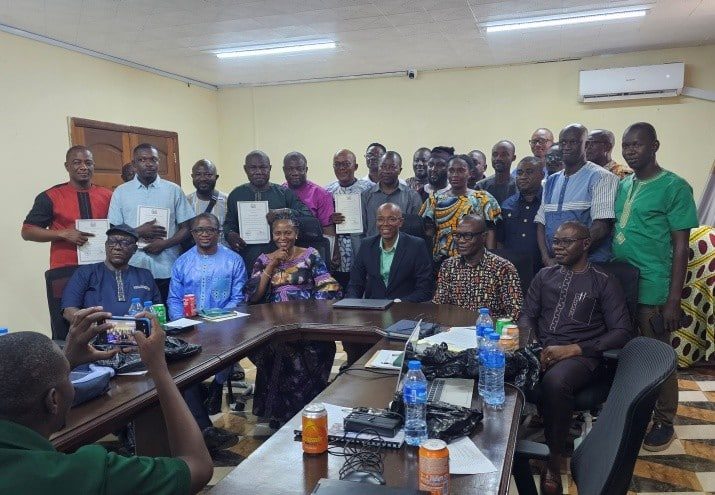
The Ministry of Lands, Housing and Country Planning has licensed 18 surveyors, with the newly licensed professionals urged to uphold high standards of professionalism, integrity and public service in the discharge of their duties.
The certification and licensing ceremony was held on Friday, September 11, 2026, at the Ministry’s headquarters, Youyi Building in Freetown.
Addressing the ceremony, Minister of Lands, Housing and Country Planning, Dr. Turad Senesie, said the granting of the licences marked the beginning of a new professional journey and not the end of learning. He urged the surveyors to demonstrate their professionalism through the quality, accuracy and integrity of their work rather than through titles.
Dr. Turad Senesie stressed that the licences carry significant responsibilities, particularly because surveying has direct implications for land ownership, development and the resolution of property disputes. He encouraged the surveyors to value their clients, maintain professional independence and ensure that their decisions and actions remain within the law and the public interest.
He warned against compromising professional standards because of pressure from clients or other individuals, noting that deliberate violations of professional rules could amount to dishonesty or criminal conduct.
The Minister also called for continuous professional training to strengthen the capacity of surveyors and improve the quality of surveying services across the country. He expressed concern over the limited representation of women in the profession, as it was only one female amongst the 18 surveyors and he called for more women to pursue and obtain licences as land surveyors.
In his statement, the Commissioner General of the National Land Commission, Abu Bakarr Sappay Foray-Musa, said the licensing of the new cohort came at a critical time in Sierra Leone’s land reform process, particularly as the country moves towards a modern Land Title Registration System.
He said competent and technologically equipped surveyors are essential to effective cadastral surveying, which provides the foundation for recording land rights and issuing secure land titles.
He described licensed surveyors as critical partners in the work of the National Land Commission, noting that their role is particularly important in ensuring that survey work undertaken within the land administration system is properly certified.
He said lessons from a recent land administration study tour to Ghana and Kenya demonstrated the importance of close coordination between surveying and land registration institutions. According to him, Sierra Leone must develop a similar institutional relationship as it advances its land reform programme.
The Commissioner General urged the newly licensed surveyors to use their professional status to help restore public confidence in land administration, provide greater certainty over land rights and contribute to reducing land disputes.
He assured them that the National Land Commission would continue working with the Ministry, licensed surveyors and other stakeholders as preparations continue towards land registration.
Speaking also, Director of Surveys and Lands at the Ministry of Lands, Housing and Country Planning, Tamba Sahr Dauda, said the licensing of the surveyors represent both a professional achievement and a public trust, stressing that practitioners must combine technical competence with integrity and accountability.
Tamba Dauda explained that the licensing process is governed by the Survey Act, Cap. 128 of 1950, which regulates land surveying and provides for the enrolment, examination and licensing of qualified surveyors.
He said the law restricts surveying for fee or reward to duly qualified and authorized persons and places professional responsibilities on licensed surveyors, including accountability for survey plans and the submission of relevant records to the Directorate of Surveys and Lands.
He noted that surveying is closely linked to law, land ownership, development and community interests, with accurate surveys helping to establish property boundaries, reduce disputes, support secure land tenure and guide infrastructure and physical development.
Tamba Dauda urged the newly licensed surveyors to accept only assignments within their competence, verify field observations and calculations, maintain proper records and avoid signing or endorsing work they had not undertaken or adequately supervised.
He also encouraged them to respect the rights of landowners and occupiers, protect survey marks and comply with lawful requirements for the submission and preservation of survey records.
While acknowledging the growing use of satellite positioning, digital mapping, Geographic Information Systems and other modern surveying technologies, Tamba Dauda cautioned that technology should complement rather than replace professional judgement, field verification and ethical responsibility.
He concluded that the Directorate remains committed to strengthening professional oversight, improving the approval of survey plans, maintaining reliable land records and supporting reforms aimed at creating a more efficient, transparent and accessible land administration system.
Speaking on behalf of the newly licensed surveyors, Ing. Gabriel Sannoh said the 2026 cohort recognized surveying as an important technical profession with a direct contribution to national development.
Ing. Gabriel Sannoh said proper mapping and surveying are fundamental to several areas of development, including structural engineering, urban planning, transportation, water distribution and infrastructure development.
He emphasized the role of accurate surveys and reliable professional records in preventing land and boundary disputes, noting that unclear property boundaries had contributed to conflicts and prolonged court cases in the past.
He pledged that the newly licensed surveyors would continue to improve their technical knowledge and practical skills and use their expertise to respond to the country’s development needs.
The ceremony formally welcomed the 18 surveyors as licensed practitioners, with authorities urging them to uphold accuracy, professionalism, transparency and respect for the law as Sierra Leone continues its land administration reforms.