
Former President Ernest Bai Koroma and the Independent Commission for Peace and National Cohesion have expressed readiness to collaborate on preventive peacebuilding, early warning, dialogue, reconciliation and national cohesion in Sierra Leone.
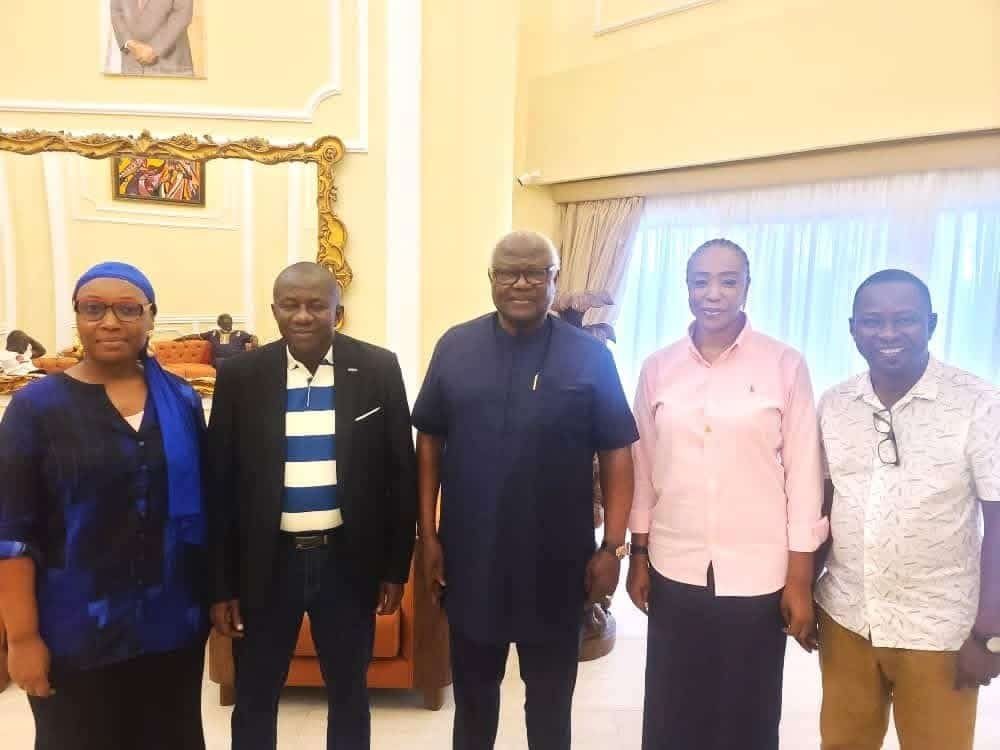
The commitment emerged during a meeting on Saturday, 12 September 2026, when a delegation from the Commission visited Former President Ernest Bai Koroma following his return to the country.
The delegation was led by the Commission’s Board Chairman, Reverend Shodankeh Johnson, and included Executive Secretary Hawa Sally Samai; Director of Conflict Prevention Adikalie Sheku Kamara; and Deputy Director of Communications and Outreach Hawa Barrie.
Reverend Shodankeh Johnson welcomed Former President Ernest Bai Koroma and expressed appreciation for his continued engagement with the Government and other national stakeholders.
Reverend Shodankeh Johnson reflected on Sierra Leone’s progress in maintaining peace and stability and assured the Former President of the Commission’s commitment to working with individuals and institutions whose experience and influence could contribute to national cohesion.
Responding, Former President Ernest Bai Koroma said he was pleased to be back home and expressed appreciation for the visit by the Commission’s leadership.
Former President Ernest Bai Koroma clarified that his return was not connected to any new official position. He said he had returned as a retired President who intended to devote attention to peace, national cohesion and development.
He stressed the need for Sierra Leone to place greater emphasis on preventive peacebuilding, noting that peace efforts should not receive attention only when tensions or crises emerge.
According to Former President Ernest Bai Koroma, periods of relative calm provide valuable opportunities to identify early warning signs, address grievances and strengthen relationships before disagreements develop into serious conflicts.
He encouraged the Commission to continue strengthening its early warning and preventive mechanisms instead of relying on what he described as a “fire brigade” approach to conflict resolution.
Former President Ernest Bai Koroma maintained that identifying risks at an early stage would enable the Commission and other stakeholders to respond more effectively and prevent disputes from escalating.
He also informed the delegation about plans to establish a foundation focusing on peace, good governance and democracy. He said the initiative could create opportunities for collaboration with the Commission.
Former President Ernest Bai Koroma disclosed that he had informed President Dr. Julius Maada Bio about the planned foundation and reaffirmed his willingness to contribute to national peacebuilding efforts.
Drawing on experiences from other West African countries, he highlighted the important role former Heads of State could play in promoting dialogue, mediation and peacebuilding.
He cited the work of the West African Elders Forum, noting that several countries in the region had benefited from the knowledge and experience of former national leaders when addressing complex national and regional challenges.
Former President Ernest Bai Koroma said Sierra Leone could similarly draw on the experience of its former leaders to complement the work of institutions mandated to promote peace, reconciliation and national cohesion.
Presenting the Commission’s Annual Report, Executive Secretary Hawa Sally Samai said the Former President’s emphasis on prevention reflected the direction the Commission had increasingly adopted during its five years of existence.
Hawa Sally Samai explained that the Commission encountered several conflicts requiring immediate intervention when it commenced operations, resulting in a largely reactive approach.
She said experience had demonstrated that responding to conflicts only after they had escalated was neither sufficient nor sustainable. This, she added, informed the Commission’s deliberate shift towards prevention and the establishment of community-based structures capable of identifying and addressing tensions at an early stage.
Hawa Sally Samai highlighted the contributions of Peace Monitors, Peace Mediators, Paramount Chiefs, civil society organisations and district civil society peace coalitions to the Commission’s early warning and response mechanisms.
She also drew attention to the Commission’s 898 Toll-Free Hotline, which allows citizens to report emerging tensions and other issues that could threaten peace within their communities.
The Executive Secretary said the Commission was also working to understand the underlying causes of conflict through studies examining disputes at the chiefdom level and a pilot initiative supported by the United Nations Development Programme.
She stressed the importance of identifying the country’s vulnerabilities and strengthening local systems through which communities could peacefully resolve disagreements before they escalated.
Hawa Sally Samai further highlighted the Commission’s engagement with schools and universities to promote a culture of peace among young people and strengthen their role in peaceful coexistence and national cohesion.
At the national level, she briefed Former President Ernest Bai Koroma on the Commission’s efforts to assess progress on major peace agreements and recommendations that have shaped Sierra Leone’s post-war peacebuilding process.
She said the Commission was working with relevant Ministries, Departments and Agencies to assess the implementation of the Truth and Reconciliation Commission recommendations. An update on the status of their implementation is expected to be published before the end of 2026.
Hawa Sally Samai also referenced ongoing work relating to the Tripartite Committee recommendations, the Agreement for National Unity and the Lomé Peace Agreement, reflecting the Commission’s wider mandate to support peace, national cohesion and democratic governance. She noted that several recent recommendations were similar to issues previously identified by the Truth and Reconciliation Commission.
With the Commission marking its fifth anniversary, Hawa Sally Samai said it would continue drawing on the knowledge and experience of respected national personalities, including Former President Ernest Bai Koroma, to strengthen its peacebuilding interventions and provide guidance where necessary.
She also briefed him on the Commission’s planned Peace and National Cohesion Symposium scheduled for October 2026 as part of activities commemorating its fifth anniversary.
The meeting concluded with both sides expressing their readiness to explore practical areas of collaboration, particularly in preventive peacebuilding, early warning, dialogue, reconciliation and national cohesion. The Commission’s work also comes ahead of its planned Peace Walk and related national cohesion activities.
Former President Ernest Bai Koroma reaffirmed his willingness to work with the Commission, stressing that sustaining Sierra Leone’s peace required continuous investment in prevention, dialogue and national cooperation, even during periods of relative calm.