

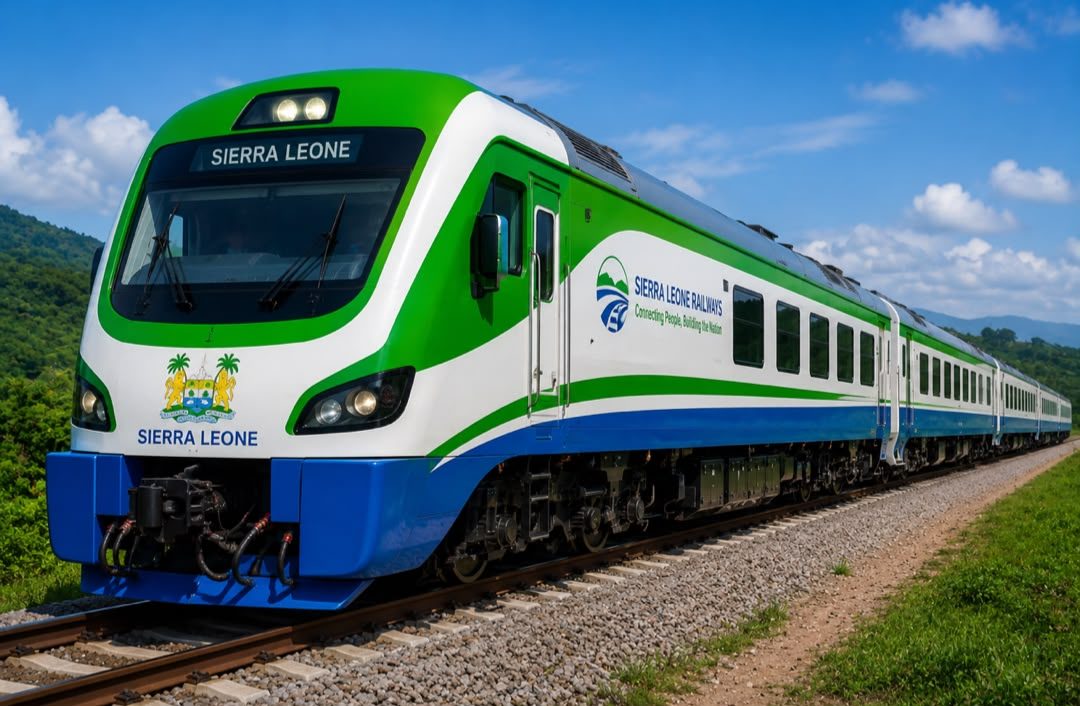
The Sierra Leone Railways Development and Regulatory Authority (SLRDRA) has presented a comprehensive report on its first year of operations to the Office of the President, highlighting significant progress in institutional development, railway infrastructure planning, regulatory reforms and investment mobilisation aimed at restoring and modernizing the country’s railway transportation system.
The report, submitted to the Secretary to the President on Friday, 9 October 2026, provides an account of the Authority’s achievements, operational challenges and strategic priorities as it works towards establishing a safe, efficient and sustainable national railway network.
Established under the Sierra Leone Railways Development and Regulatory Authority Act, No. 7 of 2025, the institution has been mandated to provide the regulatory and technical framework necessary to support railway development, attract investment and strengthen transportation connectivity across Sierra Leone.
During its first year, the Authority concentrated on building the institutional structures required to execute its mandate while undertaking preliminary assessments of potential railway corridors and developing policies intended to guide future railway operations.
One of its notable achievements was the official commissioning of its headquarters at 16 Perry Avenue, off Wilkinson Road in Freetown, on 21 May 2026. The establishment of the office marked an important step towards making the institution fully operational and accessible to stakeholders.
The Authority also recruited 17 staff members to support its administrative, technical and regulatory responsibilities, laying the foundation for the development of a professional workforce capable of overseeing the country’s emerging railway sector.
A major component of the Authority’s first-year activities involved preliminary investigations into Sierra Leone’s former railway network, which once connected several important commercial, agricultural and mining communities.
Between June and August 2026, with financial support from the Ministry of Planning and Economic Development, the SLRDRA conducted pre-feasibility surveys to assess potential railway routes and identify opportunities for future infrastructure development.
The exercise involved consultations with 21 district and municipal authorities and the collection of 144 Global Positioning System (GPS) reference points across 26 towns and stations associated with the country’s colonial-era railway system.
Particular attention was given to the former Freetown–Pendembu main railway line and the Bauya Junction–Makeni–Kamabai branch line, both of which historically contributed to the movement of passengers, agricultural produce and commercial goods.
Information gathered during the surveys is expected to provide an important basis for more detailed feasibility studies, preliminary engineering designs and the identification of financing opportunities for priority railway corridors.
The Authority believes that proper planning and investment could eventually support improved transportation links between production centres, mining communities, commercial settlements and export facilities.
Beyond infrastructure assessments, the SLRDRA has made progress in developing the legal and regulatory instruments necessary to ensure effective oversight of railway operations.
Among these initiatives is the preparation of the draft Railway and Cable Car Regulation, 2026, which seeks to establish standards covering railway safety, operational procedures, infrastructure planning, environmental compliance and development activities.
The proposed regulatory framework is intended to provide clearer guidance for railway operators, investors and other stakeholders while promoting accountability and compliance with established safety requirements.
The Authority has also developed a draft Five-Year Strategic Plan covering 2026 to 2030, outlining its institutional priorities and proposed programmes for strengthening railway governance and development.
The strategic document identifies 22 objectives under five major pillars, with an estimated implementation cost of US$14.1 million. This amount excludes the substantial capital investment that would be required for actual railway construction.
Another significant development is the preparation of a draft railway investment proposal focusing on strategic mining corridors.
The proposed investment programme covers approximately 891 route-kilometres and seeks to connect four mining locations with five export outlets.
Such infrastructure, if eventually developed, could strengthen the transportation of minerals and other bulk commodities while providing opportunities for improved logistics and commercial activities.
The proposed railway corridors could also contribute to reducing pressure on major roads currently used for transporting heavy mining equipment and mineral products, although their economic and technical viability will depend on further assessments.
Recognising the importance of sustainable financing, the SLRDRA has additionally prepared a proposed cargo levy and licence-fee framework intended to strengthen its revenue-generating capacity.
According to the Authority’s projections, the proposed arrangements could generate approximately US$33.4 million between 2027 and 2031, subject to the necessary legal approvals, budgetary procedures and successful implementation.
The anticipated revenue would potentially provide financial support for regulatory activities, institutional development and other responsibilities associated with the railway sector.
However, despite the progress recorded, the Authority acknowledged several challenges that continue to affect its operational capacity.
Among the principal concerns is the absence of an approved statutory instrument to introduce the proposed cargo and surface levies. Licence fees and railway safety-permit charges have also not yet become operational.
Consequently, the institution remains substantially dependent on government financial support to undertake its programmes and meet its administrative obligations.
The report further identifies shortages of specialised personnel in important technical areas, including railway engineering, safety regulation, economic regulation, concession management and public-private partnership arrangements.
These professional competencies are considered essential for supervising railway infrastructure projects, evaluating investment proposals and ensuring that future operators comply with national regulatory requirements.
Limited technical equipment and operational resources also present difficulties for the Authority as it seeks to expand its activities beyond preliminary planning and institutional establishment.
To address these challenges, the SLRDRA has emphasised the need for continued government support, particularly in advancing the approval of its proposed regulations and revenue measures.
The institution is also seeking resources to strengthen staff capacity, acquire essential equipment and support the preparation of a comprehensive National Railway Master Plan.
The proposed Master Plan would provide a coordinated framework for identifying priority railway corridors, conducting detailed feasibility studies and determining appropriate investment and implementation arrangements.
It would also help establish a clearer long-term direction for railway development, taking into consideration economic opportunities, infrastructure requirements, environmental considerations and national transportation priorities.
In the meantime, the Authority considers bridging financial assistance necessary to sustain its operations while the proposed revenue-generating mechanisms undergo the required approval processes.
The submission of the first-year report represents an important accountability exercise, providing the Presidency with an overview of the institution’s achievements and the outstanding requirements for advancing Sierra Leone’s railway development agenda.
Although the country remains at an early stage in rebuilding its railway infrastructure, the progress reported by the SLRDRA demonstrates efforts to establish the institutional, regulatory and investment-planning foundations needed for future development.
The Authority’s next major challenge will be translating its preliminary surveys, strategic proposals and draft regulations into approved policies, bankable investment projects and practical infrastructure development.
With adequate technical expertise, sustainable financing and continued institutional coordination, the proposed railway development programme could eventually contribute to improved transportation efficiency, stronger trade connections and greater economic opportunities across Sierra Leone.
The SLRDRA’s first-year achievements therefore mark an initial stage in what is expected to be a long-term national effort to develop a modern, reliable and interconnected railway system capable of supporting the country’s economic transformation.