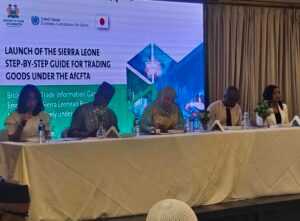

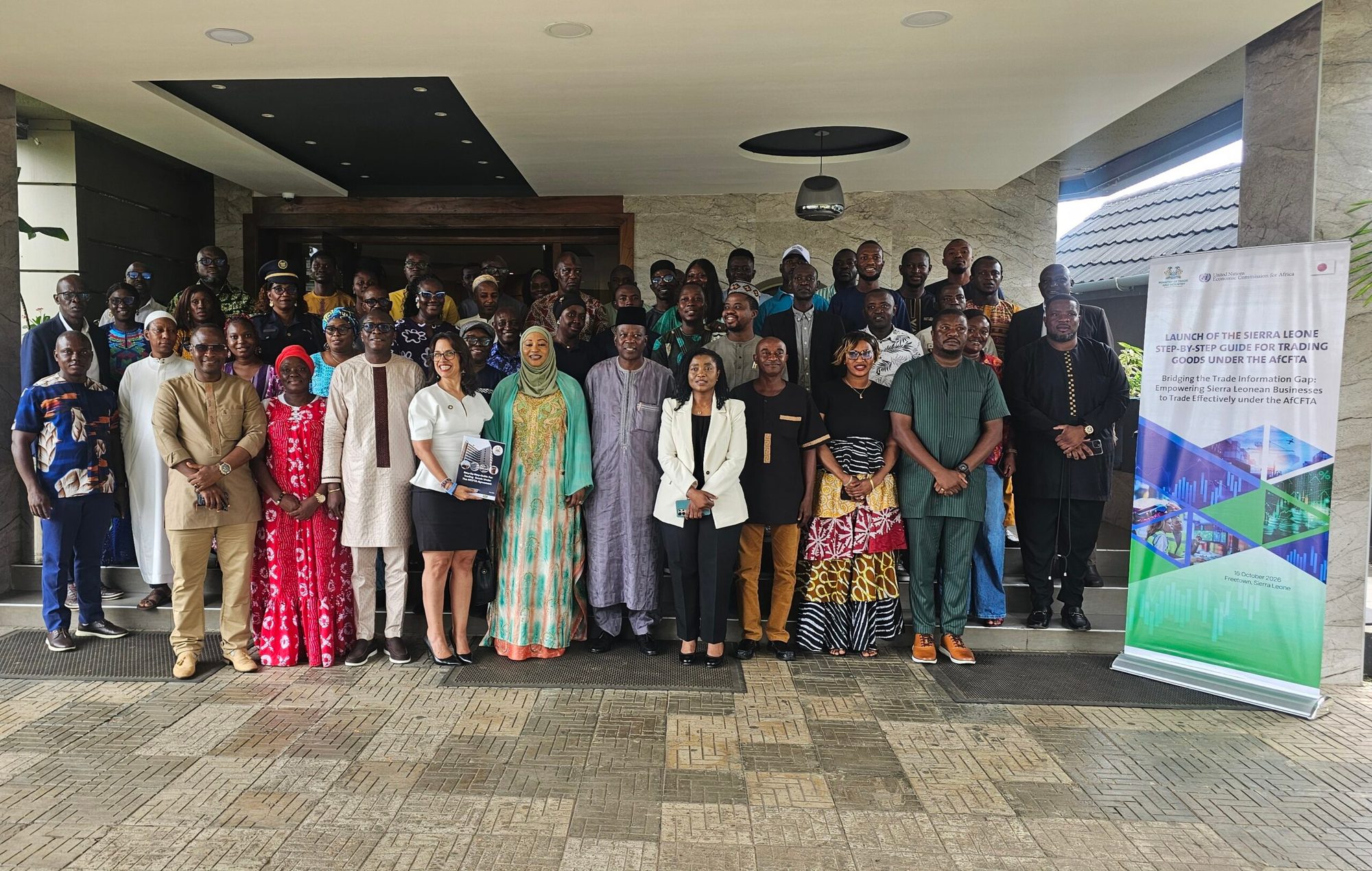
The Ministry of Trade and Industry, with technical support from the United Nations Economic Commission for Africa (UNECA) and financial support from the Government of Japan, has officially launched the Sierra Leone Step-by-Step Guide for Trading Goods under the African Continental Free Trade Area (AfCFTA), aimed at helping local businesses navigate trade procedures and access opportunities across the African market.
The launch took place on Friday, 16 October 2026, at Lagoonda Hotel in Aberdeen, Freetown, bringing together Government officials, private-sector representatives and development partners to discuss how Sierra Leonean businesses could participate more effectively in intra-African trade.
The Guide was developed to address challenges businesses face in accessing clear and consolidated information on AfCFTA trading procedures. It provides practical guidance on export and import processes, documentation requirements, regulatory obligations and the institutions responsible for administering trade procedures, with particular attention to micro, Small and Medium-Sized Enterprises (MSMEs), women-owned businesses and youth-led enterprises.
Speaking at the event, Sierra Leone Chamber of Commerce President, Oluniyi Robbin-Coker, said the success of the AfCFTA should be measured by the markets businesses entered, the goods they exported, the investments they attracted and the jobs they created, rather than the number of agreements signed or guides produced.
He explained that the Chamber had participated in consultations and workshops leading to the finalization of the Guide but noted that businesses continue to face challenges, including limited access to affordable trade finance, high transportation and logistics costs, difficulties meeting product standards, inadequate market information, limited connections with buyers and delays at border crossings.
Oluniyi Robbin-Coker recalled an experience more than three decades ago when he accompanied a cigarette importer whose consignment was reportedly stopped at 17 checkpoints on the journey to Guinea. He questioned how much progress had been made in addressing such obstacles and called for a structured mechanism through which the private sector could report trade barriers and monitor efforts to resolve them.
He stressed that small businesses, women and young entrepreneurs must benefit from the agreement, noting that more than 65 per cent of the Chamber’s members were micro, small and medium-sized enterprises. He also highlighted the need to improve maritime connections within West Africa, strengthen port operations, reduce trade costs and expand access to export training, trade finance, market information and potential buyers.
Delivering remarks on behalf of the United Nations Resident Coordinator in Sierra Leone, Silvio Vides described the launch of the Guide and its accompanying trade information portal as an important step towards helping businesses benefit from the continental free trade area.
She said the AfCFTA offered access to a market of more than 50 African countries, approximately 1.4 billion people and a combined gross domestic product exceeding US$3 trillion. However, she noted that the agreement alone would not automatically increase trade, as businesses need clear and accessible information about regulations, documentation, customs procedures and the institutions responsible for facilitating trade.
Silvio Vides said the Guide had been developed through consultations involving Government institutions and private-sector stakeholders, with technical assistance from UNECA and financial support from Japan. She urged the authorities to complement its launch with awareness campaigns, practical training and business advisory services to ensure that traders, particularly women, young entrepreneurs and small businesses, could use it to reach new markets, create jobs and contribute to inclusive economic development.
Emmanuel Billy Konjoh, Chief Director and Professional Head at the Ministry of Trade and Industry, said the Government’s responsibility is to create an enabling environment for the private sector, which he described as a key driver of economic growth.
He explained that trade is governed by rules and procedures, making it important for businesses to understand the requirements for accessing markets under the AfCFTA. He said the Ministry remains committed to improving trade protocols and addressing time-consuming processes that could increase costs and affect the quality of goods.
Emmanuel Konjoh expressed hope that by the following year, the country would be able to measure the value of trade conducted under the agreement, including the exchange of goods between Sierra Leone, Botswana and Chad. He also acknowledged UNECA’s support in developing trade, special economic zone and industrial strategies.
Referring to the country’s manufacturing sector, Emmanuel Konjoh said that, following the rebasing of the economy, manufacturing’s contribution to gross domestic product had increased from 8 per cent to 22 per cent. He said the Government is targeting 25 per cent by the end of 2026, with a longer-term ambition of reaching 35 per cent, while urging businesses to make practical use of the Guide.
Delivering the keynote address, Deputy Minister of Trade and Industry, Madam Haja Fatmata Kamara, called on Sierra Leonean producers, exporters and entrepreneurs to take advantage of the opportunities offered by the AfCFTA, stressing that the new Guide was designed to bridge the trade information gap and make it easier for businesses to participate in regional commerce.
She said the continental market, with approximately 1.4 billion people and a combined economic output of about US$3.4 trillion, presented significant opportunities for Sierra Leonean businesses to expand beyond the domestic market, increase exports and contribute to job creation.
Madam Fatmata Kamara explained that the Guide provided practical information on business registration, export documentation, rules of origin, market requirements, certificates of origin, customs procedures and the institutions traders could approach for assistance. She said the information was intended to reduce confusion, delays, repeated visits to offices and other difficulties businesses encountered when trading across borders.
She outlined steps taken by the Government to prepare for the agreement, including the development of a national trade strategy, the updating of the national export strategy for 2025 to 2030, efforts to align domestic laws and regulations with AfCFTA requirements and the establishment of a national implementation committee bringing together Government, private-sector representatives and development partners.
She also highlighted progress in preparing Sierra Leone’s commitments on trade in goods and its participation in the AfCFTA Guided Trade Initiative, noting that the Government is working to translate the agreement into practical benefits for businesses and the wider economy.
Madam Fatmata Kamara further announced that the Guide would be developed into a digital AfCFTA trade information platform, allowing businesses to access information by phone or computer and enabling updates as trade rules and procedures changed.
She thanked UNECA, the Government of Japan, private-sector stakeholders and Ministry staff for their contributions to the development of the Guide, while emphasizing that its success would depend on businesses putting the information into practice.
“The guide must work and it will work,” she said, urging local producers and exporters to improve the competitiveness of their goods and seize opportunities to sell across the African continent.
The launch marks a step in Sierra Leone’s efforts to strengthen implementation of the AfCFTA and improve collaboration between public and private-sector stakeholders. The Guide is expected to help businesses better understand trade requirements and identify opportunities to expand exports and imports within Africa. Its long-term impact, however, will depend on effective dissemination, practical use by businesses and continued efforts to address the financial, logistical and regulatory barriers affecting trade.