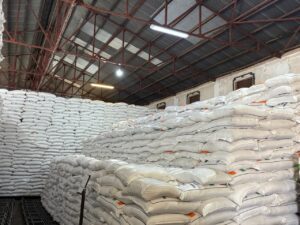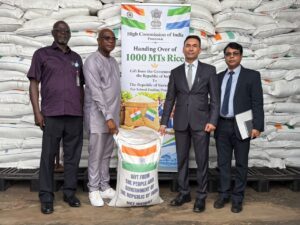

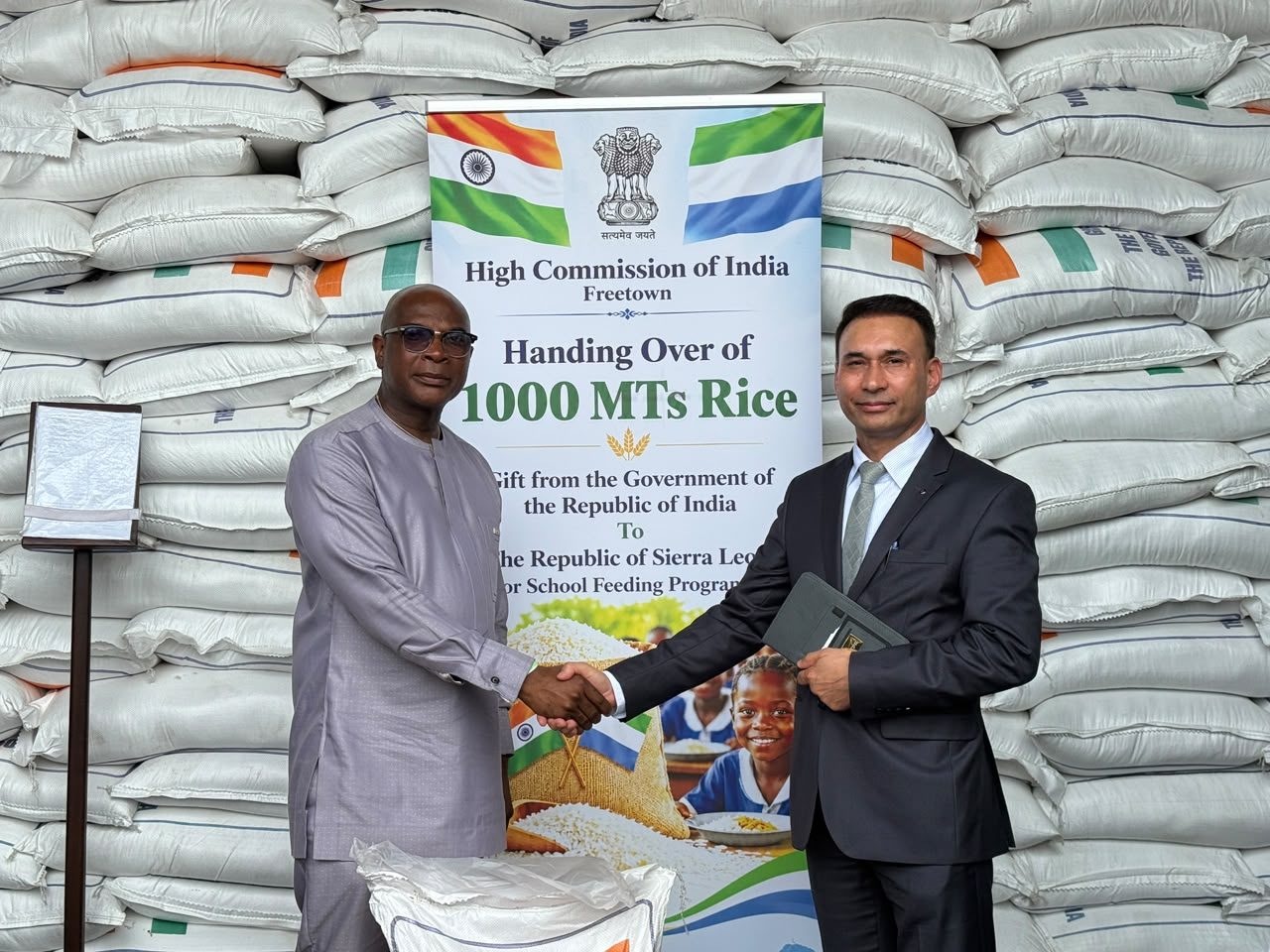
The Government of India has officially handed over 1,000 metric tonnes of rice to the Government of Sierra Leone in support of the National School Feeding Programme, reinforcing its commitment to improving food security, child nutrition and access to quality education. The handing-over ceremony took place on Tuesday, 3 November 2026, at the World Food Programme (WFP) warehouse in Kissy, Freetown, where the Indian High Commissioner to Sierra Leone, Norbu Negi, formally presented the consignment to the Minister of Basic and Senior Secondary Education, Conrad Sackey.
Speaking at the ceremony, Norbu Negi described the donation as another demonstration of the longstanding friendship between India and Sierra Leone, emphasizing that the assistance would support thousands of schoolchildren, particularly those from vulnerable households.
He explained that providing nutritious meals in schools encourages enrolment, improves attendance, reduces dropout rates and helps children concentrate on their studies.
“This rice is meant for the children of Sierra Leone. A meal at school brings children to the classroom, keeps them in school and helps them grow healthy and strong,” Norbu Negi stated.
He further noted that school feeding programmes support girls’ education by encouraging families to keep their daughters in school while reducing the financial burden on struggling households.
Drawing attention to India’s experience, Norbu Negi disclosed that his country operates one of the world’s largest school feeding initiatives, known as PM POSHAN, which provides hot cooked meals to more than 100 million children every school day.
He explained that the initiative has demonstrated the importance of school meals in improving nutrition, attendance and learning outcomes.
According to Norbu Negi, the donation aligns with President Julius Maada Bio’s development priorities, particularly Feed Salone and Human Capital Development, two of the Government’s Big Five Game Changers under the Medium-Term National Development Plan.
He added that the assistance complements Sierra Leone’s Free Quality School Education programme by addressing nutritional challenges that could prevent children from benefiting fully from classroom instruction.
Highlighting India’s broader development cooperation with Sierra Leone, Norbu Negi recalled that his Government provided US$50,000 in humanitarian assistance following the devastating floods and mudslide of 2017.
During the COVID-19 pandemic, India also supplied Sierra Leone with 1,000 metric tonnes of rice and more than 7,000 kilograms of medicines valued at nearly US$150,000.
He further disclosed that India supplied 15 haemodialysis machines in 2026 to strengthen kidney care services in Sierra Leone.
Norbu Negi explained that India’s development partnership follows the principle of “Sabka Saath, Sabka Vikas”, meaning working together for the development of all, particularly vulnerable communities.
Under this approach, India is supporting a US$990,000 project through the India-UN Development Partnership Fund, implemented by the United Nations Development Programme (UNDP), to improve opportunities for persons with disabilities.
The project involves establishing and strengthening vocational training centres in six districts to promote skills development, employment and self-employment.
Turning to capacity building, Norbu Negi disclosed that India provides 86 annual training opportunities for Sierra Leonean Government officials through the Indian Technical and Economic Cooperation (ITEC) Programme.
He said more than 200 Sierra Leonean officials have benefited from the programme during the past three financial years.
Additionally, India offers 50 fully funded scholarships annually through the Indian Council for Cultural Relations (ICCR), enabling Sierra Leonean students to pursue undergraduate, postgraduate and doctoral studies.
The High Commissioner also highlighted approximately US$250 million in concessional Lines of Credit supporting projects in irrigation, drinking water, agricultural equipment, street lighting, electricity transmission and education.
Among those investments is the US$32 million University of Science and Technology project in Koidu.
Norbu Negi expressed India’s readiness to strengthen cooperation under Feed Salone through agricultural machinery, improved seeds, irrigation facilities, farmer training and food-processing technologies.
He reaffirmed India’s commitment to Sierra Leone’s development, invoking the philosophy of “Vasudhaiva Kutumbakam”, meaning “the world is one family”.
“As we hand over this rice today, let us remember that its true value lies in the children it will feed, the families it will support and the education it will help sustain,” he stated.
Receiving the donation on behalf of President Julius Maada Bio and the Government of Sierra Leone, Minister of Basic and Senior Secondary Education, Conrad Sackey, expressed appreciation to India for supporting the country’s educational and nutritional priorities.
Conrad Sackey described the consignment as an important contribution towards ensuring that children, particularly those from disadvantaged families, receive nutritious meals while attending school.
Drawing attention to the relationship between hunger and learning, Conrad Sackey referred to an African saying: “A hungry child cannot hear the teacher.”
He explained that although children may be physically present in classrooms, hunger can prevent them from concentrating and understanding lessons.
Conrad Sackey maintained that access to education must extend beyond opening school gates, stressing that pupils require adequate support to remain in school and achieve meaningful learning outcomes.
He observed that school feeding improves attendance, supports girls’ education and provides children with more equitable learning opportunities regardless of their families’ financial circumstances.
“School feeding keeps the child in the classroom. It improves attendance, supports girls to stay in school and gives every pupil a fair chance to succeed, regardless of family income,” Conrad Sackey stated.
The Minister described India’s donation as evidence of a partnership founded on mutual respect, cooperation and a shared commitment to human development.
“This gift speaks to a friendship built on shared values and a common belief that education is the surest path to national development,” he remarked.
Conrad Sackey assured the Indian Government, development partners and Sierra Leoneans that the donated rice would be managed responsibly and distributed transparently to beneficiary schools.
“I give this assurance to our partners and to the people of Sierra Leone that every bag of this rice will be accounted for,” he declared.
He emphasized that the Ministry would ensure the consignment reaches its intended beneficiaries.
Concluding, Conrad Sackey stressed that investing in children’s nutrition represents an investment in Sierra Leone’s future.
“With this support, our children will carry the load of learning, and they will carry Sierra Leone forward,” he stated.
The ceremony concluded with the symbolic presentation of the rice by Norbu Negi to Conrad Sackey, marking another contribution to Sierra Leone’s National School Feeding Programme and the continuing development partnership between the two countries.