

By Amin Kef Sesay / Reporting from Yan’an, China
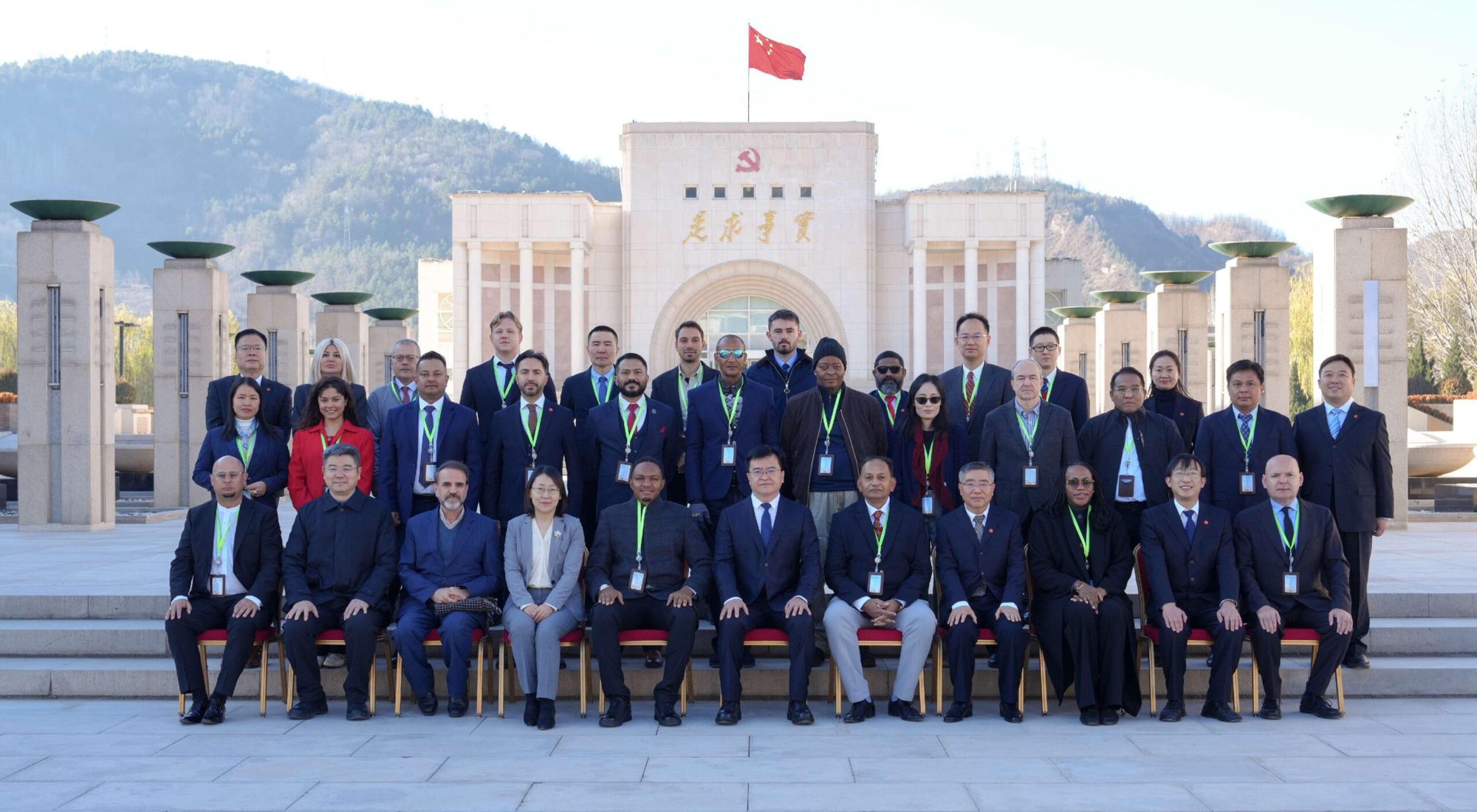
China has brought together 31 international participants from 24 countries, including Sierra Leone, for a high-level seminar examining political leadership, governance innovation, poverty reduction and people-centred development, as part of efforts to strengthen international cooperation and promote the exchange of development experiences.
The engagement, held on Monday, 9 November 2026, at the China Executive Leadership Academy Yan’an (CELAY), formed part of the Seminar on Theoretical and Practical Innovation of Political Parties, which seeks to deepen participants’ understanding of the Communist Party of China’s (CPC) political philosophy and its application to economic and social development.
The programme took place in Classroom 8 of the Academy’s Teaching Building in Yan’an, a historic city in northern Shaanxi Province, northwest China, situated on the Loess Plateau along the Yan River.
Yan’an occupies a prominent place in China’s revolutionary history and remains an important centre for political education, leadership training and the study of the CPC’s development experiences.
The opening ceremony was chaired by Wang Jigang, Vice President of CELAY, with formal addresses delivered by Li Shufeng, Executive Vice President of CELAY, and Ali Salum Hapi, Head of the Seminar participants.
The meeting also attracted senior Chinese officials, including Ji Hongtao, Deputy Director-General of the Department of International Exchange and Training Development; Shi Rui, Director of the Foreign Training Division; and Guo Rui, Director of the General Affairs Division.
Other officials included Xu Min, Deputy Director-General of the Bureau of Public Information and Communication of the International Department of the CPC Central Committee (IDCPC); Hu Xiaodong, Director of the International Communication Division; and Gao Jinxiao, Deputy Director-General of the Foreign Affairs Office of the CPC Shaanxi Provincial Committee.
A central feature of the programme was a lecture delivered by Wang Tao on the theme, “Stay True to Original Aspiration and Founding Mission of the CPC — On General Secretary Xi Jinping’s People-Centered Development Philosophy.”
The presentation examined China’s approach to governance, particularly the principle that development policies should prioritise citizens’ welfare, improve living standards and ensure that economic progress benefits communities.
Wang Tao’s presentation highlighted the CPC’s stated commitment to poverty reduction, educational opportunities, healthcare accessibility, employment creation, rural development and environmental sustainability.
Participants were introduced to China’s targeted poverty-alleviation strategy, which emphasises identifying disadvantaged households, allocating resources according to specific needs, implementing development programmes and monitoring results.
According to Chinese Government statistics presented during the lecture, the number of rural residents living below China’s official poverty threshold declined from approximately 98.99 million in 2012 to zero by the end of 2020.
The presentation further examined measures involving agricultural production, relocation assistance, social security, education and ecological compensation, which China identifies as important components of its poverty-reduction programme.
Attention was also given to the relationship between effective political leadership, institutional accountability and the implementation of development policies.
Another important aspect of the seminar was the emphasis on educational equity, healthcare improvement and digital transformation, including the expanding role of technology in agricultural production and rural commerce.
The lecture also addressed China’s broader development planning, highlighting efforts to strengthen public services, improve housing conditions, modernise infrastructure and promote environmentally sustainable economic growth.
Following the classroom session, participants visited Liangjiahe Village in Wen’anyi Town, Yanchuan County, where they examined the historical experiences of Chinese President Xi Jinping during the seven years he spent living and working in the community as a young man.
The educational visit, guided by Li Jingyi, provided participants with insights into grassroots leadership, rural development and the historical experiences that Chinese authorities associate with President Xi Jinping’s people-centred development philosophy.
Through on-site explanations and exchanges, delegates explored the relationship between community participation, political leadership and efforts to improve rural livelihoods.
The visit also provided an opportunity to reflect on how local development initiatives can contribute to national economic transformation.
Among the international participants was Amin Kef Sesay, an investigative journalist and Managing Editor of The Calabash Newspaper in Sierra Leone, who described the seminar as informative, well-structured and relevant to its objectives.
According to Amin Kef Sesay, the lecture provided valuable insights into the CPC’s people-centred development philosophy and the importance of leadership that prioritises citizens’ welfare.
He observed that the presentation encouraged reflection on how public policies could improve living conditions and recommended incorporating additional practical examples from developing countries, particularly African nations, to strengthen comparative learning.
Commenting on the visit to Liangjiahe Village, Amin Kef Sesay described the experience as educational, noting that it demonstrated the historical relationship between grassroots leadership, community development and national transformation.
He further recommended more interactive discussions and practical comparisons between China’s rural development experiences and those of African countries, particularly Sierra Leone.
The seminar also comes against the backdrop of China’s growing emphasis on international cooperation and its Global Governance Initiative, which advocates sovereign equality, multilateralism, international rule of law, people-centred development and practical cooperation.
For Sierra Leone, China’s experiences present opportunities for further examination in agriculture, vocational education, infrastructure development, industrialisation, technology transfer and youth employment.
However, translating such experiences into practical national policies would require careful consideration of Sierra Leone’s economic circumstances, institutional arrangements and development priorities.
The programme will continue with visits to other historical and development institutions across China, allowing participants to examine additional aspects of the country’s political, economic and social transformation.
The Yan’an seminar ultimately provides a platform for international dialogue, knowledge-sharing and comparative learning, while encouraging participants to consider how effective leadership and development policies can deliver measurable improvements in citizens’ lives.