
A new study by ‘Engage Salone’ has revealed that 55 percent of respondents want local councils in Sierra Leone to receive more powers and funding, highlighting growing public demand for stronger decentralization, improved service delivery and effective local governance.
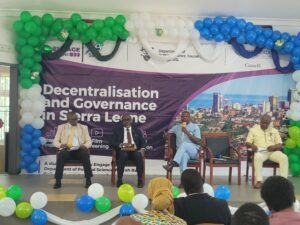
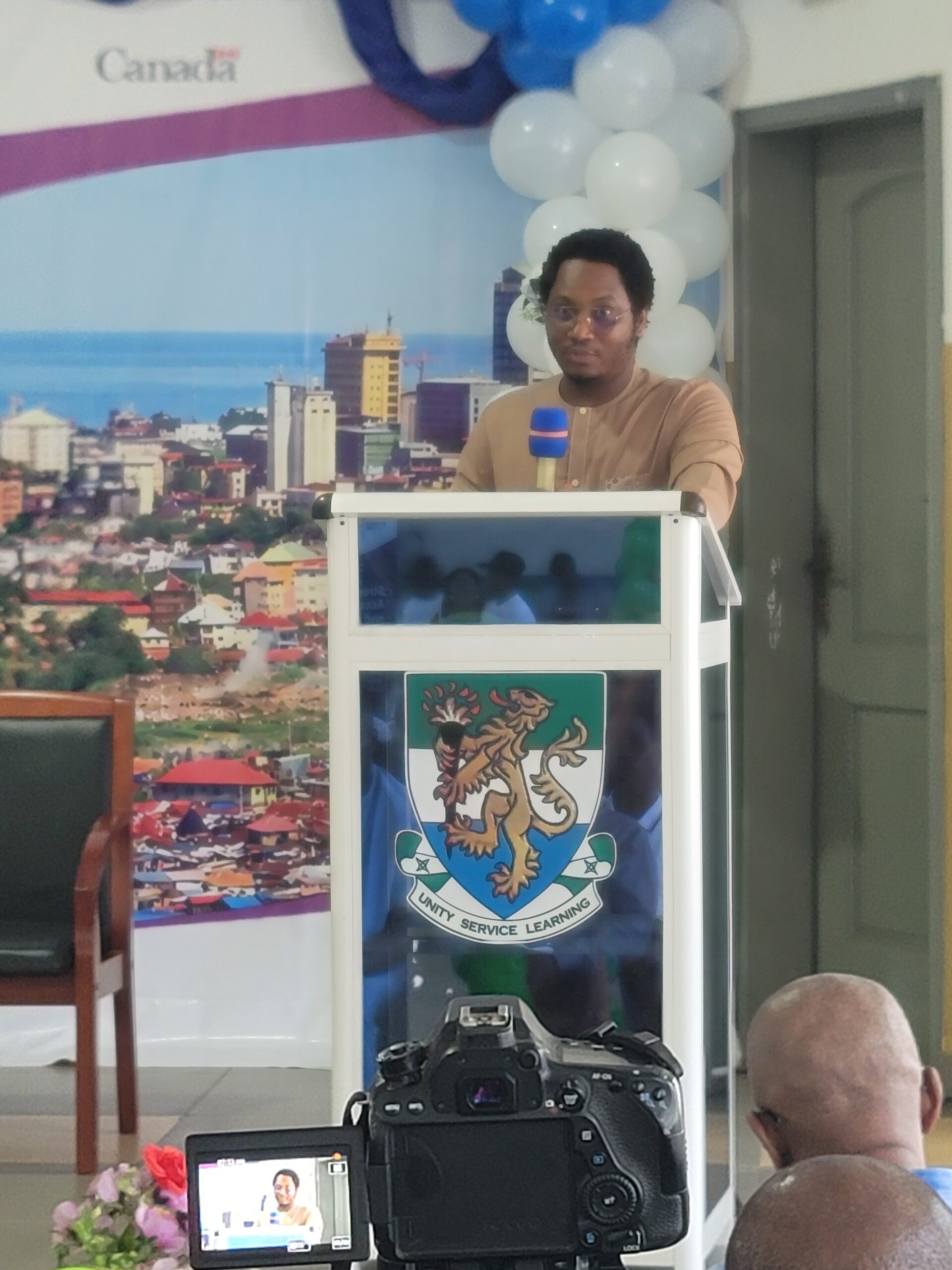
The findings were presented on Thursday, 26 November 2026, during the launch of a research report on decentralization and governance in Sierra Leone at the Multi-Purpose Hall, Fourah Bay College, Freetown.
The study, conducted in partnership with the Department of Political Science at Fourah Bay College under the Strengthening Accountability and Governance through Evidence (SAGE) project, also found that 48 percent of respondents believe decentralization has improved community life, while 49 percent said it has not brought improvements.
The research examined decentralization across six local council areas: Western Area Urban, Western Area Rural, Bo, Makeni, Kono and Port Loko. It focused on the politicization of local governance, informal practices such as patronage and ethnic loyalties, service delivery, climate resilience, institutional capacity and citizen participation.
Among its key recommendations, the report calls for the transfer of functions and financial resources to local councils to be made transparent, accessible and more difficult to reverse.
It recommends that the Government of Sierra Leone publish an authoritative schedule of devolved functions and their funding status, while the Ministry of Finance should publicly disclose the formula for allocating resources and actual quarterly disbursements to individual councils.
The report further calls on Parliament to organize annual public hearings on devolution and recentralization, while urging local councils to strengthen ward-level consultations, improve the visibility of councillors and publish summaries of expenditure at ward level.
Civil Society Organisations, the media and development partners are also encouraged to sustain non-partisan monitoring at district level and promote public disclosure to strengthen transparency and accountability.
Speaking at the event, Special Adviser on Public Sector Reform, Dr. Emmanuel Ngaima, reflected on the historical development of decentralization in Sierra Leone, particularly the enactment of the Local Government Act of 2004.
He explained that the legislation established political localities, defined administrative jurisdictions and provided a framework for the devolution of Government functions.
Dr. Emmanuel Ngaima said the decentralization process was driven by the need to address the marginalization of rural communities, bridge the gap between the central Government and citizens, rehabilitate damaged community infrastructure and tackle growing inequalities in society.
He highlighted the original expectations underpinning decentralization, providing historical context for the research findings and ongoing discussions surrounding the effectiveness of local governance in Sierra Leone.
Earlier, the Deputy Registrar of Fourah Bay College said decentralization remains an important development issue, given the need to understand how power, resources and decision-making responsibilities are transferred from Freetown to districts, chiefdoms and communities.
He emphasized that evidence-based research is essential to addressing governance challenges, adding that partnerships between academic institutions and Civil Society Organisations could help bridge the gap between research and practical policy implementation.
The Deputy Registrar further noted that Fourah Bay College could benefit from the practical field experience of Civil Society Organisations, while contributing its analytical expertise, archival resources and trained researchers to examine local governance and service delivery.
The Head of the Department of Political Science at Fourah Bay College, Dr. Mamoud Tarawallie, also emphasized the importance of strengthening the university’s research and community service responsibilities alongside teaching.
He explained that universities were established to perform three core functions: teaching, research and community engagement. However, he noted that research had remained challenging due to limited resources, inadequate access to data and insufficient research skills and experience among some faculty members.
Dr. Mamoud Tarawallie said the partnership with Engage Salone provided an opportunity to advance those institutional responsibilities.
He further announced that the Department of Political Science would introduce a Bachelor of Science programme in Electoral Management and Political Studies in the next academic year, with decentralization, local governance and elections forming part of its academic content.
Meanwhile, Executive Director of Engage Salone, Edward Kargbo, explained that the SAGE project was designed to go beyond conventional research reporting by combining evidence generation, multimedia storytelling, public engagement and policy advocacy.
He said the organisation is exploring an integrated approach aimed at translating research findings into accessible stories and taking discussions back to communities.
According to Edward Kargbo, the intention is to ensure that evidence generated through research reaches the wider public and contributes meaningfully to national discussions on development and governance.
Edward Kargbo also disclosed that Engage Salone plans to undertake further research into Sierra Leone’s civic space in 2027, with the objective of examining changes in the operating environment for Civil Society Organisations, the media and other stakeholders.
He said the organisation intends to develop a civic space tracker that could serve as a collaborative tool for Civil Society Organisations, the police, media practitioners and Government institutions.
During a panel discussion on funding challenges facing local councils and issues surrounding approval authority, Chairman of Parliament’s Committee on Local Government and Community Affairs, Hon. Peter Yaba Koroma, reaffirmed Parliament’s commitment to strengthening oversight and accountability in local Government administration.
He said Parliament is gradually moving away from being perceived solely as an institution that investigates local authorities towards becoming a supportive partner while maintaining its constitutional oversight responsibilities.
Hon. Peter Yaba Koroma cited an incident in Kenema involving a contractor who reportedly failed to complete a project, explaining that Parliament had given the contractor a one-month ultimatum to complete the work.
He disclosed that the contractor had since began taking action, adding that Parliament would continue to exercise its oversight and enforcement powers to promote accountability and support local authorities.
The report launch brought together policymakers, academics, civil society representatives and other stakeholders to examine the research findings and discuss their implications for decentralization, democratic governance, accountability and sustainable development in Sierra Leone.