

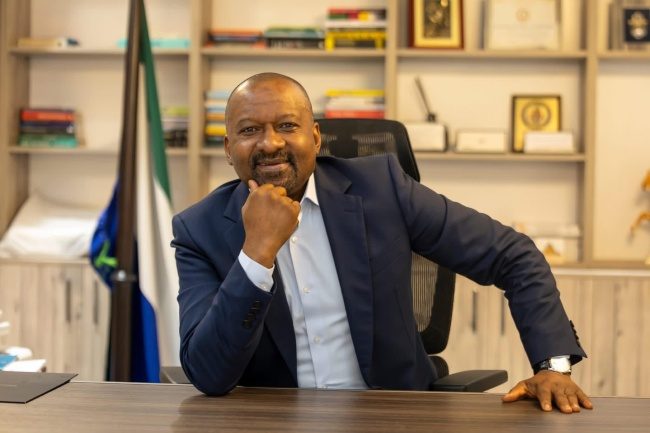
Sierra Leone has recorded an impressive score of 80 percent in its assessment under the Extractive Industries Transparency Initiative (EITI), according to the 2025 Global Progress Report, reflecting the country’s progress in promoting transparency, strengthening accountability and ensuring the responsible management of its natural resources.
Vice President, Dr. Mohamed Juldeh Jalloh, whose office provides oversight of Sierra Leone’s implementation of the EITI, announced the achievement through his official Facebook page, emphasizing that accountability remains fundamental to building public confidence in Government and safeguarding public resources.
The Vice President described the assessment outcome as significant, underscoring the importance of effective institutional mechanisms in promoting transparency, responsible governance and financial discipline across public institutions.
“Trust in Government is earned through accountability,” Dr. Mohamed Juldeh Jalloh stated.
He disclosed that the Government had established a joint Accountability Group comprising the Auditor General, the Anti-Corruption Commission and the Financial Secretary to strengthen institutional coordination and ensure that recommendations arising from audit findings are acted upon.
The initiative seeks to improve public financial management, address institutional weaknesses and strengthen mechanisms for protecting public resources against mismanagement.
“That is why we brought the Auditor General, the Anti-Corruption Commission and the Financial Secretary together in one Accountability Group so that audit findings are acted on,” the Vice President explained, adding that: “Strong institutions protect public money.”
Sierra Leone’s performance under the EITI framework reflects ongoing efforts to improve transparency in the extractive sector, which remains an important component of the country’s economy, revenue generation and national development aspirations.
The Extractive Industries Transparency Initiative is an internationally recognized standard that promotes the open and accountable management of oil, gas and mineral resources. Established in 2003 and headquartered in Oslo, Norway, the initiative operates across more than 50 implementing countries, encouraging transparency in natural resource governance, combating corruption and ensuring that revenues generated from extractive activities benefit citizens.
The Vice President’s latest remarks on accountability come against the backdrop of his recent reflections on his extensive academic and professional journey in state-building, post-conflict reconstruction, institutional development and governance.
Drawing on decades of experience in international peacebuilding, political affairs and public service, Dr. Mohamed Juldeh Jalloh highlighted his longstanding interest in understanding the circumstances that lead to state collapse and the mechanisms through which countries rebuild their institutions and restore stability.
“How does a state collapse and how is it rebuilt? I have spent most of my life on that question,” he stated.
The Vice President disclosed that his doctoral research at the University of Bordeaux in France focused on addressing that fundamental question, laying the academic foundation for his subsequent professional engagements in conflict resolution, governance and institutional transformation.
He explained that he spent nearly two decades pursuing those interests through international assignments, including post-conflict reconstruction work with the United Nations in Kosovo, analyzing political developments in West Africa for the International Crisis Group and serving in political affairs at the United Nations Office for West Africa and the Sahel (UNOWAS).
Those engagements provided him with extensive exposure to the complexities of conflict prevention, peacebuilding, political stability and the reconstruction of state institutions.
Reflecting on Sierra Leone’s development trajectory, Dr. Mohamed Juldeh Jalloh maintained that nation-building remains an ongoing process requiring collective responsibility, sustained commitment and active citizen participation.
“My conclusion then is my conviction now. The Sierra Leonean state is still in construction and every one of us has a part in building it,” he emphasized.
The Vice President further announced that over the next four weeks, he would share additional insights into his personal and professional journey, ongoing Government initiatives and his perspectives on Sierra Leone’s future development.
“Over the next four weeks I will share more of that journey, the work we are doing,and where I believe Sierra Leone is going,” he stated.
His emphasis on accountability, institutional effectiveness and collective responsibility reinforces the importance of strengthening governance structures to consolidate Sierra Leone’s democratic and developmental gains.
While the country’s 80 percent EITI assessment score represents a positive milestone, sustaining that progress will require continued institutional reforms, effective implementation of audit recommendations, public access to information and greater accountability in the management of extractive sector revenues.
Ultimately, translating transparency commitments into tangible improvements in public service delivery and citizens’ welfare remains essential to ensuring that Sierra Leone’s abundant natural resources contribute meaningfully to sustainable and inclusive national development.