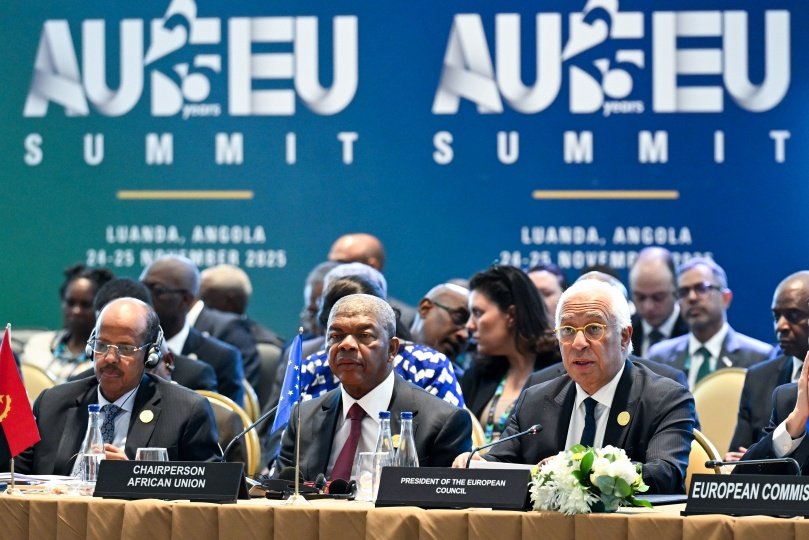
Leaders of the African Union (AU) and the European Union (EU) have renewed their commitment to a stronger, more dynamic partnership at the 7th AU–EU Summit held from 24–25 November 2025 in Luanda, Angola. The high-level gathering, co-chaired by Angolan President ,João Manuel Gonçalves Lourenço, European Council President António Costa, AU Commission Chair Mahamoud Ali Youssouf and European Commission President Ursula von der Leyen, marked 25 years of the AU–EU strategic partnership and reaffirmed the Joint Vision for 2030.

Addressing the Summit, President António Costa underscored the importance of unity in a world marked by rising geopolitical tensions. “Africa and Europe stand stronger together,” he said. European Commission President Ursula von der Leyen stressed that both continents now “need each other more than ever” amid global trade disruptions and competitive pressures.
The two blocs committed to advancing cooperation that supports job creation, sustainable economic diversification and access to capital, technology and resources.
Africa and Europe reaffirmed their commitment to open, rules-based trade, with the EU maintaining its position as Africa’s largest trading partner. Notable developments highlighted at the Summit included:
- Strengthened support for the African Continental Free Trade Area (AfCFTA);
- Progress on regional connectivity projects, especially the Lobito Corridor, which recently facilitated Angola’s first export of avocados to Europe;
- Enhanced collaboration on regional value chains, particularly in critical minerals.
President von der Leyen cited the EU’s Global Gateway initiative as a model for fostering local job creation and value addition. The initiative has already mobilized over EUR 120 billion, with a target of EUR 150 billion by 2027.
Recognizing that Africa possesses 60% of the world’s finest solar resources yet receives only 2% of global clean-energy investment, leaders pledged decisive action to close that gap. Key commitments include:
- Providing clean electricity to 100 million people by 2030;
- Scaling renewable energy generation through a EUR 15.5 billion global pledge under the G20;
- Over EUR 400 million from Team Europe to support clean cooking initiatives.
“A just transition must be for all and it must be made in Africa,” President von der Leyen emphasized.
The Summit reiterated the importance of global peace grounded in the UN Charter, including respect for sovereignty and territorial integrity. Leaders called for immediate de-escalation in Sudan and the Democratic Republic of Congo and reaffirmed support for peace efforts in Ukraine, the occupied Palestinian Territory, the Sahel and Somalia.
They further highlighted the need for predictable UN financing for AU-led peace support operations and closer cooperation to counter terrorism, organized crime, hybrid threats and disinformation.
A central pillar of the renewed partnership is investment in people, especially young Africans. The AU and EU agreed to:
- Enhance cooperation in education, research, skills development and innovation;
- Expand mobility for students, researchers and academics;
- Adopt a balanced, humane approach to migration, including improved legal pathways and measures for dignified return and reintegration;
- Strengthen diaspora engagement as drivers of innovation and investment.
As the UN marks its 80th anniversary, the two blocs pledged to jointly advocate for reforms that make multilateral institutions more representative and effective. This includes reforming global financial systems, boosting climate ambition and supporting extensive reform of the World Trade Organisation ahead of the 2026 Ministerial Conference in Cameroon.
The AU and EU agreed to finalize a joint implementation plan within six months, enhance follow-up through the Joint Monitoring Report and prepare for the 8th AU–EU Summit in Brussels.
Both sides expressed deep appreciation to President João Lourenço and the people of Angola for their warm hospitality and the successful hosting of the milestone Summit.