By Alvin Lansana Kargbo
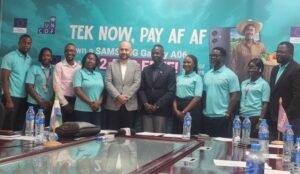
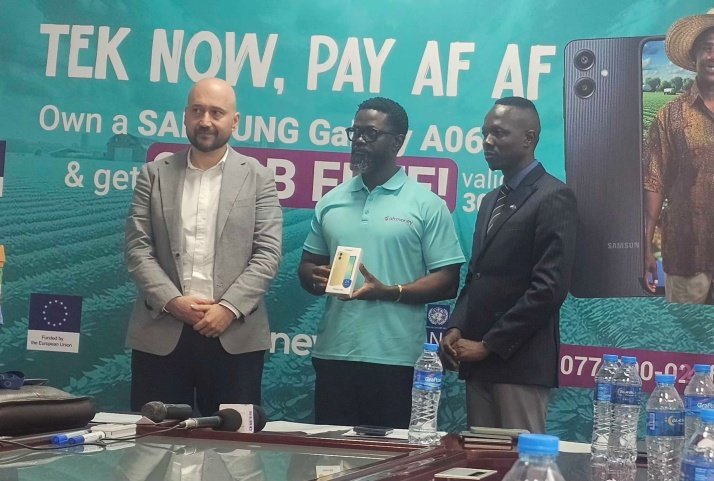
AfriMoney, in partnership with the United Nations Capital Development Fund and with funding support from the European Union, has launched a pay-as-you-go smartphone initiative targeting farming communities across Sierra Leone.

The programme, branded “Tek Now, Pay Af Af”, introduces the Samsung Galaxy A06 bundled with 2.5 Gb of free data, enabling farmers to access digital tools and information services. The initiative was unveiled on Thursday 9th April, 2026 at Africell headquarters in Wilberforce, Freetown.
Under the scheme, farmers can acquire the device with an initial deposit of 365 Leones and complete payments over time through flexible daily, weekly, or monthly instalments aligned with their income patterns.
Leon Obeng Nkansah, Device Manager, Business Development at Africell Sierra Leone, who doubles as the project lead said the initiative had been in development since 2024 and was designed to address persistent barriers to digital inclusion. He noted that farmers often lack access to smartphones while working in remote areas, limiting their ability to check market prices and weather updates.
Nkansah said the pay as you go model was introduced to remove affordability constraints and bring underserved groups into the digital ecosystem. He added that the programme reflects broader development priorities supported by international partners to ensure inclusive access to technology.
Chief Executive Officer of AfriMoney, Martison Obeng-Agyei, said agriculture remains central to Sierra Leone’s economy, with an estimated 60 to 75 per cent of the population engaged in the sector. He stated that the initiative targets not only farmers but the wider agricultural value chain, including traders, transporters, and households.
He said the distribution of smartphones is intended to improve access to information rather than entertainment, enabling users to benefit from digital content related to farming practices, market trends, and weather conditions. He added that increased connectivity would allow development partners to deliver timely information directly to rural users.
Obeng-Agyei said the initiative could evolve to include dedicated applications providing agronomic advice and market data. He noted that the flexible repayment structure was informed by transaction trends within the mobile money ecosystem, ensuring alignment with users’ earning cycles.
He said nationwide distribution would be supported by training and user education, with regional campaigns scheduled to begin on April 17 and device availability expected from April 20. He projected that within three to six months, the smartphones would reach farming communities across the country.
Speaking at the launch, Firus Shukorov, Team Lead at the United Nations Capital Development Fund, highlighted the structural gaps in Sierra Leone’s digital landscape despite widespread mobile connectivity. He said that while the country records approximately 8.94 million active cellular connections, internet usage remains low, with only a fraction of the population actively online.
He noted disparities in access between urban and rural areas and between men and women, as well as low levels of digital literacy. He said the initiative addresses both affordability and access barriers by combining device financing with mobile money services.
Shukorov said mobile money has become a key driver of financial inclusion, with significant growth over the past decade, but emphasized that most transactions remain basic and that deeper integration with digital services is still limited.
He said the PAYGO smartphone initiative is expected to improve access to market information, strengthen financial inclusion, and enhance resilience among rural populations through better access to digital tools.
He said that UNCDF support would focus on ensuring affordability, consumer protection, digital literacy, and interoperability with national systems to maximise impact and sustainability.
Representing the European Union, Franco Manso Marrah said the initiative reflects the EU’s commitment to supporting inclusive digital transformation in Sierra Leone.
He said the programme directly addresses inequalities in access to technology by targeting rural farming communities that are often excluded from digital and financial systems. He noted that affordability remains one of the biggest barriers to smartphone adoption and described the pay as you go model as a practical solution tailored to local economic realities.
He said the EU’s support is aimed at ensuring that digital tools translate into tangible economic benefits, particularly through improved access to market information, financial services, and communication channels.
He added that strengthening digital inclusion in agriculture has the potential to improve productivity, enhance food security, and create new economic opportunities across the value chain. He said the EU will continue to work with partners to support scalable solutions that empower communities and drive sustainable development.
The initiative is expected to play a significant role in bridging the digital divide in rural Sierra Leone by expanding access to smartphones, improving digital literacy, and strengthening the integration of farmers into the country’s growing digital and financial ecosystem.