

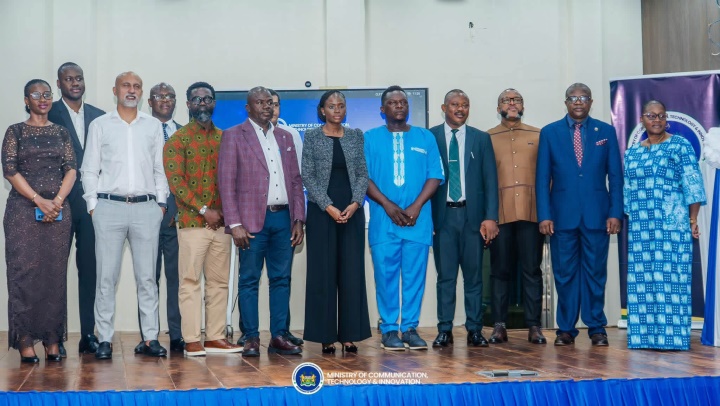
The Ministry of Communication, Technology and Innovation, in partnership with the National Communications Authority (NatCA) and other key stakeholders, has on Wednesday, 19 August 2026, concluded a two-day National Consultative Workshop to Develop a Roadmap Against Mobile Money Fraud in Sierra Leone, aimed at strengthening coordination, consumer protection, reporting mechanisms and institutional responses to the increasing cases of digital scams across the country.
The workshop, held from 18–19 August at the NatCA Building, South Ridge, IMATT, brought together telecommunications operators, financial institutions, law enforcement agencies, cybersecurity institutions, civil society organizations, consumer representatives and other stakeholders to identify gaps and develop coordinated strategies to combat mobile money and digital fraud.
Director General of NatCA, Amara Brewah, called for stronger collaboration among stakeholders, noting that many Sierra Leoneans continue to fall victim to fraudulent messages, suspicious links, impersonation, phishing, fraudulent calls and other forms of digital scams.
He said fraudsters often send messages appearing to come from trusted service providers, encouraging citizens to click links, provide personal information or follow instructions to receive supposed rewards.
“Citizens follow the instructions only to discover that they have been scammed and, in some cases, have lost all the money in their mobile money wallets,” Brewah said.
He stressed that the impact of digital fraud extends beyond financial loss, as victims can experience emotional distress, loss of income and declining confidence in digital services.
According to Brewah, digital fraud is no longer simply a technological issue but a growing concern for consumer protection, financial security, law enforcement and national security.
He said NatCA’s responsibility goes beyond connectivity to ensuring that telecommunications networks and digital services are safe, resilient and properly governed.
Brewah referenced the Cyber Security and Crime Act of 2021 and the National Communications Act of 2022 as important legal foundations for addressing cybercrime, regulating service providers and protecting critical ICT infrastructure.
However, he emphasized that laws alone cannot prevent fraud, stressing the need for effective implementation, compliance, enforcement and cooperation.
He said digital fraud often involves several institutions and can cross international boundaries, requiring telecommunications companies, banks, mobile money operators, regulators and law enforcement agencies to coordinate their responses.
Brewah called on service providers to strengthen fraud detection systems, protect customer information, respond promptly to complaints and establish effective mechanisms for reporting fraudulent activities.
He also emphasized the need to put consumers at the centre of the national response.
“When someone loses money to digital fraud, they do not distinguish between a telecommunications regulator, a bank, a mobile money operator or a law enforcement agency. They simply ask: who will help me?” he said.
He therefore called for clear reporting channels, timely responses, effective investigations and appropriate remedies for victims.
Brewah further stressed the importance of public education, saying citizens should be equipped with the knowledge to identify phishing, impersonation, fraudulent calls, suspicious links and other common scams.
He cautioned, however, that education must complement strong institutional safeguards rather than replace them.
The NatCA Director General described cybersecurity as a national priority and reaffirmed the Authority’s commitment to working with the Bank of Sierra Leone, law enforcement agencies, cybersecurity institutions, telecommunications operators, financial institutions and civil society to strengthen information sharing, incident response, compliance monitoring and public awareness.
Minister of Communication, Technology and Innovation, Madam Salima Monorma Bah, called for stronger collaboration, public education and effective law enforcement to address the growing threat of mobile money and online fraud.
Minister Bah said the recent increase in complaints from citizens who had fallen victim to digital scams made the consultation necessary.
She noted that online fraud is a global challenge that often grows alongside digital transformation.
“As countries become more digital, opportunities for development increase, but unfortunately, opportunities for fraudsters also increase,” she said.
She explained that as Sierra Leone continues moving towards a more digital and cashless economy, strong systems and safeguards are needed to protect citizens and their finances.
Minister Bah identified public education as a key tool in preventing fraud but warned that scammers continuously change their methods.
She urged citizens to carefully verify suspicious messages, particularly those requesting urgent financial assistance from friends, relatives or service providers.
The Minister advised people to directly call the person involved instead of relying solely on WhatsApp or other messaging platforms, which could have been compromised.
She also encouraged victims to report fraudulent activities immediately, saying early reporting could increase the possibility of recovering stolen funds and help protect other potential victims.
Beyond prevention, Minister Bah called for effective investigation and prosecution of offenders, noting that mobile money fraud is a criminal offence that requires appropriate legal action.
She also called for a standardized response framework so victims can receive clear and consistent assistance regardless of the telecommunications network or service provider involved.
The Minister said the workshop should help identify gaps in existing systems and clarify the responsibilities of institutions involved in preventing and responding to mobile money fraud.
Deputy Chairman of the Parliamentary Committee on Communication, Technology and Innovation, Hon. Bash Kamara, reaffirmed Parliament’s commitment to supporting efforts to strengthen consumer protection, accountability and cyber security.
Kamara commended the Ministry and NatCA for organizing the consultation, describing it as an important platform for addressing challenges within Sierra Leone’s telecommunications and digital ecosystem.
He said Parliament has consistently raised concerns about the efficiency, reliability and protection of citizens using telecommunications and digital services.
“Our objective is clear. We want our networks and mobile network operators to be more efficient, more responsive and generally more accountable to the people they serve,” he said.
Kamara stressed that the proposed roadmap should address not only mobile money fraud but also institutional responsibilities and response mechanisms required to protect citizens.
“When a Sierra Leonean loses money through mobile money fraud, there must be no confusion about who responds, how quickly they respond, how the victim is assisted and how the perpetrator is pursued,” he stated.
He described the fight against mobile money fraud as a matter of consumer protection, financial security, cyber security and public confidence in Sierra Leone’s digital economy.
Kamara assured participants that Parliament would continue to support the process through legislation, scrutiny and oversight, while emphasizing that combating digital fraud requires shared responsibility.
“This is a shared responsibility. No single institution will be able to achieve these goals alone,” he noted.
The two-day consultation concluded with stakeholders emphasizing stronger institutional coordination, improved consumer education, effective reporting and response mechanisms, enhanced cybersecurity and greater accountability within the digital financial ecosystem.
The proposed roadmap is expected to provide a coordinated national framework for preventing mobile money fraud, improving responses to reported cases and strengthening public confidence in Sierra Leone’s expanding digital economy.