

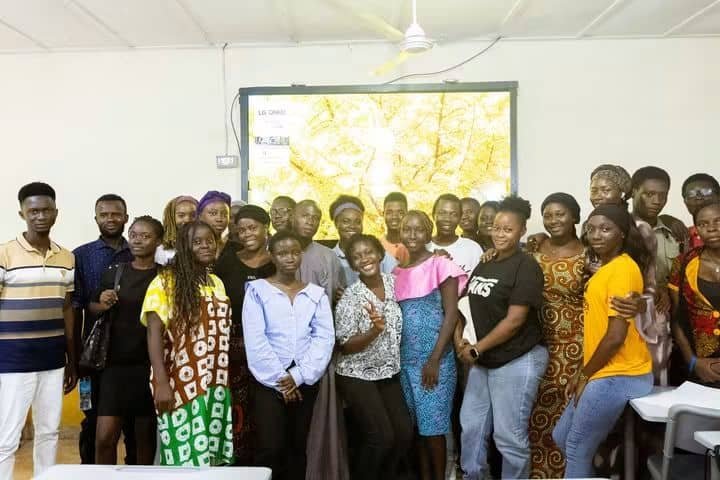
BBC Media Action Sierra Leone, with financial support from the European Union, has conducted a two-day training workshop aimed at strengthening young people’s participation in civic engagement, public discourse and positive social change.
The training was organized under the “Dis Na Wi Voice” Project on August 27 and 28, 2026, at the Mass Communication Building of Fourah Bay College, University of Sierra Leone, in Freetown.
It brought together students from Fourah Bay College and Central University, as well as young people from the Mile 91 community. Participants received practical knowledge on leadership, journalism, digital communication, advocacy and civic responsibility.
“Dis Na Wi Voice” is a 24-month media-for-youth programme implemented by BBC Media Action Sierra Leone and funded by the European Union. It targets young people between the ages of 15 and 30 and seeks to empower them to use traditional and digital media platforms to influence public conversations and contribute meaningfully to national development.
The project is designed to strengthen the confidence, motivation and skills of young Sierra Leoneans while increasing their participation in civic life. It also seeks to address the social and political marginalization of young people by creating opportunities for them to express their views and engage decision-makers.
As part of its university-based component, the project operates through three media hubs: Radio Mount Aureol at Fourah Bay College, Njala University’s Mokonde Campus and Central University Radio in Mile 91.
BBC Media Action said the hubs would serve as youth-led production spaces where participants could receive training in journalism, leadership, advocacy and digital content creation. They would also enable young people to produce radio and online content addressing issues affecting their universities and communities.
The Fourah Bay College workshop formed part of a broader initiative to establish vibrant youth-led media spaces within participating universities. The hubs will also conduct community outreach activities to amplify grassroots voices and provide platforms for young people whose concerns are often excluded from mainstream public discussions.
Welcoming participants, Project Officer, Bashiru Kallon, encouraged them to make full use of the opportunity by asking questions, sharing experiences and participating actively in the discussions.
Bashiru Kallon said the success of the workshop depends largely on the willingness of participants to engage meaningfully with the facilitators and one another.
“Feel free to ask questions, participate and engage in meaningful discourse,” he urged, emphasizing that active involvement would help participants gain maximum benefit from the training.
Journalism Mentor for the “Dis Na Wi Voice” Project, Victor Siaka Kamara, highlighted the importance of strengthening the media and journalism capabilities of young people.
He described the training as an important platform for helping participants understand leadership and civic engagement as central components of responsible citizenship.
“Developing young people’s media and journalism capabilities is essential because it enables them to communicate responsibly, understand the issues affecting their communities and participate more effectively in public discourse,” Victor Siaka Kamara said.
He explained that the programme went beyond teaching participants how to practice journalism or operate digital platforms. It was also intended to help young people understand the responsibilities associated with having a public voice.
According to Victor Siaka Kamara, leadership does not begin with holding an official position. It involves taking responsibility, identifying community problems and contributing to efforts aimed at addressing them.
He expressed confidence that young people could play a meaningful role in shaping public discourse when provided with the appropriate knowledge, skills and opportunities.
Speaking to The Calabash Newspaper, Central University student Hassan K. Kamara praised BBC Media Action Sierra Leone for providing young people with an opportunity to contribute to national conversations.
He said the workshop had strengthened his understanding of leadership and demonstrated that people do not necessarily need formal positions to lead or make a difference in their communities.
“This training has given me an opportunity to understand that leadership does not mean that you should have a position before taking up leadership roles in your community,” Hassan K. Kamara said.
As a hub facilitator for Central University, Hassan K. Kamara pledged to share the knowledge acquired during the training with other students.
“I will make sure that other students also benefit from the knowledge I have gained from this training,” he stated.
Fourah Bay College student, Christiana Sawyerr, similarly described the workshop as an important learning experience that had deepened her understanding of civic rights and responsibilities.
She said leadership should not be viewed solely in terms of titles or positions, but as a willingness to participate in civic activities and contribute to community and national development.
“As a youth in my community, I don’t need to sit down expecting another person from another community to tell me about my civic rights and responsibilities,” Christiana Sawyerr said.
She described young people as community watchdogs with a responsibility to identify and speak out against problems affecting their surroundings. She stressed that age should not prevent any Sierra Leonean youth from exercising their civic rights or contributing to change.
Reflecting on one of the key lessons from the workshop, Christiana Sawyerr said, “Change starts with anyone.” She called on community stakeholders to support young people who are committed to promoting positive transformation.
“Without my voice, I’m unable to make changes, but with my voice, I can make a positive change,” she added.
The project also involves young people outside university communities. Sahr Samuel George, a participant from Mile 91, welcomed the inclusion of community youth in discussions surrounding civic engagement and development.
Sahr Samuel George said the workshop had helped him understand that every issue affecting his community should be a concern to him as a young person.
“I learned from this workshop about issues I previously thought were not my concern. Through this workshop, I have come to understand that, as a young person, every issue affecting my community should be a concern to me,” he said.
He stressed the importance of unity among young people, irrespective of age, gender, ethnicity or other differences.
“For our communities to develop, it is the responsibility of young people to come together and work collectively, regardless of age, gender or tribe. We must put a stop to wrongdoing in our communities,” Sahr Samuel George added.
He disclosed plans to establish a team of young people upon his return to Mile 91 to identify and help address challenges affecting the community.
The “Dis Na Wi Voice” Project targets 240 university students, 60 community youths, 15 hub facilitators, 10 digital stewards, 100 digital content creators and 16 young people who will receive placements in national media institutions.
Its expected outcomes include increased confidence, motivation, practical skills, civic participation and activism among young Sierra Leoneans.
Through university media hubs, digital platforms, community outreach and placements in mainstream media institutions, the project seeks to equip young people with the tools required to participate constructively in civic life, influence public discourse and promote positive social change across Sierra Leone.