

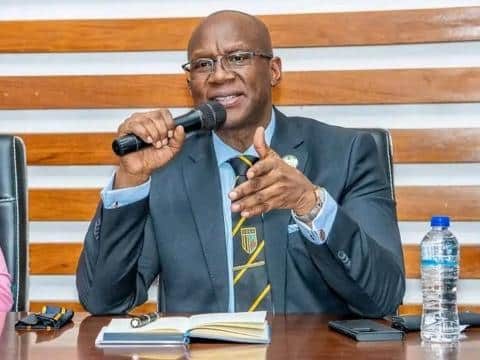
Minister of Mines and Mineral Resources, Julius Daniel Mattai, has presented a detailed explanation of Sierra Leone’s mining fiscal regime, showing how a model bauxite operation could generate approximately US$3.63 billion for the Government and host communities over 25 years.
The presentation, titled: “From Ore to Treasury: Sierra Leone’s Mining Fiscal Regime Explained in Plain Language,” was prepared in collaboration with the National Minerals Agency and delivered in Freetown in September 2026.
Minister Julius Daniel Mattai said Sierra Leone’s mining fiscal regime should not be viewed as a single tax, but as a system comprising 11 distinct charges drawn from four principal statutes and applied in an order fixed by law.
He explained that seven of the 11 charges are payable whether or not a mining company makes a profit, while only four depend on profitability. According to him, understanding the distinction is crucial to assessing what the country receives from its mineral resources.
The presentation used a fictitious company, Mining Company A Limited, operating a large-scale bauxite mine in Port Loko District, to demonstrate how the fiscal system works. The model is illustrative and does not represent any existing mining company in Sierra Leone.
Under the assumptions, the company would operate for 25 years, producing five million tonnes of bauxite in its first year, six million tonnes in the second year and 10 million tonnes annually from the third year.
With an assumed free-on-board price of US$60 per tonne, the company would generate US$300 million in its first year, US$360 million in its second year and US$600 million annually thereafter. Its total gross revenue over the licence period was estimated at US$14.46 billion.
The model assumes operating costs equivalent to 50 per cent of revenue, capital expenditure of US$250 million over the first three years and a US$200 million debt facility carrying annual interest of 5.5 per cent. Payments to contractors were estimated at 15 per cent of revenue.
Minister Julius Daniel Mattai identified the 11 applicable fiscal charges as royalty, mining income tax, minimum alternate tax, mineral resource rent tax, withholding tax on contractors, withholding tax on interest, withholding tax on dividends, State participation, surface rent, rehabilitation funding and the Community Development Fund.
Royalty on bulk minerals, including bauxite, rutile and iron ore, is charged at three per cent of market value. In the model, royalty payments would amount to US$9 million in the first year, US$10.8 million in the second year and US$18 million annually from the third year.
Over 25 years, total royalty payments would reach US$433.8 million, of which US$86.76 million, representing 20 per cent, would be allocated to mining districts.
The Minister stressed that royalty is payable regardless of whether a company records a profit because it represents the price of the mineral removed from the ground. He noted that royalty losses normally occur through weaknesses in determining tonnage, moisture content, mineral grade and reference prices rather than through the royalty rate itself.
Mining income tax is charged at 30 per cent of chargeable income under the Extractive Industries Revenue Act 2018, as amended by the Finance Act 2026. In a mature year, the model company would record chargeable income of US$276 million and pay US$82.8 million in mining income tax.
The mineral resource rent tax, which targets exceptional returns after a project has recovered its expenditure, would generate US$27.6 million in a mature year. Minister Julius Daniel Mattai warned against incorrectly applying the resource rent tax rate directly to chargeable income, saying the law requires it to be calculated on accumulated net receipts.
Together, mining income tax and the mineral resource rent tax would take exactly 40 per cent of chargeable returns under the model.
Withholding tax on contractor payments is fixed at 20 per cent. Based on contractor payments equivalent to 15 per cent of revenue, this charge would generate another US$433.8 million over the project’s lifespan—the same amount generated by royalty.
Withholding tax on annual interest payments would generate US$55 million over 25 years. The model excludes dividend withholding tax because no dividend policy was assumed, meaning actual Government revenue could be higher if dividends were declared.
The State is also entitled to a 10 per cent free-carried and non-dilutable interest in large-scale mining operations under the Mines and Minerals Development Act 2022. It may acquire a further 35 per cent interest on agreed terms, subject to the required approvals.
Host communities would receive additional support through the Community Development Fund. Mining companies are required to contribute not less than one per cent of annual gross revenue directly to communities under publicly accessible community development agreements.
For the model bauxite mine, the fund would receive US$3 million in the first year and US$6 million in a mature year, amounting to US$144.6 million over the entire project.
Surface rent would be distributed separately, with 70 per cent going to landowners, 10 per cent to the Paramount Chief, 10 per cent to the Constituency Development Fund and 10 per cent to the District Council.
In a mature year, the model shows that the Government and host communities would receive US$154.6 million from US$600 million in gross sales, equivalent to 25.8 per cent. Across the full 25-year period, their combined share would amount to US$3.627 billion, or approximately 25.1 per cent of total gross revenue.
Mining income tax would contribute US$1.92 billion, followed by the mineral resource rent tax at US$640.16 million. Royalty and contractor withholding tax would each contribute US$433.8 million, while the Community Development Fund and interest withholding tax would provide US$144.6 million and US$55 million, respectively.
The Mines Minister recommended that the Government consistently model resource rent tax on its statutory base, clarify unresolved fiscal questions, digitize community development agreements and strengthen the measurement of mineral production and exports.
He also called for every mining project to be modelled against the statutory fiscal baseline before agreements are signed.
The Minister maintained that the presentation did not advocate an increase in mining tax rates or pass judgment on any company. Instead, it demonstrated the importance of applying existing laws correctly, strengthening transparency and ensuring that public officials fully understand the financial implications of mining agreements.
“We cannot put the ore back,” he stated, emphasizing that every tonne of bauxite exported leaves Sierra Leone only once. He said the country must ensure that the price charged for its mineral resources is determined by informed officials and subjected to transparent public scrutiny.